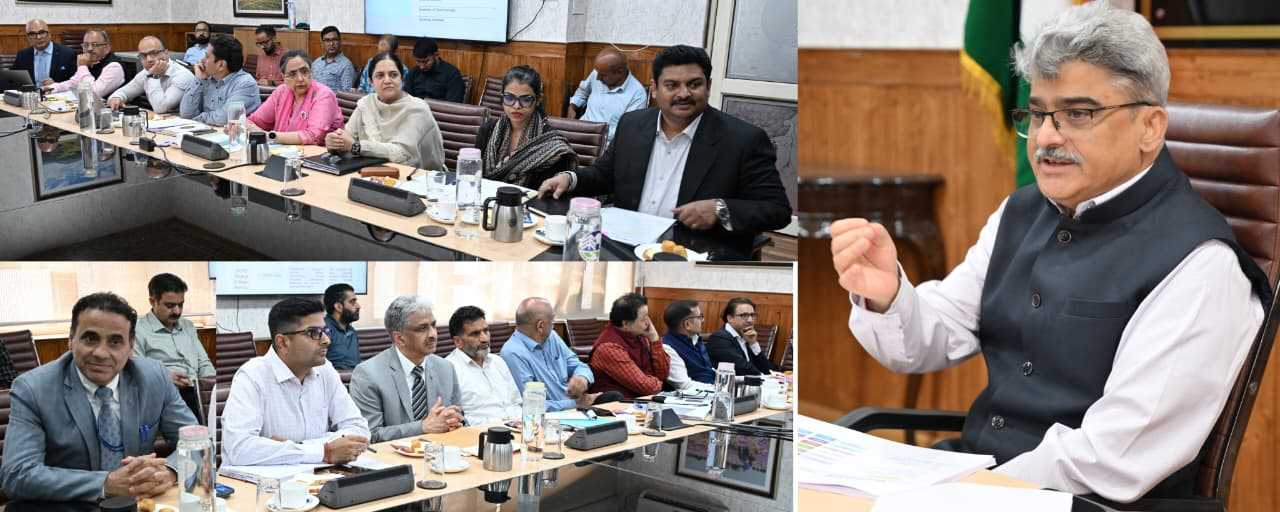
Srinagar, June 6: Chief Secretary Atal Dulloo on Saturday chaired a comprehensive review meeting to assess the progress of health sector reforms being implemented across Jammu and Kashmir over the past few years.
The meeting reviewed measures aimed at strengthening tertiary and secondary healthcare services, expanding medical education, improving digital health infrastructure and enhancing access to specialised treatment facilities across the Union Territory.
Senior officials, including the Commissioner Secretary, Health & Medical Education, Director SKIMS, MD NHM, CEO SHA, principals of Government Medical Colleges, Directors of Health Services Kashmir and Jammu, and representatives from AIIMS Jammu, SMVDIME and other institutions attended the meeting.
The Chief Secretary was apprised of progress in building collaborative frameworks among SKIMS, Government Medical Colleges, AIIMS Jammu and other institutions to improve specialty and super-specialty services, academic collaboration, research and digital healthcare delivery.
He stressed that every tertiary care institution must strengthen critical care, trauma care and emergency medicine services, calling them essential for improving patient outcomes.
Dulloo directed that reforms should not remain limited to new medical colleges and must also extend to district and sub-district hospitals, ensuring balanced healthcare development across all regions. He asked that future planning be based on the specific needs and capacities of each institution.
He assured full administrative and financial support for effective healthcare initiatives and encouraged innovative proposals to improve patient care, education and service delivery.
Emphasising the role of technology, he called for expanding Virtual Medical Boards across more specialties and introducing virtual academic platforms and grand rounds in peripheral institutions for continuous training and better clinical support.
He also directed the establishment of a clear accountability framework and a strong IT-enabled monitoring system to track healthcare delivery and institutional performance in real time.
The Chief Secretary asked the department to set clear short-, medium- and long-term targets over the next six months, one year and two years.
The meeting was informed that proposals are under consideration for increasing 300 MBBS seats, 243 MD/MS seats, 64 DM/MCh super-specialty seats and additional DNB seats across medical institutions, with several already under regulatory review.
Officials also briefed that Tele-MANAS and tele-psychiatry services are operational in major institutions, while mental health and de-addiction services have been expanded under a three-tier Substance Use Disorder framework.
SKIMS Director Dr. Ashraf Ganai informed the meeting about the formation of the J&K Research Consortium to promote collaborative research among SKIMS, GMCs and AIIMS Jammu.
SMVDIME Executive Director Dr. Yashpal Sharma highlighted reforms including virtual medical boards, proposed Tele-ICU facilities in seven new GMCs, and ongoing work on tele-radiology services for remote areas.
IMHANS Srinagar Head Dr. Arshid Dada presented the roadmap for expanding de-addiction services and training over 3,200 grassroots workers under the “Circle of Care” programme.
The meeting was also briefed on food safety reforms, including over 1,700 adjudicated cases and penalties exceeding ₹1.67 crore, along with improved laboratory infrastructure and enforcement.
Future initiatives discussed included mental health expansion, liver transplant services and strengthening dental healthcare, with collaborations planned with premier institutions.
The Chief Secretary reiterated that the core objective of reforms is to ensure accessible, affordable and quality healthcare for all citizens of Jammu and Kashmir through technology, capacity building and institutional coordination.

Srinagar, June 6: Chief Secretary Atal Dulloo on Saturday chaired a comprehensive review meeting to assess the progress of health sector reforms being implemented across Jammu and Kashmir over the past few years.
The meeting reviewed measures aimed at strengthening tertiary and secondary healthcare services, expanding medical education, improving digital health infrastructure and enhancing access to specialised treatment facilities across the Union Territory.
Senior officials, including the Commissioner Secretary, Health & Medical Education, Director SKIMS, MD NHM, CEO SHA, principals of Government Medical Colleges, Directors of Health Services Kashmir and Jammu, and representatives from AIIMS Jammu, SMVDIME and other institutions attended the meeting.
The Chief Secretary was apprised of progress in building collaborative frameworks among SKIMS, Government Medical Colleges, AIIMS Jammu and other institutions to improve specialty and super-specialty services, academic collaboration, research and digital healthcare delivery.
He stressed that every tertiary care institution must strengthen critical care, trauma care and emergency medicine services, calling them essential for improving patient outcomes.
Dulloo directed that reforms should not remain limited to new medical colleges and must also extend to district and sub-district hospitals, ensuring balanced healthcare development across all regions. He asked that future planning be based on the specific needs and capacities of each institution.
He assured full administrative and financial support for effective healthcare initiatives and encouraged innovative proposals to improve patient care, education and service delivery.
Emphasising the role of technology, he called for expanding Virtual Medical Boards across more specialties and introducing virtual academic platforms and grand rounds in peripheral institutions for continuous training and better clinical support.
He also directed the establishment of a clear accountability framework and a strong IT-enabled monitoring system to track healthcare delivery and institutional performance in real time.
The Chief Secretary asked the department to set clear short-, medium- and long-term targets over the next six months, one year and two years.
The meeting was informed that proposals are under consideration for increasing 300 MBBS seats, 243 MD/MS seats, 64 DM/MCh super-specialty seats and additional DNB seats across medical institutions, with several already under regulatory review.
Officials also briefed that Tele-MANAS and tele-psychiatry services are operational in major institutions, while mental health and de-addiction services have been expanded under a three-tier Substance Use Disorder framework.
SKIMS Director Dr. Ashraf Ganai informed the meeting about the formation of the J&K Research Consortium to promote collaborative research among SKIMS, GMCs and AIIMS Jammu.
SMVDIME Executive Director Dr. Yashpal Sharma highlighted reforms including virtual medical boards, proposed Tele-ICU facilities in seven new GMCs, and ongoing work on tele-radiology services for remote areas.
IMHANS Srinagar Head Dr. Arshid Dada presented the roadmap for expanding de-addiction services and training over 3,200 grassroots workers under the “Circle of Care” programme.
The meeting was also briefed on food safety reforms, including over 1,700 adjudicated cases and penalties exceeding ₹1.67 crore, along with improved laboratory infrastructure and enforcement.
Future initiatives discussed included mental health expansion, liver transplant services and strengthening dental healthcare, with collaborations planned with premier institutions.
The Chief Secretary reiterated that the core objective of reforms is to ensure accessible, affordable and quality healthcare for all citizens of Jammu and Kashmir through technology, capacity building and institutional coordination.
© Copyright 2023 brighterkashmir.com All Rights Reserved. Quantum Technologies