08-06-2026     3 رجب 1440

CS Dulloo reviews anti-drug strategy

August 06, 2026 | BK NEWS SERVICE

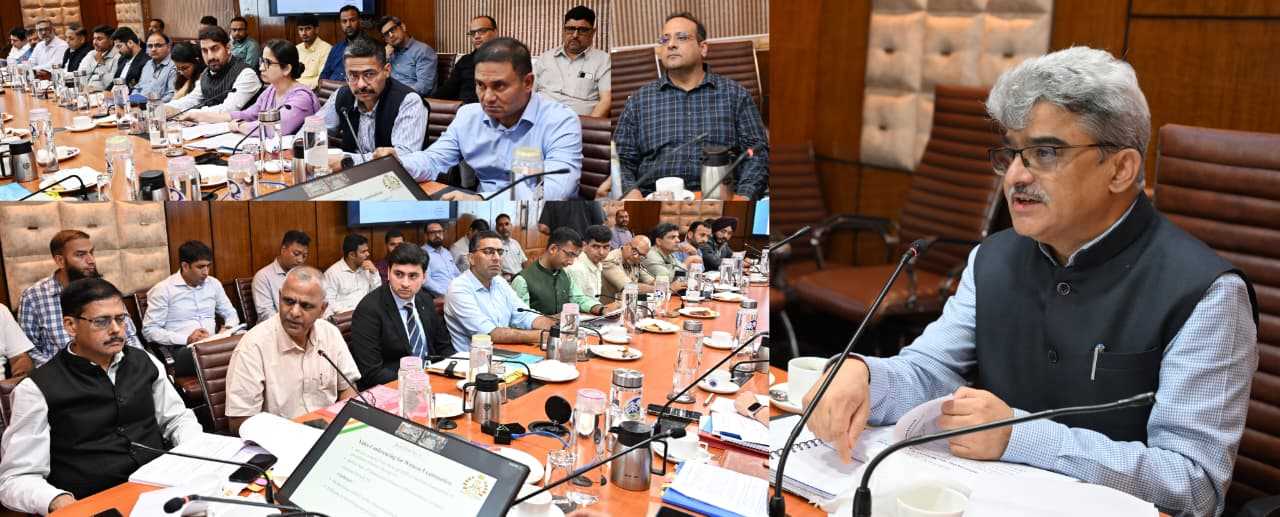
Srinagar, Aug 5: Chief Secretary Atal Dulloo on Wednesday chaired the 18th Union Territory-level meeting of the Narcotics Coordination (NCORD) Committee and reviewed Jammu and Kashmir's anti-narcotics strategy, directing authorities to strengthen enforcement, speed up prosecution, expand rehabilitation facilities and intensify action against organised drug networks.
The meeting was attended by senior civil, police and security officials, including the Director General of Police, Director General Prosecution, Principal Secretary Home, senior officers from the Army, Central Armed Police Forces, Narcotics Control Bureau (NCB), divisional commissioners, deputy commissioners and SSPs.
Reviewing the implementation of previous decisions, the Chief Secretary assessed progress in enforcement, preventive detention, financial investigations, rehabilitation, regulatory oversight and institutional capacity building.
He also reviewed the proposed Vision Document on Narcotics Control (2026-29) and the roadmap under the Prime Minister's 100-Week "Nasha Mukt Yuva for Viksit Bharat Sankalp" campaign, which focuses on technology-driven enforcement, stronger financial investigations, enhanced prosecution, dismantling organised drug syndicates and expanding rehabilitation services.
Dulloo said the 100-day Nasha Mukt J&K Abhiyaan, launched under the leadership of Lieutenant Governor Manoj Sinha, had evolved into a mass movement with widespread public participation across the Union Territory.
He directed all Deputy Commissioners to implement the Prime Minister's anti-drug campaign in letter and spirit and asked the Information Department to regularly monitor its progress through the NMBA Portal.
To ensure speedy disposal of NDPS cases, the Chief Secretary ordered the operationalisation of video conferencing facilities in all NDPS and Sessions Courts for recording witness statements, saying it would accelerate trials and reduce inconvenience to witnesses.
He also directed the Director General Prosecution to review all NDPS cases proposed for closure to ensure every legally sustainable case is pursued effectively.
Calling for stronger financial investigations, Dulloo asked the Law Department to examine the use of laws such as the GST Act, MSME Act, Shops and Establishments Act and Tourism Trade Act against drug traffickers, while also scrutinising financial transactions and bank accounts to dismantle narcotics funding networks.
Reviewing rehabilitation measures, he instructed the Health Department to strictly implement Standard Operating Procedures for de-addiction treatment and ensure the availability of essential medicines at all health institutions, from Primary Health Centres to Government Medical Colleges.
He also reviewed the functioning of addiction treatment facilities in newly established Government Medical Colleges and district hospitals, directing authorities to deploy trained counsellors in schools, health centres and Self-Help Groups to strengthen community-level interventions.
The Chief Secretary further directed that the proposed Rehabilitation Policy be implemented on a pilot basis in selected districts before being expanded across Jammu and Kashmir. He also called for the creation of an integrated digital platform to monitor rehabilitation and improve inter-departmental coordination.
Emphasising capacity building, Dulloo asked departments to prepare structured six-month training calendars for investigating officers and prosecutors and explore the engagement of Special Public Prosecutors for NDPS cases on the pattern followed by the Narcotics Control Bureau.
He also directed agencies to identify vulnerabilities in courier services and develop mechanisms to prevent their misuse for transporting narcotic substances.
During the meeting, Inspector General of Police, Crime Branch, Sarah Rizvi, presented a detailed review of the Union Territory's anti-narcotics efforts.
The presentation revealed a sharp rise in enforcement during April-June 2026, with 1,856 NDPS cases registered compared to 428 during the corresponding period last year. A total of 2,190 persons were arrested and 1,455 kilograms of narcotic substances seized.
Financial investigations also witnessed a major jump, with authorities attaching 228 properties worth ₹138.34 crore, compared to 31 properties worth ₹7.36 crore during the same period last year. Bank accounts containing ₹1.40 crore linked to narcotics trafficking were also frozen.
Officials informed the meeting that Jammu and Kashmir Police accounted for nearly 50 per cent of the total value of narcotics-related properties attached across the country during 2026.
Authorities also initiated action against habitual offenders by recommending cancellation or suspension of 839 driving licences, 612 vehicle registration certificates, 52 passports, besides taking action against arms licences, contractor licences, government accommodation and security cover.
The meeting was informed that 135 detention proposals had been sponsored under the PIT NDPS Act this year, resulting in 113 preventive detention orders against habitual drug traffickers.
To curb the misuse of pharmaceutical drugs, authorities conducted over 10,300 inspections of pharmacies and medical establishments, detecting 312 violations that led to cancellation of 16 licences and suspension of 296 licences. Enforcement agencies also seized 17,528 Pregabalin capsules and 6,190 Tapentadol tablets valued at over ₹17 lakh.
The meeting further reviewed action against illicit cultivation of narcotic crops. Authorities destroyed 96 kanals of poppy and 1,157 kanals of cannabis following satellite-based identification of cultivation across six Kashmir districts, registering 247 FIRs and booking 254 cultivators.
Officials also highlighted the expansion of addiction treatment facilities and capacity-building initiatives through IMHANS Kashmir, under which more than 4,100 Master Trainers and nearly 4,900 officers and officials have been trained.
Concluding the meeting, the Chief Secretary called upon all stakeholder departments to sustain coordinated efforts to curb drug trafficking, strengthen rehabilitation mechanisms and realise the vision of a drug-free Jammu and Kashmir.

 

CS Dulloo reviews anti-drug strategy

August 06, 2026 | BK NEWS SERVICE

Srinagar, Aug 5: Chief Secretary Atal Dulloo on Wednesday chaired the 18th Union Territory-level meeting of the Narcotics Coordination (NCORD) Committee and reviewed Jammu and Kashmir's anti-narcotics strategy, directing authorities to strengthen enforcement, speed up prosecution, expand rehabilitation facilities and intensify action against organised drug networks.
The meeting was attended by senior civil, police and security officials, including the Director General of Police, Director General Prosecution, Principal Secretary Home, senior officers from the Army, Central Armed Police Forces, Narcotics Control Bureau (NCB), divisional commissioners, deputy commissioners and SSPs.
Reviewing the implementation of previous decisions, the Chief Secretary assessed progress in enforcement, preventive detention, financial investigations, rehabilitation, regulatory oversight and institutional capacity building.
He also reviewed the proposed Vision Document on Narcotics Control (2026-29) and the roadmap under the Prime Minister's 100-Week "Nasha Mukt Yuva for Viksit Bharat Sankalp" campaign, which focuses on technology-driven enforcement, stronger financial investigations, enhanced prosecution, dismantling organised drug syndicates and expanding rehabilitation services.
Dulloo said the 100-day Nasha Mukt J&K Abhiyaan, launched under the leadership of Lieutenant Governor Manoj Sinha, had evolved into a mass movement with widespread public participation across the Union Territory.
He directed all Deputy Commissioners to implement the Prime Minister's anti-drug campaign in letter and spirit and asked the Information Department to regularly monitor its progress through the NMBA Portal.
To ensure speedy disposal of NDPS cases, the Chief Secretary ordered the operationalisation of video conferencing facilities in all NDPS and Sessions Courts for recording witness statements, saying it would accelerate trials and reduce inconvenience to witnesses.
He also directed the Director General Prosecution to review all NDPS cases proposed for closure to ensure every legally sustainable case is pursued effectively.
Calling for stronger financial investigations, Dulloo asked the Law Department to examine the use of laws such as the GST Act, MSME Act, Shops and Establishments Act and Tourism Trade Act against drug traffickers, while also scrutinising financial transactions and bank accounts to dismantle narcotics funding networks.
Reviewing rehabilitation measures, he instructed the Health Department to strictly implement Standard Operating Procedures for de-addiction treatment and ensure the availability of essential medicines at all health institutions, from Primary Health Centres to Government Medical Colleges.
He also reviewed the functioning of addiction treatment facilities in newly established Government Medical Colleges and district hospitals, directing authorities to deploy trained counsellors in schools, health centres and Self-Help Groups to strengthen community-level interventions.
The Chief Secretary further directed that the proposed Rehabilitation Policy be implemented on a pilot basis in selected districts before being expanded across Jammu and Kashmir. He also called for the creation of an integrated digital platform to monitor rehabilitation and improve inter-departmental coordination.
Emphasising capacity building, Dulloo asked departments to prepare structured six-month training calendars for investigating officers and prosecutors and explore the engagement of Special Public Prosecutors for NDPS cases on the pattern followed by the Narcotics Control Bureau.
He also directed agencies to identify vulnerabilities in courier services and develop mechanisms to prevent their misuse for transporting narcotic substances.
During the meeting, Inspector General of Police, Crime Branch, Sarah Rizvi, presented a detailed review of the Union Territory's anti-narcotics efforts.
The presentation revealed a sharp rise in enforcement during April-June 2026, with 1,856 NDPS cases registered compared to 428 during the corresponding period last year. A total of 2,190 persons were arrested and 1,455 kilograms of narcotic substances seized.
Financial investigations also witnessed a major jump, with authorities attaching 228 properties worth ₹138.34 crore, compared to 31 properties worth ₹7.36 crore during the same period last year. Bank accounts containing ₹1.40 crore linked to narcotics trafficking were also frozen.
Officials informed the meeting that Jammu and Kashmir Police accounted for nearly 50 per cent of the total value of narcotics-related properties attached across the country during 2026.
Authorities also initiated action against habitual offenders by recommending cancellation or suspension of 839 driving licences, 612 vehicle registration certificates, 52 passports, besides taking action against arms licences, contractor licences, government accommodation and security cover.
The meeting was informed that 135 detention proposals had been sponsored under the PIT NDPS Act this year, resulting in 113 preventive detention orders against habitual drug traffickers.
To curb the misuse of pharmaceutical drugs, authorities conducted over 10,300 inspections of pharmacies and medical establishments, detecting 312 violations that led to cancellation of 16 licences and suspension of 296 licences. Enforcement agencies also seized 17,528 Pregabalin capsules and 6,190 Tapentadol tablets valued at over ₹17 lakh.
The meeting further reviewed action against illicit cultivation of narcotic crops. Authorities destroyed 96 kanals of poppy and 1,157 kanals of cannabis following satellite-based identification of cultivation across six Kashmir districts, registering 247 FIRs and booking 254 cultivators.
Officials also highlighted the expansion of addiction treatment facilities and capacity-building initiatives through IMHANS Kashmir, under which more than 4,100 Master Trainers and nearly 4,900 officers and officials have been trained.
Concluding the meeting, the Chief Secretary called upon all stakeholder departments to sustain coordinated efforts to curb drug trafficking, strengthen rehabilitation mechanisms and realise the vision of a drug-free Jammu and Kashmir.


  • Address: R.C 2 Quarters Press Enclave Near Pratap Park, Srinagar 190001.
  • Phone: 0194-2451076 , +91-941-940-0056 , +91-962-292-4716
  • Email: brighterkmr@gmail.com
Owner, Printer, Publisher, Editor: Farooq Ahmad Wani
Legal Advisor: M.J. Hubi
Printed at: Sangermal offset Printing Press Rangreth ( Budgam)
Published from: Gulshanabad Chraresharief Budgam
RNI No.: JKENG/2010/33802
Office No’s: 0194-2451076
Mobile No’s 9419400056, 9622924716 ,7006086442
Postal Regd No: SK/135/2010-2019
POST BOX NO: 1001
Administrative Office: R.C 2 Quarters Press Enclave Near Pratap Park ( Srinagar -190001)

© Copyright 2023 brighterkashmir.com All Rights Reserved. Quantum Technologies

Owner, Printer, Publisher, Editor: Farooq Ahmad Wani
Legal Advisor: M.J. Hubi
Printed at: Abid Enterprizes, Zainkote Srinagar
Published from: Gulshanabad Chraresharief Budgam
RNI No.: JKENG/2010/33802
Office No’s: 0194-2451076, 9622924716 , 9419400056
Postal Regd No: SK/135/2010-2019
Administrative Office: Abi Guzer Srinagar

© Copyright 2018 brighterkashmir.com All Rights Reserved.