
BREAKING NEWS
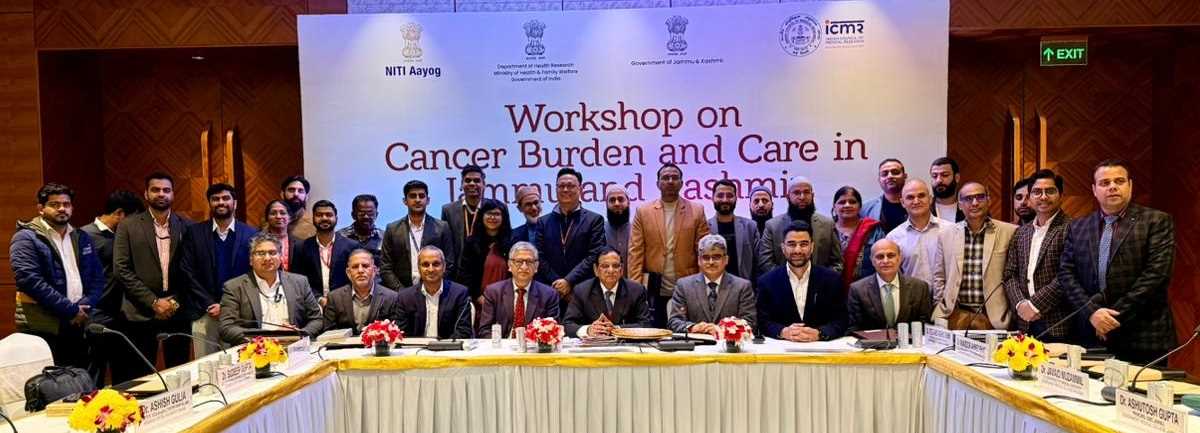
New Delhi, Jan 30: A high-level consultation on cancer burden, research and care in Jammu and Kashmir was held at Bharat Mandapam, New Delhi, bringing together senior officials from NITI Aayog, the Department of Health Research (DHR), the Indian Council of Medical Research (ICMR), the Government of Jammu and Kashmir, and leading clinicians, researchers and public health experts.
The meeting was attended by Member (Health), NITI Aayog, Dr V.K. Paul; Chief Secretary J&K, Atal Dulloo; Secretary DHR and Director General ICMR, Dr Rajiv Behl; and Secretary, Health and Medical Education J&K, Dr Syed Abid Rasheed Shah, along with other senior officers and experts.
Deliberations focused on developing a comprehensive, evidence-based and implementable cancer control strategy for Jammu and Kashmir, tailored to regional disease patterns, existing health system capacity and long-term sustainability. Participants emphasized the urgent need to strengthen cancer screening and early detection, particularly by identifying priority cancer types suitable for population-based screening.
Addressing the consultation, Chief Secretary Atal Dulloo said the J&K government would adopt a phased, research-driven and implementable cancer control framework aligned with national priorities. He stressed that early detection, timely referral and equitable access to quality cancer care must form the backbone of future interventions, while also underlining the importance of a context-specific approach for the Union Territory.
Secretary Health J&K, Dr Syed Abid Rasheed Shah, highlighted recent initiatives such as expansion of tertiary healthcare services and an increase in medical education seats. He called for context-specific, evidence-based cancer prevention guidelines and stronger information, education and communication (IEC) strategies to support public awareness and prevention efforts.
The consultation underscored the importance of district-level implementation models supported by structured implementation research to assess feasibility, coverage, cost-effectiveness and health outcomes. A strong consensus emerged on making implementation research a core pillar of cancer prevention, screening and care.
Participants proposed establishing a Centre for Implementation Research in Oncology to generate scalable, real-world solutions, with a focus on improving quality of life, integrating palliative care and strengthening health systems. The role of community medicine departments in advancing preventive oncology initiatives was also emphasized.
Preventive strategies discussed included tobacco control, HPV-related cancer prevention, addressing dietary and lifestyle risk factors, and tackling infection-associated cancers such as Helicobacter pylori-linked gastrointestinal malignancies. The need for prioritising large, high-impact research initiatives over fragmented small studies was stressed, with recommendations for creating longitudinal cohorts, biobanks and randomized controlled trials.
The establishment of a comprehensive, state-wide cancer registry was identified as critical for evidence-based planning, monitoring and policy formulation in Jammu and Kashmir. Strengthening cancer care infrastructure was also flagged as a priority, including advanced diagnostic facilities in all medical colleges, molecular diagnostics, immunohistochemistry, and clearly defined referral pathways supported by Centres of Excellence.
The consultation concluded with agreement on adopting a phased, research-linked and implementable cancer control framework for Jammu and Kashmir, supported through institutional partnerships and technical collaboration with ICMR and leading national cancer institutions. The outcomes are expected to guide future policy actions, research collaborations and health system strengthening initiatives to reduce cancer burden and improve patient outcomes in the Union Territory.
New Delhi, Jan 30: A high-level consultation on cancer burden, research and care in Jammu and Kashmir was held at Bharat Mandapam, New Delhi, bringing together senior officials from NITI Aayog, the Department of Health Research (DHR), the Indian Council of Medical Research (ICMR), the Government of Jammu and Kashmir, and leading clinicians, researchers and public health experts.
The meeting was attended by Member (Health), NITI Aayog, Dr V.K. Paul; Chief Secretary J&K, Atal Dulloo; Secretary DHR and Director General ICMR, Dr Rajiv Behl; and Secretary, Health and Medical Education J&K, Dr Syed Abid Rasheed Shah, along with other senior officers and experts.
Deliberations focused on developing a comprehensive, evidence-based and implementable cancer control strategy for Jammu and Kashmir, tailored to regional disease patterns, existing health system capacity and long-term sustainability. Participants emphasized the urgent need to strengthen cancer screening and early detection, particularly by identifying priority cancer types suitable for population-based screening.
Addressing the consultation, Chief Secretary Atal Dulloo said the J&K government would adopt a phased, research-driven and implementable cancer control framework aligned with national priorities. He stressed that early detection, timely referral and equitable access to quality cancer care must form the backbone of future interventions, while also underlining the importance of a context-specific approach for the Union Territory.
Secretary Health J&K, Dr Syed Abid Rasheed Shah, highlighted recent initiatives such as expansion of tertiary healthcare services and an increase in medical education seats. He called for context-specific, evidence-based cancer prevention guidelines and stronger information, education and communication (IEC) strategies to support public awareness and prevention efforts.
The consultation underscored the importance of district-level implementation models supported by structured implementation research to assess feasibility, coverage, cost-effectiveness and health outcomes. A strong consensus emerged on making implementation research a core pillar of cancer prevention, screening and care.
Participants proposed establishing a Centre for Implementation Research in Oncology to generate scalable, real-world solutions, with a focus on improving quality of life, integrating palliative care and strengthening health systems. The role of community medicine departments in advancing preventive oncology initiatives was also emphasized.
Preventive strategies discussed included tobacco control, HPV-related cancer prevention, addressing dietary and lifestyle risk factors, and tackling infection-associated cancers such as Helicobacter pylori-linked gastrointestinal malignancies. The need for prioritising large, high-impact research initiatives over fragmented small studies was stressed, with recommendations for creating longitudinal cohorts, biobanks and randomized controlled trials.
The establishment of a comprehensive, state-wide cancer registry was identified as critical for evidence-based planning, monitoring and policy formulation in Jammu and Kashmir. Strengthening cancer care infrastructure was also flagged as a priority, including advanced diagnostic facilities in all medical colleges, molecular diagnostics, immunohistochemistry, and clearly defined referral pathways supported by Centres of Excellence.
The consultation concluded with agreement on adopting a phased, research-linked and implementable cancer control framework for Jammu and Kashmir, supported through institutional partnerships and technical collaboration with ICMR and leading national cancer institutions. The outcomes are expected to guide future policy actions, research collaborations and health system strengthening initiatives to reduce cancer burden and improve patient outcomes in the Union Territory.

© Copyright 2023 brighterkashmir.com All Rights Reserved. Quantum Technologies