
Education must remain at the centre of this transformation. The future workforce will require more than academic qualifications. Communication skills, digital knowledge, financial literacy, vocational training, entrepreneurship and problem-solving abilities are increasingly important in a changing economy
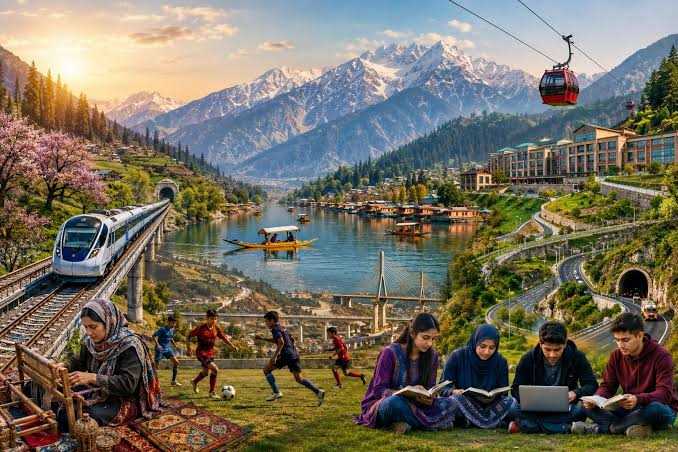
For decades, Jammu and Kashmir has often been described through the language of conflict. Violence, uncertainty, political tensions and terrorism dominated headlines and shaped the region’s image before the outside world. But another story is emerging today—one shaped by infrastructure, education, tourism, entrepreneurship, sports, technology and the aspirations of a young generation seeking opportunity, stability and a better quality of life. This does not mean that every challenge has disappeared. Jammu and Kashmir continues to face economic, social and security-related concerns. Yet alongside these challenges, there is a growing effort to create conditions in which people can look towards the future with greater confidence.
Peace remains the foundation of meaningful development. A stable environment creates space for tourism, investment, education, business and employment to grow. Kashmir’s natural beauty has always attracted visitors, but a sustainable tourism economy requires more than mountains, lakes and landscapes. Tourists also look for safety, connectivity, infrastructure and quality services. The expansion of tourism beyond traditional destinations can create opportunities for hotels, transport operators, restaurants, guides, handicraft producers, adventure activities and local businesses. If smaller towns and rural destinations receive better infrastructure and promotion, tourism can become a broader source of livelihood rather than remaining concentrated in a few established locations.
Connectivity is equally important in transforming everyday life. Roads, bridges, tunnels and improved transport networks are reducing distances between communities and markets. Their value is not simply measured by kilometres of roads constructed or projects completed. A road matters when it helps a farmer take produce to market, enables a student to reach an educational institution, allows a patient to reach a hospital faster or connects a small business with customers outside its immediate area. Infrastructure becomes meaningful when it improves opportunities and makes everyday life easier for ordinary citizens.
The aspirations of Jammu and Kashmir’s youth are perhaps the most important part of this changing landscape. Young people today are better connected with the wider world and increasingly seek opportunities beyond traditional government employment. They want to become entrepreneurs, technology professionals, athletes, skilled workers, artists and innovators. Government jobs will continue to remain important, but the region’s economic future cannot depend exclusively on public employment. Private investment, startups, tourism enterprises, agriculture-based businesses, information technology and creative industries can provide additional avenues for young people to build sustainable careers.
Kashmir’s traditional economic strengths also offer considerable potential. Handicrafts, handloom, horticulture, saffron, apples and other agricultural products are not only sources of income but also part of the region’s cultural identity. Better branding, packaging, digital marketing, e-commerce and access to national and international markets can help local producers reach wider consumers. Technology can further expand these possibilities. A young entrepreneur in Srinagar can potentially sell products to customers across India or abroad, while skilled professionals can work remotely for companies located thousands of kilometres away. Digital connectivity is therefore becoming an important economic asset.
Education must remain at the centre of this transformation. The future workforce will require more than academic qualifications. Communication skills, digital knowledge, financial literacy, vocational training, entrepreneurship and problem-solving abilities are increasingly important in a changing economy. Educational institutions must therefore prepare young people not only to pass examinations but also to adapt to new forms of employment and enterprise.
Sports can also play an important role in shaping the aspirations of the younger generation. Jammu and Kashmir possesses considerable sporting talent, and better facilities, coaching and competitive opportunities can help young athletes pursue their ambitions. Sporting success can provide young people with discipline, confidence and a platform to represent the region at national and international levels. It can also contribute to a broader identity based on achievement and talent. At the same time, development must remain inclusive. Jammu and Kashmir’s geographical diversity means that the priorities of major urban centres cannot automatically represent the needs of remote villages and mountain communities. Rural areas require reliable roads, healthcare, electricity, internet connectivity and educational opportunities. Good governance is therefore central to development. Citizens expect public institutions to be transparent, accountable and responsive. The quality of development is ultimately reflected in how easily an ordinary person can access public services and resolve everyday problems.
The new Kashmir story must also recognise the importance of its social and cultural heritage. Languages, traditions, handicrafts, cuisine, literature and religious heritage are integral to the region’s identity. Modernisation should not mean abandoning these traditions. Instead, cultural heritage can become an economic and social strength, particularly through tourism, handicrafts, creative industries and cultural initiatives. It is equally important to acknowledge that challenges remain.
Employment continues to be a concern, businesses face difficulties, infrastructure requires constant improvement and young people continue to search for better opportunities. Recognising these realities does not weaken the development story; it makes it more credible. Progress should be measured not merely through announcements and projects, but through improvements in the lives of ordinary people. What is changing is increasingly the direction of public aspirations. Discussions about jobs, education, tourism, healthcare, investment, sports, technology and quality of life are becoming increasingly important. A new generation wants to be recognised for its achievements rather than defined by the difficulties of the past. It wants to study, build businesses, win medals, innovate, travel and contribute to the wider economy of India.
The new Kashmir story is therefore not about claiming that every problem has been solved. It is about recognising a gradual shift towards opportunity, aspiration and development. Peace provides the foundation, infrastructure creates possibilities, education builds capabilities and the energy of young people can shape the future. Ultimately, the success of this transformation will be reflected in a simple question: whether an ordinary young person in Jammu and Kashmir feels that the future offers more possibilities than the past. If that confidence continues to grow, Kashmir’s story will increasingly be written not only through the history of conflict, but through the everyday achievements of its people.

Education must remain at the centre of this transformation. The future workforce will require more than academic qualifications. Communication skills, digital knowledge, financial literacy, vocational training, entrepreneurship and problem-solving abilities are increasingly important in a changing economy
For decades, Jammu and Kashmir has often been described through the language of conflict. Violence, uncertainty, political tensions and terrorism dominated headlines and shaped the region’s image before the outside world. But another story is emerging today—one shaped by infrastructure, education, tourism, entrepreneurship, sports, technology and the aspirations of a young generation seeking opportunity, stability and a better quality of life. This does not mean that every challenge has disappeared. Jammu and Kashmir continues to face economic, social and security-related concerns. Yet alongside these challenges, there is a growing effort to create conditions in which people can look towards the future with greater confidence.
Peace remains the foundation of meaningful development. A stable environment creates space for tourism, investment, education, business and employment to grow. Kashmir’s natural beauty has always attracted visitors, but a sustainable tourism economy requires more than mountains, lakes and landscapes. Tourists also look for safety, connectivity, infrastructure and quality services. The expansion of tourism beyond traditional destinations can create opportunities for hotels, transport operators, restaurants, guides, handicraft producers, adventure activities and local businesses. If smaller towns and rural destinations receive better infrastructure and promotion, tourism can become a broader source of livelihood rather than remaining concentrated in a few established locations.
Connectivity is equally important in transforming everyday life. Roads, bridges, tunnels and improved transport networks are reducing distances between communities and markets. Their value is not simply measured by kilometres of roads constructed or projects completed. A road matters when it helps a farmer take produce to market, enables a student to reach an educational institution, allows a patient to reach a hospital faster or connects a small business with customers outside its immediate area. Infrastructure becomes meaningful when it improves opportunities and makes everyday life easier for ordinary citizens.
The aspirations of Jammu and Kashmir’s youth are perhaps the most important part of this changing landscape. Young people today are better connected with the wider world and increasingly seek opportunities beyond traditional government employment. They want to become entrepreneurs, technology professionals, athletes, skilled workers, artists and innovators. Government jobs will continue to remain important, but the region’s economic future cannot depend exclusively on public employment. Private investment, startups, tourism enterprises, agriculture-based businesses, information technology and creative industries can provide additional avenues for young people to build sustainable careers.
Kashmir’s traditional economic strengths also offer considerable potential. Handicrafts, handloom, horticulture, saffron, apples and other agricultural products are not only sources of income but also part of the region’s cultural identity. Better branding, packaging, digital marketing, e-commerce and access to national and international markets can help local producers reach wider consumers. Technology can further expand these possibilities. A young entrepreneur in Srinagar can potentially sell products to customers across India or abroad, while skilled professionals can work remotely for companies located thousands of kilometres away. Digital connectivity is therefore becoming an important economic asset.
Education must remain at the centre of this transformation. The future workforce will require more than academic qualifications. Communication skills, digital knowledge, financial literacy, vocational training, entrepreneurship and problem-solving abilities are increasingly important in a changing economy. Educational institutions must therefore prepare young people not only to pass examinations but also to adapt to new forms of employment and enterprise.
Sports can also play an important role in shaping the aspirations of the younger generation. Jammu and Kashmir possesses considerable sporting talent, and better facilities, coaching and competitive opportunities can help young athletes pursue their ambitions. Sporting success can provide young people with discipline, confidence and a platform to represent the region at national and international levels. It can also contribute to a broader identity based on achievement and talent. At the same time, development must remain inclusive. Jammu and Kashmir’s geographical diversity means that the priorities of major urban centres cannot automatically represent the needs of remote villages and mountain communities. Rural areas require reliable roads, healthcare, electricity, internet connectivity and educational opportunities. Good governance is therefore central to development. Citizens expect public institutions to be transparent, accountable and responsive. The quality of development is ultimately reflected in how easily an ordinary person can access public services and resolve everyday problems.
The new Kashmir story must also recognise the importance of its social and cultural heritage. Languages, traditions, handicrafts, cuisine, literature and religious heritage are integral to the region’s identity. Modernisation should not mean abandoning these traditions. Instead, cultural heritage can become an economic and social strength, particularly through tourism, handicrafts, creative industries and cultural initiatives. It is equally important to acknowledge that challenges remain.
Employment continues to be a concern, businesses face difficulties, infrastructure requires constant improvement and young people continue to search for better opportunities. Recognising these realities does not weaken the development story; it makes it more credible. Progress should be measured not merely through announcements and projects, but through improvements in the lives of ordinary people. What is changing is increasingly the direction of public aspirations. Discussions about jobs, education, tourism, healthcare, investment, sports, technology and quality of life are becoming increasingly important. A new generation wants to be recognised for its achievements rather than defined by the difficulties of the past. It wants to study, build businesses, win medals, innovate, travel and contribute to the wider economy of India.
The new Kashmir story is therefore not about claiming that every problem has been solved. It is about recognising a gradual shift towards opportunity, aspiration and development. Peace provides the foundation, infrastructure creates possibilities, education builds capabilities and the energy of young people can shape the future. Ultimately, the success of this transformation will be reflected in a simple question: whether an ordinary young person in Jammu and Kashmir feels that the future offers more possibilities than the past. If that confidence continues to grow, Kashmir’s story will increasingly be written not only through the history of conflict, but through the everyday achievements of its people.

© Copyright 2023 brighterkashmir.com All Rights Reserved. Quantum Technologies