
BREAKING NEWS
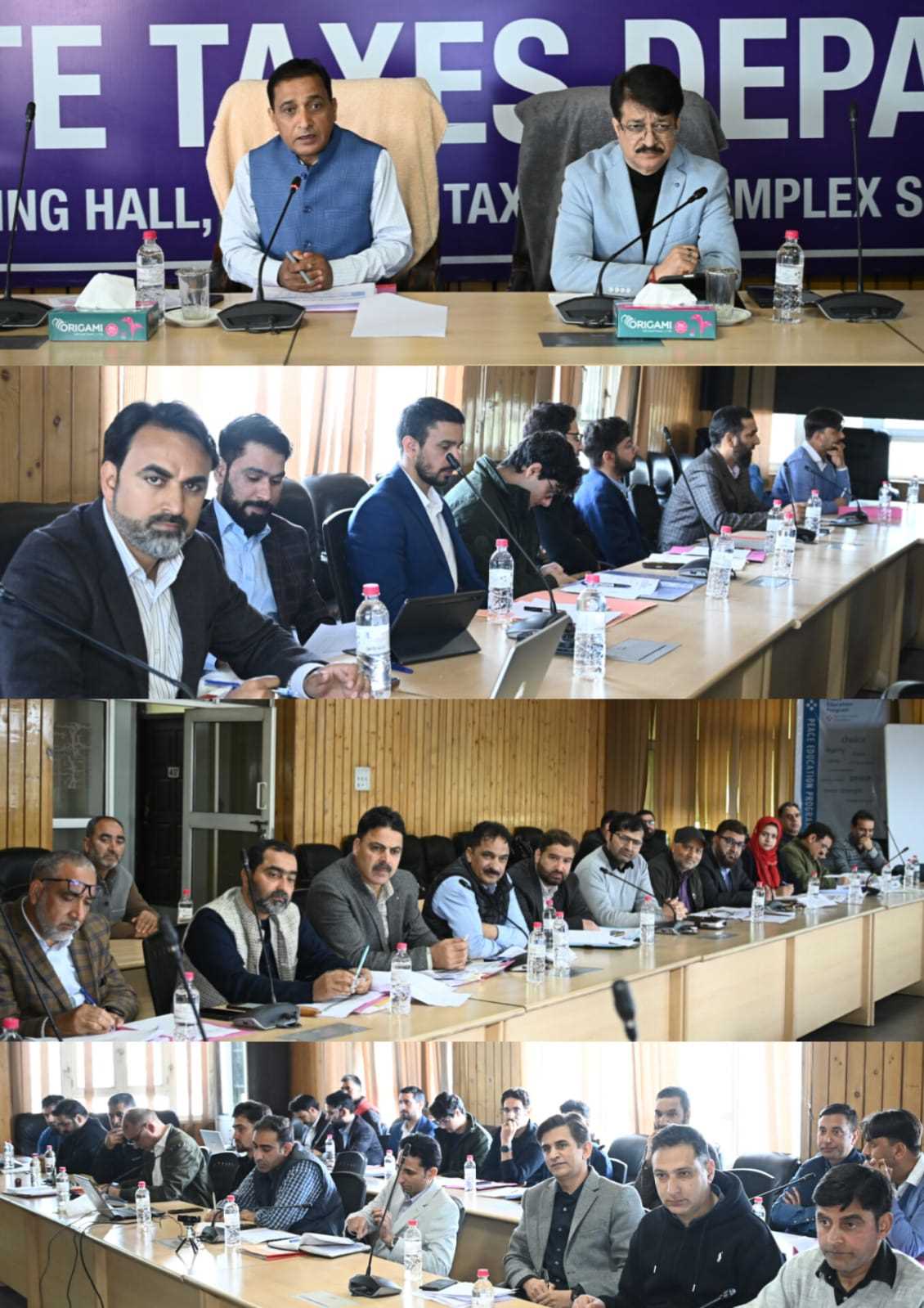
Commissioner State Taxes Department, P.K. Bhat today chaired a comprehensive review meeting to assess the performance and progress of the department in the Kashmir Division.
The meeting was attended by Additional Commissioners State Taxes (Adm. & Enf.) Kashmir, Parveez Ahmad Raina and State Taxes Officers of all Circles of Kashmir Division.
The meeting focused on key agenda items, including year-on-year revenue realisation, action taken on reports generated by GST Analytics & Fraud Detection (BISAG), growth in cash and IGST settlements, progress in Audit cases initiated under Section 65 of the JK GST/CGST Act for FY 2022-23, efforts to curb the menace of fake Input Tax Credit (ITC), payments released by Drawing and Disbursing Officers (DDOs) and resultant tax paid by taxpayers, scrutiny of returns under Section 61 of the Act, enforcement activities and their outcomes, as well as utilisation of various analytical reports and their results.
The Commissioner deliberated on the impact of rate rationalisation on the Automobile, Cement, and Insurance sectors. The tax rate was revised from 28% to 18% for Automobiles and Cement, and to zero percent for Insurance. While the rationalisation is likely to affect revenue growth during FY 2025-26, it is expected to have a positive impact on revenue collection in the current financial year.
The rationalisation exercise reflects the government’s broader objective of making essential and mass-market goods and services more affordable while simplifying the tax regime and promoting sectors such as affordable housing, mobility, and financial protection.
The Commissioner also acknowledged that compared to payments of Rs 9007 crore released against various works contractors, payments of Rs 8994 have been released during FY 2025-26. He also emphasized that registrations granted under Rule 14A need to be scrutinised properly and on regular basis to check any misuse and passing on of fake ITC.
During the circle-wise review, the Commissioner evaluated the progress made by each circle towards target achievement, including DRC-03 realised as a result of assessments, follow-up on non-filers, and actions initiated as per the Act.
P.K. Bhat emphasised the critical need to leverage data, reports, and inputs generated by BISAG, PRIME, DC IT and Analytics, specialised teams such as the Special Investigation Unit (SIU), Business Intelligence Unit (BIU), and field enforcement units. He stressed meticulous scrutiny, integration of field inputs, and available reports to effectively curb fake ITC and other fraudulent practices.
The Commissioner reiterated that the overarching purpose of these efforts is to ensure achievement of assigned revenue targets, containment of fraudulent activities, promotion of fair trade practices, and safeguarding the revenue of the state exchequer.
The Additional Commissioner stressed the urgent need for officers to adopt a highly proactive and vigilant approach. He directed focused monitoring on sectors prone to fake Input Tax Credit (ITC) claims, ensuring that cancelled taxpayers do not result in revenue loss to the State Exchequer through payments by DDOs. He further emphasized maximizing the use of modern IT tools and intelligence reports to encourage fair trade practices and robustly safeguard the revenue of the exchequer.
The department remains committed to strengthening GST compliance, enhancing enforcement, and utilising technology-driven analytics for transparent and efficient tax administration in the Kashmir Division.
Commissioner State Taxes Department, P.K. Bhat today chaired a comprehensive review meeting to assess the performance and progress of the department in the Kashmir Division.
The meeting was attended by Additional Commissioners State Taxes (Adm. & Enf.) Kashmir, Parveez Ahmad Raina and State Taxes Officers of all Circles of Kashmir Division.
The meeting focused on key agenda items, including year-on-year revenue realisation, action taken on reports generated by GST Analytics & Fraud Detection (BISAG), growth in cash and IGST settlements, progress in Audit cases initiated under Section 65 of the JK GST/CGST Act for FY 2022-23, efforts to curb the menace of fake Input Tax Credit (ITC), payments released by Drawing and Disbursing Officers (DDOs) and resultant tax paid by taxpayers, scrutiny of returns under Section 61 of the Act, enforcement activities and their outcomes, as well as utilisation of various analytical reports and their results.
The Commissioner deliberated on the impact of rate rationalisation on the Automobile, Cement, and Insurance sectors. The tax rate was revised from 28% to 18% for Automobiles and Cement, and to zero percent for Insurance. While the rationalisation is likely to affect revenue growth during FY 2025-26, it is expected to have a positive impact on revenue collection in the current financial year.
The rationalisation exercise reflects the government’s broader objective of making essential and mass-market goods and services more affordable while simplifying the tax regime and promoting sectors such as affordable housing, mobility, and financial protection.
The Commissioner also acknowledged that compared to payments of Rs 9007 crore released against various works contractors, payments of Rs 8994 have been released during FY 2025-26. He also emphasized that registrations granted under Rule 14A need to be scrutinised properly and on regular basis to check any misuse and passing on of fake ITC.
During the circle-wise review, the Commissioner evaluated the progress made by each circle towards target achievement, including DRC-03 realised as a result of assessments, follow-up on non-filers, and actions initiated as per the Act.
P.K. Bhat emphasised the critical need to leverage data, reports, and inputs generated by BISAG, PRIME, DC IT and Analytics, specialised teams such as the Special Investigation Unit (SIU), Business Intelligence Unit (BIU), and field enforcement units. He stressed meticulous scrutiny, integration of field inputs, and available reports to effectively curb fake ITC and other fraudulent practices.
The Commissioner reiterated that the overarching purpose of these efforts is to ensure achievement of assigned revenue targets, containment of fraudulent activities, promotion of fair trade practices, and safeguarding the revenue of the state exchequer.
The Additional Commissioner stressed the urgent need for officers to adopt a highly proactive and vigilant approach. He directed focused monitoring on sectors prone to fake Input Tax Credit (ITC) claims, ensuring that cancelled taxpayers do not result in revenue loss to the State Exchequer through payments by DDOs. He further emphasized maximizing the use of modern IT tools and intelligence reports to encourage fair trade practices and robustly safeguard the revenue of the exchequer.
The department remains committed to strengthening GST compliance, enhancing enforcement, and utilising technology-driven analytics for transparent and efficient tax administration in the Kashmir Division.

© Copyright 2023 brighterkashmir.com All Rights Reserved. Quantum Technologies