
BREAKING NEWS
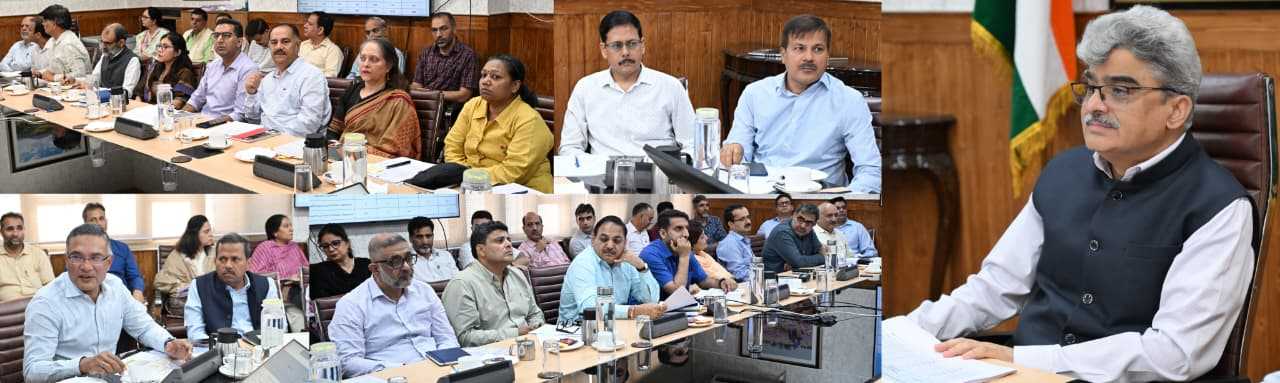
Chief Secretary, Atal Dulloo, today chaired a meeting of all Administrative Secretaries and Deputy Commissioners to undertake a comprehensive sector-wise and department-wise review of expenditure under the Capital Expenditure (CAPEX), Centrally Sponsored Schemes (CSS), Special Assistance to States for Capital Investment (SASCI) and NABARD-funded projects, besides reviewing the position of revenue generation across different sectors.
The meeting was attended by Administrative Secretaries, Deputy Commissioners, DG, Resources; DG, Budget; Director, Resources and other senior officers and HoDs of the Finance and Planning Departments.
At the outset, the Chief Secretary directed departments to prepare a shelf of projects under SASCI for the next financial year, with all requisite formalities like securing of Administrative Approval, Technical Sanction, Tendering process completed well in advance.
He stressed that these prerequisites should be completed beforehand so that capital works are allotted immediately upon release of funds and completed at a brisk pace. He observed that advance preparation of projects would enable departments to utilise the available funding window more effectively and accelerate creation of public infrastructure.
The Chief Secretary further directed departments to make dedicated efforts towards implementation of all incentive-linked reforms prescribed under SASCI, observing that successful completion of these reforms could enable J&K to secure additional funding under this component of this scheme.
He also called upon departments to identify suitable works that could be taken up through this additional funding so that the reform-linked resources are translated into tangible infrastructure and development outcomes.
The Chief Secretary specifically urged departments including School Education, Jal Shakti, Higher Education, Culture, Science & Technology, Irrigation and Power, among others, to start identifying priority works capable of being taken up under these funding opportunities.
Reviewing the progress of works under UT and District CAPEX, the Chief Secretary directed the Planning Department to submit a weekly report on works tendered and allotted by departments and districts.
He called upon all Administrative Secretaries and Deputy Commissioners to ensure that each approved work is allotted within the least possible timeframe, stressing that budgetary allocations and approvals must translate into actual execution on the ground without avoidable delays.
He emphasised the need for close monitoring of the tendering and allotment process so that implementation of capital works gains the desired momentum.
The Chief Secretary directed the Power Development Department to constitute a committee under the Engineer-in-Chief, comprising other senior engineers of the department, to assess the performance of field functionaries, particularly their role in ensuring billing and collection efficiency on the ground.
Observing that the power sector remains one of the major areas of fiscal pressure for the UT, he called for focused and sustained reforms to improve the sector's financial position. He directed the department to develop an end-to-end digital mechanism to track the chain of supply of every unit of energy pumped into the distribution system, with a view to ensuring accountability for every unit of energy.
During the meeting, the Finance Department made a detailed presentation on the expenditure position under CAPEX, CSS, SASCI and NABARD, besides highlighting the revenue performance of major sectors.
The ACS Finance, Shailendra Kumar took this occasion to emphasise the need for departments and districts to ensure that approved works move swiftly from planning and tendering to actual execution, while simultaneously improving financial management and utilisation of available Central assistance.
The ACS also presented the roadmap for leveraging SASCI and other reform-linked funding opportunities. He revealed that under SASCI Part-I for 2026-27, project proposals worth ₹1,231 crore covering 219 projects have been mapped, including ₹412.83 crore sought by the Power Development Department and ₹158.83 crore by the Health sector.
Under SASCI Part-II, it was added that an assistance of ₹176 crore for 10 critical schemes has been sought, including ₹46 crore for the Flexible Pool for RCH & Health System Strengthening and ₹45 crore for PMGSY.
The presentation revealed that under the District CAPEX Budget 2026-27, 88 per cent of the 47,794 new works, 42,219 works have received Administrative Approval, while 13 per cent have so far been allotted. The total allocation under District CAPEX stands at ₹1,236.08 crore across 20 districts, with an additional special allocation of ₹3 crore per district.
The presentation also highlighted the pace of physical verification of completed works. Against 29,193 completed works, it was divulged that 2,376 works have been physically verified through the online Physical Verification portal.
The Finance Department informed that the CSS CAPEX Budget Estimate for the current financial year stands at ₹10,632 crore. Among the major sectors, Rural Development has the highest Budget Estimate at ₹2,655.1 crore, followed by Housing & Urban Development at ₹1,877.6 crore and Public Works Department at ₹1,694.4 crore.
Regarding the Integrated Financial Management Information System (IFMIS), it was informed that three of the nine core modules have been fully implemented. Successful implementation of the remaining modules is expected to enable J&K to avail an incentive of up to ₹200 crore.
The presentation also highlighted a potential incentive of up to ₹650 crore under Digital Public Infrastructure for Agriculture through creation of an AgriStack-enabled Farmer Registry and another ₹105 crore under Compressed Bio-Gas reforms.
Regarding NABARD-RIDF projects, the Finance Department informed that 157 projects under RIDF XXVII to XXXI have been completed, with total disbursement of ₹2,301 crore. Further, 227 new project proposals worth ₹1,288 crore have been prepared under RIDF-XXXII. The concerned departments have been given a 15-day timeframe for uploading these proposals on the NABARD portal.
The meeting also reviewed revenue generation across major revenue-generating departments. It was revealed that the GST collections during 2026-27 have reached ₹3,292.38 crore, with J&K recording a 96.78 per cent return filing rate, compared to the national average of 95.73 per cent.
Similarly the Excise Department has recorded ₹782 crore in year-to-date collections, while the Stamps & Registration Department has realised ₹248.3 crore. The presentation also highlighted the fiscal gap in the power sector, with power purchase costs at ₹2,697 crore against receipts of ₹1,747 crore, resulting in a gap of around ₹940 crore in the ensuing financial year.
The meeting also underscored the importance of timely implementation of reform-linked measures, strengthening revenue collection mechanisms, improving expenditure efficiency and leveraging available funding windows for creation of quality public infrastructure across J&K.
Chief Secretary, Atal Dulloo, today chaired a meeting of all Administrative Secretaries and Deputy Commissioners to undertake a comprehensive sector-wise and department-wise review of expenditure under the Capital Expenditure (CAPEX), Centrally Sponsored Schemes (CSS), Special Assistance to States for Capital Investment (SASCI) and NABARD-funded projects, besides reviewing the position of revenue generation across different sectors.
The meeting was attended by Administrative Secretaries, Deputy Commissioners, DG, Resources; DG, Budget; Director, Resources and other senior officers and HoDs of the Finance and Planning Departments.
At the outset, the Chief Secretary directed departments to prepare a shelf of projects under SASCI for the next financial year, with all requisite formalities like securing of Administrative Approval, Technical Sanction, Tendering process completed well in advance.
He stressed that these prerequisites should be completed beforehand so that capital works are allotted immediately upon release of funds and completed at a brisk pace. He observed that advance preparation of projects would enable departments to utilise the available funding window more effectively and accelerate creation of public infrastructure.
The Chief Secretary further directed departments to make dedicated efforts towards implementation of all incentive-linked reforms prescribed under SASCI, observing that successful completion of these reforms could enable J&K to secure additional funding under this component of this scheme.
He also called upon departments to identify suitable works that could be taken up through this additional funding so that the reform-linked resources are translated into tangible infrastructure and development outcomes.
The Chief Secretary specifically urged departments including School Education, Jal Shakti, Higher Education, Culture, Science & Technology, Irrigation and Power, among others, to start identifying priority works capable of being taken up under these funding opportunities.
Reviewing the progress of works under UT and District CAPEX, the Chief Secretary directed the Planning Department to submit a weekly report on works tendered and allotted by departments and districts.
He called upon all Administrative Secretaries and Deputy Commissioners to ensure that each approved work is allotted within the least possible timeframe, stressing that budgetary allocations and approvals must translate into actual execution on the ground without avoidable delays.
He emphasised the need for close monitoring of the tendering and allotment process so that implementation of capital works gains the desired momentum.
The Chief Secretary directed the Power Development Department to constitute a committee under the Engineer-in-Chief, comprising other senior engineers of the department, to assess the performance of field functionaries, particularly their role in ensuring billing and collection efficiency on the ground.
Observing that the power sector remains one of the major areas of fiscal pressure for the UT, he called for focused and sustained reforms to improve the sector's financial position. He directed the department to develop an end-to-end digital mechanism to track the chain of supply of every unit of energy pumped into the distribution system, with a view to ensuring accountability for every unit of energy.
During the meeting, the Finance Department made a detailed presentation on the expenditure position under CAPEX, CSS, SASCI and NABARD, besides highlighting the revenue performance of major sectors.
The ACS Finance, Shailendra Kumar took this occasion to emphasise the need for departments and districts to ensure that approved works move swiftly from planning and tendering to actual execution, while simultaneously improving financial management and utilisation of available Central assistance.
The ACS also presented the roadmap for leveraging SASCI and other reform-linked funding opportunities. He revealed that under SASCI Part-I for 2026-27, project proposals worth ₹1,231 crore covering 219 projects have been mapped, including ₹412.83 crore sought by the Power Development Department and ₹158.83 crore by the Health sector.
Under SASCI Part-II, it was added that an assistance of ₹176 crore for 10 critical schemes has been sought, including ₹46 crore for the Flexible Pool for RCH & Health System Strengthening and ₹45 crore for PMGSY.
The presentation revealed that under the District CAPEX Budget 2026-27, 88 per cent of the 47,794 new works, 42,219 works have received Administrative Approval, while 13 per cent have so far been allotted. The total allocation under District CAPEX stands at ₹1,236.08 crore across 20 districts, with an additional special allocation of ₹3 crore per district.
The presentation also highlighted the pace of physical verification of completed works. Against 29,193 completed works, it was divulged that 2,376 works have been physically verified through the online Physical Verification portal.
The Finance Department informed that the CSS CAPEX Budget Estimate for the current financial year stands at ₹10,632 crore. Among the major sectors, Rural Development has the highest Budget Estimate at ₹2,655.1 crore, followed by Housing & Urban Development at ₹1,877.6 crore and Public Works Department at ₹1,694.4 crore.
Regarding the Integrated Financial Management Information System (IFMIS), it was informed that three of the nine core modules have been fully implemented. Successful implementation of the remaining modules is expected to enable J&K to avail an incentive of up to ₹200 crore.
The presentation also highlighted a potential incentive of up to ₹650 crore under Digital Public Infrastructure for Agriculture through creation of an AgriStack-enabled Farmer Registry and another ₹105 crore under Compressed Bio-Gas reforms.
Regarding NABARD-RIDF projects, the Finance Department informed that 157 projects under RIDF XXVII to XXXI have been completed, with total disbursement of ₹2,301 crore. Further, 227 new project proposals worth ₹1,288 crore have been prepared under RIDF-XXXII. The concerned departments have been given a 15-day timeframe for uploading these proposals on the NABARD portal.
The meeting also reviewed revenue generation across major revenue-generating departments. It was revealed that the GST collections during 2026-27 have reached ₹3,292.38 crore, with J&K recording a 96.78 per cent return filing rate, compared to the national average of 95.73 per cent.
Similarly the Excise Department has recorded ₹782 crore in year-to-date collections, while the Stamps & Registration Department has realised ₹248.3 crore. The presentation also highlighted the fiscal gap in the power sector, with power purchase costs at ₹2,697 crore against receipts of ₹1,747 crore, resulting in a gap of around ₹940 crore in the ensuing financial year.
The meeting also underscored the importance of timely implementation of reform-linked measures, strengthening revenue collection mechanisms, improving expenditure efficiency and leveraging available funding windows for creation of quality public infrastructure across J&K.

© Copyright 2023 brighterkashmir.com All Rights Reserved. Quantum Technologies