
BREAKING NEWS
Jammu, Feb 4: Chief Secretary Atal Dulloo on Tuesday called for strong public participation in identifying, digitising and preserving rare manuscripts in Jammu and Kashmir under the Government of India’s flagship Mission Gyan Bharatam, describing the initiative as a collective cultural responsibility.
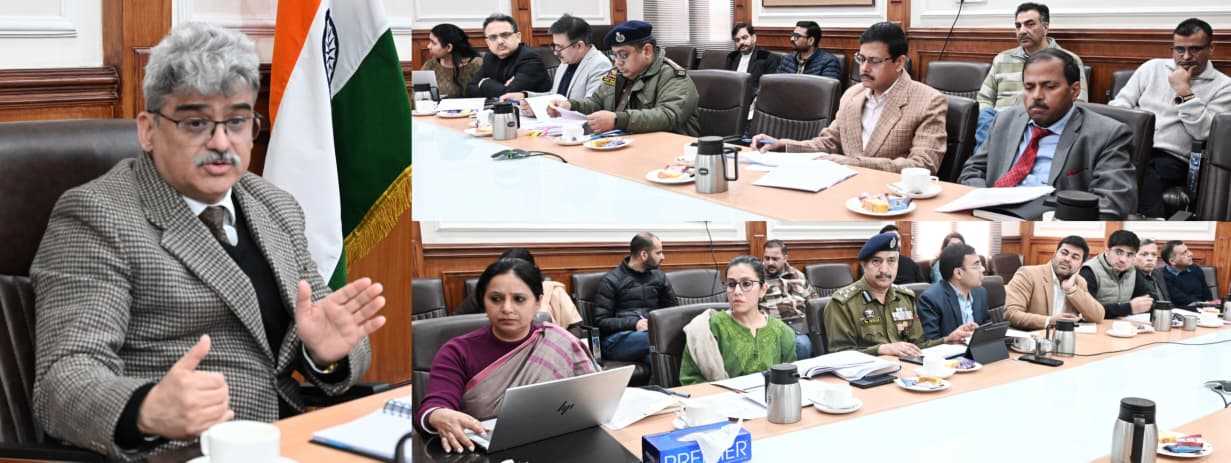
Chairing a high-level review meeting on the Mission’s implementation in the Union Territory, the Chief Secretary said that a large number of invaluable manuscripts are held privately or housed in religious and traditional institutions, making people’s involvement essential for safeguarding India’s manuscript heritage for future generations.
He stressed the need for intensive awareness programmes with the support of professionals and individuals already engaged in manuscript preservation. Dulloo also urged active involvement of religious heads, civil society organisations and self-help groups, noting that many rare manuscripts are preserved at religious places across the UT.
Emphasising effective execution, the Chief Secretary called for capacity building of field officers involved in surveys and monitoring, and directed that a designated supervisory officer be appointed in each block. Drawing parallels with Mission YUVA, he suggested adopting a technology-driven approach to conduct a UT-wide household survey through an online platform. Deputy Commissioners were asked to identify capable personnel for this sensitive task.
Principal Secretary, Culture, Brij Mohan Sharma informed the meeting that Mission Gyan Bharatam aims to digitise one crore manuscripts across the country to create a National Digital Repository of Indian Knowledge Systems. He said the Mission is guided by the three “Ds” — Digitisation, Deciphering and Democratisation — implemented through a “4S” strategy of searching, saving, scanning and sharing manuscripts in the public domain.
He added that Memorandums of Understanding have been signed with States, Union Territories and institutions to establish Cluster Centres and State Nodal Agencies for coordinated implementation.
Giving a status update, Director Archives, Archaeology and Museums, K.K. Sidha said 33,858 manuscripts have already been identified from government and semi-government institutions, religious establishments and private custodians. He said a special household survey, ‘Har Ghar Dastak’, is being planned to trace and digitise manuscripts with owners’ consent, following the ‘Har Din–Ek Gin’ approach of covering at least one panchayat per day.
Jehangir Ahmad, Head of the Department of Persian at the University of Kashmir, which has been designated a Cluster Centre, said around 5,000 manuscript pages have already been digitised at the university’s lab. He also announced that a separate digitisation laboratory will be set up at the Archives in Jammu to ensure smooth implementation in the Jammu region.
Concluding the meeting, the Chief Secretary reiterated that Mission Gyan Bharatam goes beyond technology and requires close cooperation between the government, institutions and citizens to preserve the region’s invaluable intellectual and cultural legacy.
Jammu, Feb 4: Chief Secretary Atal Dulloo on Tuesday called for strong public participation in identifying, digitising and preserving rare manuscripts in Jammu and Kashmir under the Government of India’s flagship Mission Gyan Bharatam, describing the initiative as a collective cultural responsibility.
Chairing a high-level review meeting on the Mission’s implementation in the Union Territory, the Chief Secretary said that a large number of invaluable manuscripts are held privately or housed in religious and traditional institutions, making people’s involvement essential for safeguarding India’s manuscript heritage for future generations.
He stressed the need for intensive awareness programmes with the support of professionals and individuals already engaged in manuscript preservation. Dulloo also urged active involvement of religious heads, civil society organisations and self-help groups, noting that many rare manuscripts are preserved at religious places across the UT.
Emphasising effective execution, the Chief Secretary called for capacity building of field officers involved in surveys and monitoring, and directed that a designated supervisory officer be appointed in each block. Drawing parallels with Mission YUVA, he suggested adopting a technology-driven approach to conduct a UT-wide household survey through an online platform. Deputy Commissioners were asked to identify capable personnel for this sensitive task.
Principal Secretary, Culture, Brij Mohan Sharma informed the meeting that Mission Gyan Bharatam aims to digitise one crore manuscripts across the country to create a National Digital Repository of Indian Knowledge Systems. He said the Mission is guided by the three “Ds” — Digitisation, Deciphering and Democratisation — implemented through a “4S” strategy of searching, saving, scanning and sharing manuscripts in the public domain.
He added that Memorandums of Understanding have been signed with States, Union Territories and institutions to establish Cluster Centres and State Nodal Agencies for coordinated implementation.
Giving a status update, Director Archives, Archaeology and Museums, K.K. Sidha said 33,858 manuscripts have already been identified from government and semi-government institutions, religious establishments and private custodians. He said a special household survey, ‘Har Ghar Dastak’, is being planned to trace and digitise manuscripts with owners’ consent, following the ‘Har Din–Ek Gin’ approach of covering at least one panchayat per day.
Jehangir Ahmad, Head of the Department of Persian at the University of Kashmir, which has been designated a Cluster Centre, said around 5,000 manuscript pages have already been digitised at the university’s lab. He also announced that a separate digitisation laboratory will be set up at the Archives in Jammu to ensure smooth implementation in the Jammu region.
Concluding the meeting, the Chief Secretary reiterated that Mission Gyan Bharatam goes beyond technology and requires close cooperation between the government, institutions and citizens to preserve the region’s invaluable intellectual and cultural legacy.

© Copyright 2023 brighterkashmir.com All Rights Reserved. Quantum Technologies