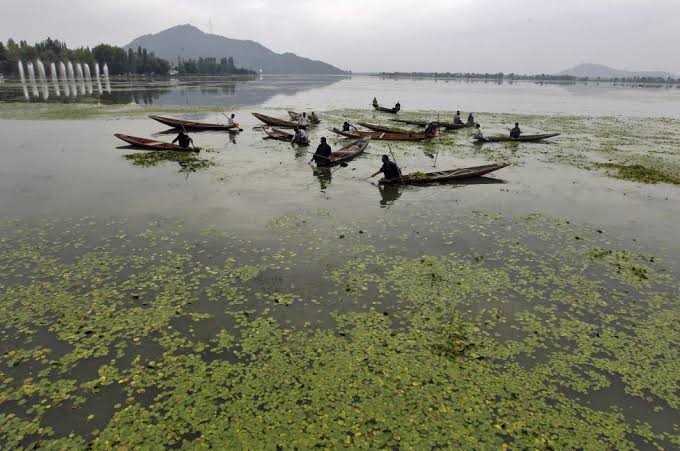
Srinagar, Aug 25: Kashmir’s iconic Dal Lake is facing renewed ecological pressure as pollution, nutrient enrichment and extensive algae growth continue to threaten its fragile ecosystem despite ongoing restoration efforts. Recent images from the lake show stretches of water covered with algae, underscoring the scale of the environmental challenge confronting one of Srinagar’s most important natural and tourism landmarks.
The deterioration is linked to a combination of untreated sewage, solid waste, silt and nutrient-rich inflows entering the lake. Elevated levels of nutrients such as nitrogen and phosphorus encourage the rapid growth of algae and aquatic weeds, while reducing dissolved oxygen and disturbing the ecological balance of the water body.
The problem has consequences beyond the appearance of the lake. Declining water quality affects aquatic habitats, including fish breeding and survival, while also putting pressure on communities whose livelihoods are connected to the lake. Environmentalists and conservation authorities have repeatedly raised concerns over the cumulative impact of pollution and urbanisation on Dal Lake.
Dal Lake is situated at the heart of Srinagar and remains central to Kashmir’s tourism economy, with shikaras, houseboats, waterways and surrounding landscapes forming an important part of the region’s tourism identity. Its ecological health is therefore closely connected with both the environment and the livelihoods of people dependent on the lake.
The latest concerns come despite sustained restoration work. Government workers continue efforts to remove aquatic weeds and maintain the lake, but the persistence of pollution indicates that restoration cannot rely solely on removing weeds from the water. The sources feeding pollutants and nutrients into the lake also need to be addressed.
Research published in recent years has similarly identified eutrophication—the excessive enrichment of water with nutrients—as a major long-term challenge for Dal Lake. A 2026 study examining trends between 1997 and 2023 found continuing deterioration associated with the lake’s eutrophication process and stressed the need for an integrated management strategy.
The challenge is particularly complex because Dal Lake exists within a densely populated urban environment. Sewage from surrounding settlements, pressure from tourism and houseboats, solid waste and changes in natural drainage and water circulation collectively increase the stress on the lake. Earlier assessments have also raised concerns about the capacity and functioning of sewage-treatment infrastructure around the lake.
Experts have increasingly argued that conservation efforts must move beyond periodic cleaning and weed removal towards a comprehensive strategy covering sewage treatment, waste management, nutrient control, catchment protection, monitoring and enforcement.
For Kashmir, the issue is more than an environmental concern. Dal Lake is a cultural symbol, a major tourist attraction and an economic resource supporting numerous families. Its continuing deterioration therefore raises questions about the long-term sustainability of both Srinagar’s urban environment and the tourism economy.
The renewed algae growth serves as a visible warning that restoring Dal Lake requires sustained action at the source of pollution as well as continued conservation within the lake itself. Without effective control of pollutant and nutrient inflows, restoration efforts risk becoming a continuous battle against symptoms rather than a lasting solution.

Srinagar, Aug 25: Kashmir’s iconic Dal Lake is facing renewed ecological pressure as pollution, nutrient enrichment and extensive algae growth continue to threaten its fragile ecosystem despite ongoing restoration efforts. Recent images from the lake show stretches of water covered with algae, underscoring the scale of the environmental challenge confronting one of Srinagar’s most important natural and tourism landmarks.
The deterioration is linked to a combination of untreated sewage, solid waste, silt and nutrient-rich inflows entering the lake. Elevated levels of nutrients such as nitrogen and phosphorus encourage the rapid growth of algae and aquatic weeds, while reducing dissolved oxygen and disturbing the ecological balance of the water body.
The problem has consequences beyond the appearance of the lake. Declining water quality affects aquatic habitats, including fish breeding and survival, while also putting pressure on communities whose livelihoods are connected to the lake. Environmentalists and conservation authorities have repeatedly raised concerns over the cumulative impact of pollution and urbanisation on Dal Lake.
Dal Lake is situated at the heart of Srinagar and remains central to Kashmir’s tourism economy, with shikaras, houseboats, waterways and surrounding landscapes forming an important part of the region’s tourism identity. Its ecological health is therefore closely connected with both the environment and the livelihoods of people dependent on the lake.
The latest concerns come despite sustained restoration work. Government workers continue efforts to remove aquatic weeds and maintain the lake, but the persistence of pollution indicates that restoration cannot rely solely on removing weeds from the water. The sources feeding pollutants and nutrients into the lake also need to be addressed.
Research published in recent years has similarly identified eutrophication—the excessive enrichment of water with nutrients—as a major long-term challenge for Dal Lake. A 2026 study examining trends between 1997 and 2023 found continuing deterioration associated with the lake’s eutrophication process and stressed the need for an integrated management strategy.
The challenge is particularly complex because Dal Lake exists within a densely populated urban environment. Sewage from surrounding settlements, pressure from tourism and houseboats, solid waste and changes in natural drainage and water circulation collectively increase the stress on the lake. Earlier assessments have also raised concerns about the capacity and functioning of sewage-treatment infrastructure around the lake.
Experts have increasingly argued that conservation efforts must move beyond periodic cleaning and weed removal towards a comprehensive strategy covering sewage treatment, waste management, nutrient control, catchment protection, monitoring and enforcement.
For Kashmir, the issue is more than an environmental concern. Dal Lake is a cultural symbol, a major tourist attraction and an economic resource supporting numerous families. Its continuing deterioration therefore raises questions about the long-term sustainability of both Srinagar’s urban environment and the tourism economy.
The renewed algae growth serves as a visible warning that restoring Dal Lake requires sustained action at the source of pollution as well as continued conservation within the lake itself. Without effective control of pollutant and nutrient inflows, restoration efforts risk becoming a continuous battle against symptoms rather than a lasting solution.
© Copyright 2023 brighterkashmir.com All Rights Reserved. Quantum Technologies