
BREAKING NEWS
It is about expanding strategic options. For Russia, it is less about finding a replacement for Europe and more about remaining relevant in Asia’s unfolding century. Behind this strategic layer lies another, quieter truth: economic interdependence. Russian oil stabilizes Indian energy prices; India’s pharmaceuticals and technology provide Moscow with critical channels amid sanctions. Trade in fertilizers, machinery, diamonds, and defence components forms an invisible but sturdy web often overlooked in public debate.
Western analysis frequently misinterprets the India–Russia equation, viewing every handshake through the anxieties of Washington or Brussels
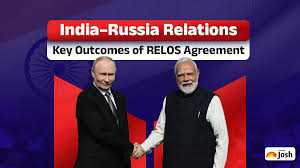
There are moments in international politics when an agreement becomes more than a strategic document. It becomes a message — subtle, unannounced, but powerful enough to shift the geometry of global power. The RELOS pact between India and Russia, allowing reciprocal access to each other’s logistics facilities, is one such message. It is a quiet recalibration of the strategic landscape stretching from the warm waters of the Indian Ocean to the icy frontier of the Arctic.
At a time when the world is anxiously rearranging its alliances, the India–Russia relationship has neither fractured under global pressure nor remained fossilized in nostalgia. Instead, it has evolved into something more deliberate: a partnership anchored in old trust yet driven by new strategic ambition. This is not the sentimental camaraderie of the Cold War, nor merely the transactional pragmatism of recent years. It is a conscious assertion of strategic autonomy in a world rapidly hardening into rival blocs.
India and Russia have never needed grand declarations to validate their bond. Their relationship has endured through understatement. RELOS continues this legacy, converting goodwill into capability and capability into influence. It means Indian vessels could refuel or undergo maintenance in Arctic facilities, while Russian ships may find support in the Indian Ocean — areas where logistics is not convenience but power. The symbolism has given way to operational reality.
For India, RELOS is not about choosing Russia over anyone else; it is about expanding strategic options. For Russia, it is less about finding a replacement for Europe and more about remaining relevant in Asia’s unfolding century. Behind this strategic layer lies another, quieter truth: economic interdependence. Russian oil stabilizes Indian energy prices; India’s pharmaceuticals and technology provide Moscow with critical channels amid sanctions. Trade in fertilizers, machinery, diamonds, and defence components forms an invisible but sturdy web often overlooked in public debate.
Western analysis frequently misinterprets the India–Russia equation, viewing every handshake through the anxieties of Washington or Brussels. But India’s objective is far simpler: room to manoeuvre without being boxed into loyalties it never signed up for. Russia, meanwhile, seeks partners who judge less and engage more. Together, they articulate a subtle resistance to the re-emerging idea that the world must align along two rigid poles. Their partnership argues instead for a multipolar order where interests can overlap without clashing.
The significance of RELOS extends far beyond naval logistics. It signals a transition from sentiment to strategy, from ceremonial diplomacy to functional partnership, and from history-driven ties to future-oriented pragmatism. In the coming years, this cooperation may expand into joint maritime development, deeper Arctic engagement, diversified energy corridors, next-generation space and nuclear projects, and more flexible financial mechanisms that reduce dependence on traditional currency systems. If pursued with discipline, these developments could reshape Asia’s strategic architecture.
Yet the relationship is not without its challenges. India must diversify its defence procurement. Trade imbalances require correction. Payment systems need stability. And Russia’s growing closeness to China remains an unspoken concern for New Delhi. But diplomacy is rarely about perfect conditions; it is about constructing durable bridges on imperfect terrain. In that sense, RELOS is less a destination and more the first step onto a bridge still being built.
In an increasingly fragmented world — where alliances are fragile, loyalties transactional, and geopolitical winds unpredictable — the India–Russia partnership stands out for one reason: consistency. Not loud, not performative, not romantic. Just steady. And in the volatile theatre of geopolitics, steadiness is an underrated currency.
RELOS demonstrates that this relationship is not a relic. It is an adaptation — a recalibration in tune with new realities. India no longer looks at Russia through the rear-view mirror, and Russia no longer views India merely as a market. Each sees the other as a strategic partner capable of shaping regional outcomes.
If the next decade rewards nations that diversify, de-risk, and define their own terms, then India and Russia — through RELOS and beyond — are positioning themselves not as followers of global tides but as authors of their own trajectory.
Email:-----------------------junaidsirsolapur@gmail.com
It is about expanding strategic options. For Russia, it is less about finding a replacement for Europe and more about remaining relevant in Asia’s unfolding century. Behind this strategic layer lies another, quieter truth: economic interdependence. Russian oil stabilizes Indian energy prices; India’s pharmaceuticals and technology provide Moscow with critical channels amid sanctions. Trade in fertilizers, machinery, diamonds, and defence components forms an invisible but sturdy web often overlooked in public debate.
Western analysis frequently misinterprets the India–Russia equation, viewing every handshake through the anxieties of Washington or Brussels
There are moments in international politics when an agreement becomes more than a strategic document. It becomes a message — subtle, unannounced, but powerful enough to shift the geometry of global power. The RELOS pact between India and Russia, allowing reciprocal access to each other’s logistics facilities, is one such message. It is a quiet recalibration of the strategic landscape stretching from the warm waters of the Indian Ocean to the icy frontier of the Arctic.
At a time when the world is anxiously rearranging its alliances, the India–Russia relationship has neither fractured under global pressure nor remained fossilized in nostalgia. Instead, it has evolved into something more deliberate: a partnership anchored in old trust yet driven by new strategic ambition. This is not the sentimental camaraderie of the Cold War, nor merely the transactional pragmatism of recent years. It is a conscious assertion of strategic autonomy in a world rapidly hardening into rival blocs.
India and Russia have never needed grand declarations to validate their bond. Their relationship has endured through understatement. RELOS continues this legacy, converting goodwill into capability and capability into influence. It means Indian vessels could refuel or undergo maintenance in Arctic facilities, while Russian ships may find support in the Indian Ocean — areas where logistics is not convenience but power. The symbolism has given way to operational reality.
For India, RELOS is not about choosing Russia over anyone else; it is about expanding strategic options. For Russia, it is less about finding a replacement for Europe and more about remaining relevant in Asia’s unfolding century. Behind this strategic layer lies another, quieter truth: economic interdependence. Russian oil stabilizes Indian energy prices; India’s pharmaceuticals and technology provide Moscow with critical channels amid sanctions. Trade in fertilizers, machinery, diamonds, and defence components forms an invisible but sturdy web often overlooked in public debate.
Western analysis frequently misinterprets the India–Russia equation, viewing every handshake through the anxieties of Washington or Brussels. But India’s objective is far simpler: room to manoeuvre without being boxed into loyalties it never signed up for. Russia, meanwhile, seeks partners who judge less and engage more. Together, they articulate a subtle resistance to the re-emerging idea that the world must align along two rigid poles. Their partnership argues instead for a multipolar order where interests can overlap without clashing.
The significance of RELOS extends far beyond naval logistics. It signals a transition from sentiment to strategy, from ceremonial diplomacy to functional partnership, and from history-driven ties to future-oriented pragmatism. In the coming years, this cooperation may expand into joint maritime development, deeper Arctic engagement, diversified energy corridors, next-generation space and nuclear projects, and more flexible financial mechanisms that reduce dependence on traditional currency systems. If pursued with discipline, these developments could reshape Asia’s strategic architecture.
Yet the relationship is not without its challenges. India must diversify its defence procurement. Trade imbalances require correction. Payment systems need stability. And Russia’s growing closeness to China remains an unspoken concern for New Delhi. But diplomacy is rarely about perfect conditions; it is about constructing durable bridges on imperfect terrain. In that sense, RELOS is less a destination and more the first step onto a bridge still being built.
In an increasingly fragmented world — where alliances are fragile, loyalties transactional, and geopolitical winds unpredictable — the India–Russia partnership stands out for one reason: consistency. Not loud, not performative, not romantic. Just steady. And in the volatile theatre of geopolitics, steadiness is an underrated currency.
RELOS demonstrates that this relationship is not a relic. It is an adaptation — a recalibration in tune with new realities. India no longer looks at Russia through the rear-view mirror, and Russia no longer views India merely as a market. Each sees the other as a strategic partner capable of shaping regional outcomes.
If the next decade rewards nations that diversify, de-risk, and define their own terms, then India and Russia — through RELOS and beyond — are positioning themselves not as followers of global tides but as authors of their own trajectory.
Email:-----------------------junaidsirsolapur@gmail.com

© Copyright 2023 brighterkashmir.com All Rights Reserved. Quantum Technologies