
BREAKING NEWS
The journey begins in 1932 when the Chamber of Commerce and Industry of Morbihan, Brittany commissioned a mural from the local artist Pierre Cadre for its offices in Lorient. The result was a forty-square-metre painting entitled Madame de Sévigné débarquant à Lorient showing the celebrated seventeenth-century letter writer arriving at the bustling port of Lorient.
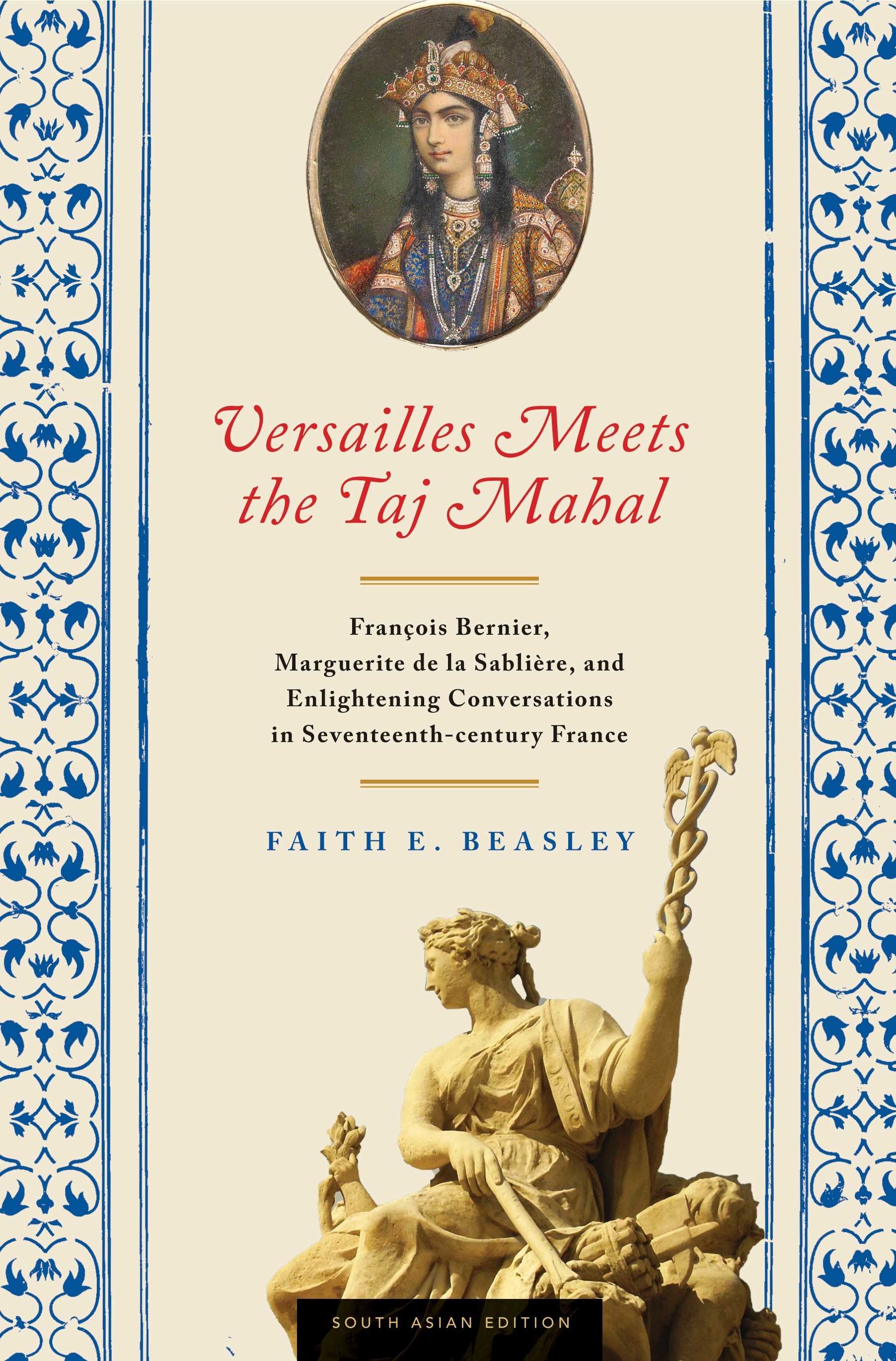
‘In Versailles Meets the Taj Mahal’, the author provides a richly textured analysis of France's seventeenth-century cultural imagination and its multilayered engagement with India. Drawing from literary texts, visual art, and historical correspondence, the book reconstructs a forgotten intellectual history-one shaped not only by merchants and monarchs but by salon conversations, female letter writers, and philosophical travellers.
It is a work that challenges the terms of the conventional narrative of East-West encounters by foregrounding the voices and spaces often relegated to the margins of historical discourse.
The journey begins in 1932 when the Chamber of Commerce and Industry of Morbihan, Brittany commissioned a mural from the local artist Pierre Cadre for its offices in Lorient. The result was a forty-square-metre painting entitled Madame de Sévigné débarquant à Lorient showing the celebrated seventeenth-century letter writer arriving at the bustling port of Lorient.
The painting is a feast for the eyes: Sévigné steps off her barge amidst sailing ships, courtiers, foreign merchants, exotic birds and tropical fruits. The scene vividly summons up the drama of an encounter between Ancien Régime France and the products and people of “les Indes.” The starting point for Cadre had been a letter written by Sévigné in August 1689, describing her arrival in Lorient and her meeting with Claude Céberet du Boullay, head of the revived French East India Company. The grand and theatrical painting rests on a foundation of historical detail, challenging viewers to reconsider the nature of France’s engagement with the East.
This is not an isolated artefact. The book traces similar resonances in the literary texts of Sévigné and her close friend, Marie-Madeleine Pioche de La Vergne, comtesse de Lafayette. In La Princesse de Clèves, Lafayette includes a suggestive scene in which the protagonist winds ribbons around a “canne des Indes fort extraordinaire” while gazing at a portrait of her beloved. The cane, more often viewed through Freudian lenses, is rarely interrogated for its origins. Why an Indian cane? What does its presence signify in a moment of introspection and desire? Such questions propel the book’s inquiry into the deeper cultural meanings of India in France’s Grand Siècle.
As is persuasively argued, these textual and visual traces point to a more profound engagement with India than has hitherto been acknowledged. Sévigné's letters mention indiennes, painted cottons from India, while Lafayette's novel and La Fontaine's Fables confirm an interest in Indian aesthetics and philosophy. In the preface to his second volume of Fables, published in 1678, La Fontaine explicitly acknowledges his indebtedness to the Indian sage Pilpay, making the perceptive comment that Pilpay's work predates Aesop and has been translated into many languages.
This shift in inspiration marks a significant moment in French literary history as India becomes a lens through which new moral and philosophical ideas are explored.
‘In Versailles Meets the Taj Mahal’ (Sanctum Books) places these literary encounters within the larger context of salon culture, particularly in the seventeenth-century ruelles of France. The salons, hosted largely by women, were intellectual spaces that paralleled the male-dominated academies. One such salon, hosted by Marguerite de La Sablière, emerges as a central site in the book's narrative. On rue Neuve des Petits-Champs, La Sablière's salon brought together figures like La Fontaine, Lafayette, Sévigné, and the philosopher-traveller François Bernier. It was here, in the late 1670s, that conversations about India flowered-fueled by Bernier's first-hand experiences, as well as the literary output of his companions.
Bernier, known as “le Mogol” by his contemporaries, spent nearly a decade in India. Unlike merchants or diplomats, he travelled purely out of intellectual curiosity. Arriving in Surat in 1658, he witnessed the succession war between Dara Shikoh and Aurangzeb.
After Dara’s defeat, Bernier became a court physician to Aurangzeb and later served Daneshmend Khan, the Mughal Empire’s foreign affairs secretary. Bernier’s role extended beyond medicine; he introduced European scientific ideas to the Mughal court and learned about Indian civilization in return. His travels took him across the subcontinent—from Kashmir to Golconda—and his writings became foundational texts for European understanding of Mughal India.
Upon his return to France in 1669, Bernier joined La Sablière's salon and published a spate of works that framed the French imaginary of India. His Histoire de la dernière révolution des états du Grand Mogol narrated the Mughal succession crisis, while the works titled Les Evénements particuliers and Lettre de l’étendue de l’Hindoustan dealt with the life at the court and geography respectively. In 1671, he published Suite des Mémoires du Sieur Bernier sur l’empire du Grand Mogol, which comprised letters to noted intellectuals and a travelogue of his journey to Kashmir. These were among the most widely read and translated texts about India, establishing Bernier as a leading authority on the topic.
This book underlines the fact that Bernier's influence was not confined to his writings. His presence in La Sablière's salon infused Indian motifs and ideas into the works of Sévigné, Lafayette, and La Fontaine. The salon became a conduit for knowledge about India, merging travel narratives with philosophical inquiry and literary creativity.
This suggests a different kind of cultural exchange than the one imagined within the confines of French mercantile or orientalist interests. Instead, the cultural relationship between France and India appears as dynamic, intellectual, and driven by curiosity, conversation, and collaboration.
The book also contributes to the historiographical arguments on literary analysis and historical method. Inspired by Sanjay Subrahmanyam's critique of the "literary turn" in studies of East-West encounters, it argues for a balance between textual nuance and historical context.
Above all, there is the appeal for attention to language, production, and reception-a call to scholars to read texts in their original form and to consider the cultural space that allowed their creation. In terms of its methodology, the book mixes literary criticism with archival research; it is therefore a model for interdisciplinary scholarship.
The book concludes with a reflection upon the wider implications of France's seventeenth-century engagement with India: whether India was conflated with the Orient in French thought, or a discrete cultural entity; how France viewed India in a very different way from Britain because of sharp differences in intellectual and mercantile approaches. Arguably more important is its foregrounding of women and salon culture in the history of ideas, taking figures such as Sévigné, Lafayette, and La Sablière not merely as passive consumers but rather as active participants in the construction of France's cultural imaginary.
‘Versailles Meets the Taj Mahal’ is a compelling and meticulously researched work that reclaims a forgotten chapter in the history of cross-cultural exchange. It invites readers to reconsider the intellectual landscape of seventeenth-century France and its complex relationship with India. Through its rich tapestry of texts, images, and conversations, the book offers a new lens on the past—one that is as illuminating as it is provocative.
For scholars of literature, history, and cultural studies, it is an essential contribution to the study of global intellectual history.
Email:daanishinterview@gmail.com
The journey begins in 1932 when the Chamber of Commerce and Industry of Morbihan, Brittany commissioned a mural from the local artist Pierre Cadre for its offices in Lorient. The result was a forty-square-metre painting entitled Madame de Sévigné débarquant à Lorient showing the celebrated seventeenth-century letter writer arriving at the bustling port of Lorient.
‘In Versailles Meets the Taj Mahal’, the author provides a richly textured analysis of France's seventeenth-century cultural imagination and its multilayered engagement with India. Drawing from literary texts, visual art, and historical correspondence, the book reconstructs a forgotten intellectual history-one shaped not only by merchants and monarchs but by salon conversations, female letter writers, and philosophical travellers.
It is a work that challenges the terms of the conventional narrative of East-West encounters by foregrounding the voices and spaces often relegated to the margins of historical discourse.
The journey begins in 1932 when the Chamber of Commerce and Industry of Morbihan, Brittany commissioned a mural from the local artist Pierre Cadre for its offices in Lorient. The result was a forty-square-metre painting entitled Madame de Sévigné débarquant à Lorient showing the celebrated seventeenth-century letter writer arriving at the bustling port of Lorient.
The painting is a feast for the eyes: Sévigné steps off her barge amidst sailing ships, courtiers, foreign merchants, exotic birds and tropical fruits. The scene vividly summons up the drama of an encounter between Ancien Régime France and the products and people of “les Indes.” The starting point for Cadre had been a letter written by Sévigné in August 1689, describing her arrival in Lorient and her meeting with Claude Céberet du Boullay, head of the revived French East India Company. The grand and theatrical painting rests on a foundation of historical detail, challenging viewers to reconsider the nature of France’s engagement with the East.
This is not an isolated artefact. The book traces similar resonances in the literary texts of Sévigné and her close friend, Marie-Madeleine Pioche de La Vergne, comtesse de Lafayette. In La Princesse de Clèves, Lafayette includes a suggestive scene in which the protagonist winds ribbons around a “canne des Indes fort extraordinaire” while gazing at a portrait of her beloved. The cane, more often viewed through Freudian lenses, is rarely interrogated for its origins. Why an Indian cane? What does its presence signify in a moment of introspection and desire? Such questions propel the book’s inquiry into the deeper cultural meanings of India in France’s Grand Siècle.
As is persuasively argued, these textual and visual traces point to a more profound engagement with India than has hitherto been acknowledged. Sévigné's letters mention indiennes, painted cottons from India, while Lafayette's novel and La Fontaine's Fables confirm an interest in Indian aesthetics and philosophy. In the preface to his second volume of Fables, published in 1678, La Fontaine explicitly acknowledges his indebtedness to the Indian sage Pilpay, making the perceptive comment that Pilpay's work predates Aesop and has been translated into many languages.
This shift in inspiration marks a significant moment in French literary history as India becomes a lens through which new moral and philosophical ideas are explored.
‘In Versailles Meets the Taj Mahal’ (Sanctum Books) places these literary encounters within the larger context of salon culture, particularly in the seventeenth-century ruelles of France. The salons, hosted largely by women, were intellectual spaces that paralleled the male-dominated academies. One such salon, hosted by Marguerite de La Sablière, emerges as a central site in the book's narrative. On rue Neuve des Petits-Champs, La Sablière's salon brought together figures like La Fontaine, Lafayette, Sévigné, and the philosopher-traveller François Bernier. It was here, in the late 1670s, that conversations about India flowered-fueled by Bernier's first-hand experiences, as well as the literary output of his companions.
Bernier, known as “le Mogol” by his contemporaries, spent nearly a decade in India. Unlike merchants or diplomats, he travelled purely out of intellectual curiosity. Arriving in Surat in 1658, he witnessed the succession war between Dara Shikoh and Aurangzeb.
After Dara’s defeat, Bernier became a court physician to Aurangzeb and later served Daneshmend Khan, the Mughal Empire’s foreign affairs secretary. Bernier’s role extended beyond medicine; he introduced European scientific ideas to the Mughal court and learned about Indian civilization in return. His travels took him across the subcontinent—from Kashmir to Golconda—and his writings became foundational texts for European understanding of Mughal India.
Upon his return to France in 1669, Bernier joined La Sablière's salon and published a spate of works that framed the French imaginary of India. His Histoire de la dernière révolution des états du Grand Mogol narrated the Mughal succession crisis, while the works titled Les Evénements particuliers and Lettre de l’étendue de l’Hindoustan dealt with the life at the court and geography respectively. In 1671, he published Suite des Mémoires du Sieur Bernier sur l’empire du Grand Mogol, which comprised letters to noted intellectuals and a travelogue of his journey to Kashmir. These were among the most widely read and translated texts about India, establishing Bernier as a leading authority on the topic.
This book underlines the fact that Bernier's influence was not confined to his writings. His presence in La Sablière's salon infused Indian motifs and ideas into the works of Sévigné, Lafayette, and La Fontaine. The salon became a conduit for knowledge about India, merging travel narratives with philosophical inquiry and literary creativity.
This suggests a different kind of cultural exchange than the one imagined within the confines of French mercantile or orientalist interests. Instead, the cultural relationship between France and India appears as dynamic, intellectual, and driven by curiosity, conversation, and collaboration.
The book also contributes to the historiographical arguments on literary analysis and historical method. Inspired by Sanjay Subrahmanyam's critique of the "literary turn" in studies of East-West encounters, it argues for a balance between textual nuance and historical context.
Above all, there is the appeal for attention to language, production, and reception-a call to scholars to read texts in their original form and to consider the cultural space that allowed their creation. In terms of its methodology, the book mixes literary criticism with archival research; it is therefore a model for interdisciplinary scholarship.
The book concludes with a reflection upon the wider implications of France's seventeenth-century engagement with India: whether India was conflated with the Orient in French thought, or a discrete cultural entity; how France viewed India in a very different way from Britain because of sharp differences in intellectual and mercantile approaches. Arguably more important is its foregrounding of women and salon culture in the history of ideas, taking figures such as Sévigné, Lafayette, and La Sablière not merely as passive consumers but rather as active participants in the construction of France's cultural imaginary.
‘Versailles Meets the Taj Mahal’ is a compelling and meticulously researched work that reclaims a forgotten chapter in the history of cross-cultural exchange. It invites readers to reconsider the intellectual landscape of seventeenth-century France and its complex relationship with India. Through its rich tapestry of texts, images, and conversations, the book offers a new lens on the past—one that is as illuminating as it is provocative.
For scholars of literature, history, and cultural studies, it is an essential contribution to the study of global intellectual history.
Email:daanishinterview@gmail.com

© Copyright 2023 brighterkashmir.com All Rights Reserved. Quantum Technologies