
BREAKING NEWS
Srinagar, Aug 14: With 4.61 lakh artisans and weavers registered and handicraft exports reaching ₹817.39 crore in 2025-26, Jammu and Kashmir is strengthening infrastructure, quality certification, credit access and market linkages to give its traditional crafts a stronger domestic and global presence.
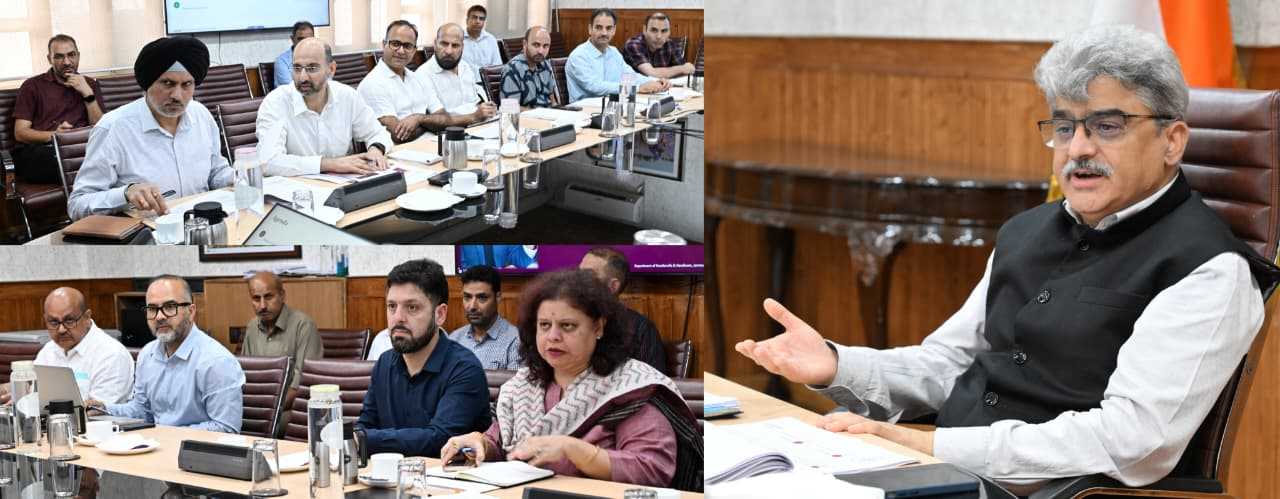
Chief Secretary Atal Dulloo reviewed the ongoing initiatives at a meeting attended by senior officials of the Industries & Commerce and Handicrafts & Handloom departments, besides representatives of NIFT Srinagar, Craft Development Institute and Indian Institute of Carpet Technology.
Dulloo directed officials to expedite ongoing projects, with particular focus on craft villages, Common Facility Centres, laboratories, wool-processing facilities, quality testing and GI certification.
He called for vocational and skill-oriented diploma and certificate courses at NIFT Srinagar to create new opportunities for youth and help preserve traditional and declining crafts.
Emphasising the importance of authenticity, the Chief Secretary directed the department to strengthen traceability of GI-tagged products. He also suggested using IoT-based technology to assess the time and effort invested in individual products so that artisans receive remuneration commensurate with their skill and labour.
Commissioner Secretary Industries & Commerce Vikramjit Singh said handicraft exports stood at ₹817.39 crore during FY 2025-26, while ₹73.85 crore had already been recorded in the first quarter of the current financial year.
The number of registered artisans and weavers has risen to 4,61,381, with another 13,264 registered during the current year.
Under the Artisans/Weavers Credit Card Scheme, beneficiaries can avail credit support of up to ₹2 lakh with 7 per cent interest subvention for five years. So far this year, 2,750 cases have been sponsored and ₹8.69 crore disbursed.
J&K now has 63 GI-registered crafts, comprising 39 from Kashmir and 24 from Jammu. As many as 97,178 GI labels have been issued, including 14,714 during the current financial year. The Indian Institute of Carpet Technology has also GI-tagged and QR-labelled 22,500 carpets, strengthening product authentication and traceability.
Infrastructure projects are also progressing. The Sonpah Craft Village in Budgam has received ₹4.5 crore as the first tranche of its ₹10-crore project cost, while three Common Facility Centres for bamboo diversification and agarbatti manufacturing have been completed in Jammu division.
The upgraded Pashmina Testing & Quality Certification Centre has nearly tripled its testing capacity, now processing around 120–140 tests daily.
To expand market access, 1,871 artisans and weavers have been onboarded onto ONDC. The government is also advancing plans for the PM Ekta Mall at Jammu and the PM Unity Mall at Kashmir Haat, Srinagar, aimed at providing dedicated platforms for local handicrafts and handlooms.
Dulloo stressed that infrastructure, GI protection, affordable credit, skill development and digital market access must ultimately translate into higher and sustainable incomes for artisans while preserving J&K’s rich craft heritage.
Srinagar, Aug 14: With 4.61 lakh artisans and weavers registered and handicraft exports reaching ₹817.39 crore in 2025-26, Jammu and Kashmir is strengthening infrastructure, quality certification, credit access and market linkages to give its traditional crafts a stronger domestic and global presence.
Chief Secretary Atal Dulloo reviewed the ongoing initiatives at a meeting attended by senior officials of the Industries & Commerce and Handicrafts & Handloom departments, besides representatives of NIFT Srinagar, Craft Development Institute and Indian Institute of Carpet Technology.
Dulloo directed officials to expedite ongoing projects, with particular focus on craft villages, Common Facility Centres, laboratories, wool-processing facilities, quality testing and GI certification.
He called for vocational and skill-oriented diploma and certificate courses at NIFT Srinagar to create new opportunities for youth and help preserve traditional and declining crafts.
Emphasising the importance of authenticity, the Chief Secretary directed the department to strengthen traceability of GI-tagged products. He also suggested using IoT-based technology to assess the time and effort invested in individual products so that artisans receive remuneration commensurate with their skill and labour.
Commissioner Secretary Industries & Commerce Vikramjit Singh said handicraft exports stood at ₹817.39 crore during FY 2025-26, while ₹73.85 crore had already been recorded in the first quarter of the current financial year.
The number of registered artisans and weavers has risen to 4,61,381, with another 13,264 registered during the current year.
Under the Artisans/Weavers Credit Card Scheme, beneficiaries can avail credit support of up to ₹2 lakh with 7 per cent interest subvention for five years. So far this year, 2,750 cases have been sponsored and ₹8.69 crore disbursed.
J&K now has 63 GI-registered crafts, comprising 39 from Kashmir and 24 from Jammu. As many as 97,178 GI labels have been issued, including 14,714 during the current financial year. The Indian Institute of Carpet Technology has also GI-tagged and QR-labelled 22,500 carpets, strengthening product authentication and traceability.
Infrastructure projects are also progressing. The Sonpah Craft Village in Budgam has received ₹4.5 crore as the first tranche of its ₹10-crore project cost, while three Common Facility Centres for bamboo diversification and agarbatti manufacturing have been completed in Jammu division.
The upgraded Pashmina Testing & Quality Certification Centre has nearly tripled its testing capacity, now processing around 120–140 tests daily.
To expand market access, 1,871 artisans and weavers have been onboarded onto ONDC. The government is also advancing plans for the PM Ekta Mall at Jammu and the PM Unity Mall at Kashmir Haat, Srinagar, aimed at providing dedicated platforms for local handicrafts and handlooms.
Dulloo stressed that infrastructure, GI protection, affordable credit, skill development and digital market access must ultimately translate into higher and sustainable incomes for artisans while preserving J&K’s rich craft heritage.

© Copyright 2023 brighterkashmir.com All Rights Reserved. Quantum Technologies