
BREAKING NEWS
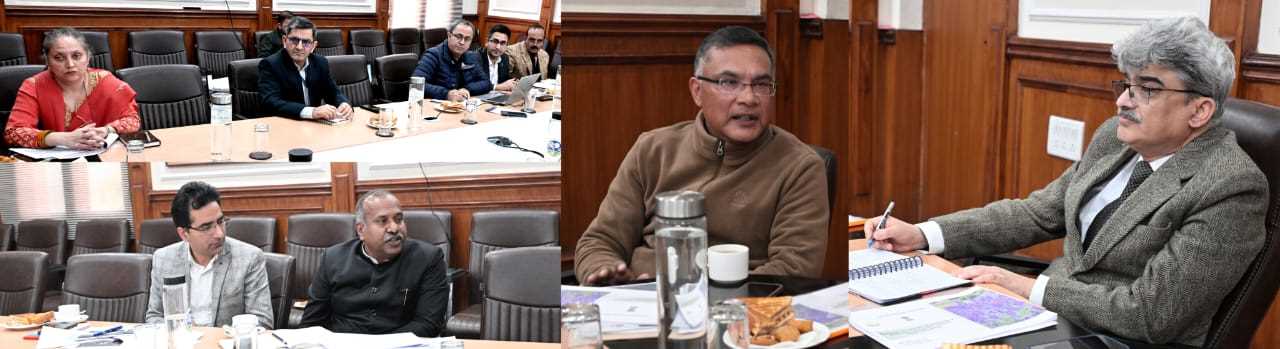
Chief Secretary Atal Dulloo chaired a joint meeting with the Forest and Agriculture Production Departments and CSIR–IIIM Jammu to chart a comprehensive roadmap for large-scale commercial cultivation and conservation of medicinal and aromatic plants (MAPs) in Jammu and Kashmir.
Highlighting the region’s vast potential, the Chief Secretary noted that J&K currently generates only ₹12 crore annually from the MAP sector, despite an estimated national potential of ₹10,000 crore and a global market of nearly ₹2 lakh crore. He called for a structured, scientific and commercially driven strategy to boost farmer incomes and build a sustainable MAP economy.
Dulloo assigned clear responsibilities: the Forest Department will strengthen propagation through nurseries, train farmers and develop replicable models; the Agriculture Production Department will identify high-value species, conduct agro-climatic zonation, develop cultivation protocols, enhance extension services, and ensure market integration. CSIR-IIIM and SKUAST will provide technical expertise, technology transfer, and support R&D through Centres of Excellence and germplasm banks.
Additional Chief Secretary Shailendra Kumar stressed creating a long-term, self-sustaining MAP ecosystem with initial government support. Forest Commissioner Secretary Sheetal Nanda assured farmer-friendly regulations and quality planting material from Forest Department nurseries.
HADP Managing Director Sandeep Kumar reported the establishment of 28 MAP clusters involving 1,400 farmers and training of over 5,300 individuals. Key crops under cultivation include Lavender, Harad, Wild Marigold and Rosemary, with high-demand species priced between ₹100 and ₹1,00,000 per kg.
CSIR-IIIM Director Dr. Zabeer Ahmad underscored the region’s rich biodiversity—over 1,100 native MAP species—and the global market expected to exceed USD 650 billion by 2030. He highlighted IIIM’s work on phytopharmaceuticals, nutraceuticals, MAP varieties and germplasm conservation, envisioning J&K as a major MAP-driven bio-economy hub.
Key strategies discussed included land zonation using degraded forest areas, developing aroma and phyto-pharma clusters across Jammu, Kashmir and the Chenab Valley, and strengthening community–industry partnerships. Amendments to the J&K Minor Forest Produce Policy-2022 were also proposed to boost farmer participation, species identification, niche cultivation and market linkages.
Chief Secretary Atal Dulloo chaired a joint meeting with the Forest and Agriculture Production Departments and CSIR–IIIM Jammu to chart a comprehensive roadmap for large-scale commercial cultivation and conservation of medicinal and aromatic plants (MAPs) in Jammu and Kashmir.
Highlighting the region’s vast potential, the Chief Secretary noted that J&K currently generates only ₹12 crore annually from the MAP sector, despite an estimated national potential of ₹10,000 crore and a global market of nearly ₹2 lakh crore. He called for a structured, scientific and commercially driven strategy to boost farmer incomes and build a sustainable MAP economy.
Dulloo assigned clear responsibilities: the Forest Department will strengthen propagation through nurseries, train farmers and develop replicable models; the Agriculture Production Department will identify high-value species, conduct agro-climatic zonation, develop cultivation protocols, enhance extension services, and ensure market integration. CSIR-IIIM and SKUAST will provide technical expertise, technology transfer, and support R&D through Centres of Excellence and germplasm banks.
Additional Chief Secretary Shailendra Kumar stressed creating a long-term, self-sustaining MAP ecosystem with initial government support. Forest Commissioner Secretary Sheetal Nanda assured farmer-friendly regulations and quality planting material from Forest Department nurseries.
HADP Managing Director Sandeep Kumar reported the establishment of 28 MAP clusters involving 1,400 farmers and training of over 5,300 individuals. Key crops under cultivation include Lavender, Harad, Wild Marigold and Rosemary, with high-demand species priced between ₹100 and ₹1,00,000 per kg.
CSIR-IIIM Director Dr. Zabeer Ahmad underscored the region’s rich biodiversity—over 1,100 native MAP species—and the global market expected to exceed USD 650 billion by 2030. He highlighted IIIM’s work on phytopharmaceuticals, nutraceuticals, MAP varieties and germplasm conservation, envisioning J&K as a major MAP-driven bio-economy hub.
Key strategies discussed included land zonation using degraded forest areas, developing aroma and phyto-pharma clusters across Jammu, Kashmir and the Chenab Valley, and strengthening community–industry partnerships. Amendments to the J&K Minor Forest Produce Policy-2022 were also proposed to boost farmer participation, species identification, niche cultivation and market linkages.

© Copyright 2023 brighterkashmir.com All Rights Reserved. Quantum Technologies