
BREAKING NEWS
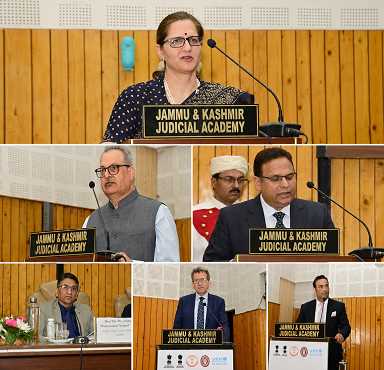
Srinagar, Sep 5: The Juvenile Justice Committee of the High Court of Jammu & Kashmir and Ladakh, in collaboration with UNICEF India, organised a one-day annual consultation at the J&K Judicial Academy, Mominabad, Srinagar, to review a decade of implementation of the Juvenile Justice (Care and Protection of Children) Act, 2015, and chart the way forward.
The consultation brought together High Court Judges, judicial officers, Principal Magistrates of Juvenile Justice Boards (JJBs), Chairpersons of Child Welfare Committees (CWCs), Special Juvenile Police Units, senior government officials, Legal Services Authorities, child-protection professionals, mental-health experts, civil society and academia. Participants from Jammu and Ladakh also joined virtually.
Justice Sindhu Sharma, Judge of the High Court and Chairperson of the Juvenile Justice Committee, stressed that a child in conflict with law remains, first and foremost, a child. She said the juvenile justice system must remain rooted in fairness, rehabilitation and the developmental needs of children.
Justice Sharma said the first decade had focused largely on creating the institutional framework, while the next decade must ensure that these institutions deliver meaningful, child-centred outcomes. She called for adequate resources, trained personnel, effective data systems and greater accountability.
Justice Mohd. Akram Chowdhary, Member of the Juvenile Justice Committee, said completion of ten years of the Act provided an opportunity to objectively assess its implementation. He emphasised that the success of the system must ultimately be measured by its impact on children and called for stronger infrastructure, continuous capacity building, financial support and better inter-departmental coordination.
Justice Wasim Sadiq Nargal highlighted the need for a multidisciplinary approach to juvenile justice. He stressed addressing implementation gaps, protecting the confidentiality of juvenile records and strengthening the functioning of JJBs and CWCs. He also underlined the need for child-centric adoption, trained personnel and adequate institutional support.
Jesper Moller, Deputy Representative (Programme), UNICEF India Country Office, described the completion of a decade under the Act as an important milestone. He highlighted progress in prevention, family-based care, Child-Friendly Spaces, Adolescent Resource Centres and strengthening of Child Care Institutions, besides training more than 9,000 frontline workers. He identified prevention, family-based care, coordination, accountability and disability inclusion as key priorities for the coming decade.
Earlier, Naseer Ahmed Dar, Director, J&K Judicial Academy and Ex-Officio Member Secretary of the Juvenile Justice Committee, welcomed participants and said child protection was a shared responsibility requiring coordinated institutional action. He called for practical recommendations to shape the 2026–27 Action Plan.
The consultation featured four thematic sessions covering implementation of the JJ Act, rights of children in need of care and protection, preliminary assessment in heinous offences involving juveniles, and adoption as a pathway to permanency.
The sessions examined issues including mental-health and psychosocial support, legal aid, witness protection, rehabilitation, family-based care, aftercare, age determination, expert assistance, confidentiality of records and coordination among JJBs, CWCs, District Child Protection Units, Special Juvenile Police Units and District Magistrates.
The session on heinous offences also examined preliminary assessment under Section 15 of the JJ Act, including psycho-social factors and the circumstances in which a juvenile may be considered for transfer to the adult justice system.
The final session on adoption focused on timely case management, monitoring and coordination among CWCs, District Child Protection Units, Specialised Adoption Agencies and District Magistrates, with the long-term welfare of the child at the centre.
During the valedictory session, UNICEF India presented key action points and takeaways for incorporation into the 2026–27 Action Plan. The consultation concluded with a renewed emphasis on strengthening the juvenile justice and child-protection system while ensuring dignity, safety, rehabilitation and hope for every vulnerable child.
Srinagar, Sep 5: The Juvenile Justice Committee of the High Court of Jammu & Kashmir and Ladakh, in collaboration with UNICEF India, organised a one-day annual consultation at the J&K Judicial Academy, Mominabad, Srinagar, to review a decade of implementation of the Juvenile Justice (Care and Protection of Children) Act, 2015, and chart the way forward.
The consultation brought together High Court Judges, judicial officers, Principal Magistrates of Juvenile Justice Boards (JJBs), Chairpersons of Child Welfare Committees (CWCs), Special Juvenile Police Units, senior government officials, Legal Services Authorities, child-protection professionals, mental-health experts, civil society and academia. Participants from Jammu and Ladakh also joined virtually.
Justice Sindhu Sharma, Judge of the High Court and Chairperson of the Juvenile Justice Committee, stressed that a child in conflict with law remains, first and foremost, a child. She said the juvenile justice system must remain rooted in fairness, rehabilitation and the developmental needs of children.
Justice Sharma said the first decade had focused largely on creating the institutional framework, while the next decade must ensure that these institutions deliver meaningful, child-centred outcomes. She called for adequate resources, trained personnel, effective data systems and greater accountability.
Justice Mohd. Akram Chowdhary, Member of the Juvenile Justice Committee, said completion of ten years of the Act provided an opportunity to objectively assess its implementation. He emphasised that the success of the system must ultimately be measured by its impact on children and called for stronger infrastructure, continuous capacity building, financial support and better inter-departmental coordination.
Justice Wasim Sadiq Nargal highlighted the need for a multidisciplinary approach to juvenile justice. He stressed addressing implementation gaps, protecting the confidentiality of juvenile records and strengthening the functioning of JJBs and CWCs. He also underlined the need for child-centric adoption, trained personnel and adequate institutional support.
Jesper Moller, Deputy Representative (Programme), UNICEF India Country Office, described the completion of a decade under the Act as an important milestone. He highlighted progress in prevention, family-based care, Child-Friendly Spaces, Adolescent Resource Centres and strengthening of Child Care Institutions, besides training more than 9,000 frontline workers. He identified prevention, family-based care, coordination, accountability and disability inclusion as key priorities for the coming decade.
Earlier, Naseer Ahmed Dar, Director, J&K Judicial Academy and Ex-Officio Member Secretary of the Juvenile Justice Committee, welcomed participants and said child protection was a shared responsibility requiring coordinated institutional action. He called for practical recommendations to shape the 2026–27 Action Plan.
The consultation featured four thematic sessions covering implementation of the JJ Act, rights of children in need of care and protection, preliminary assessment in heinous offences involving juveniles, and adoption as a pathway to permanency.
The sessions examined issues including mental-health and psychosocial support, legal aid, witness protection, rehabilitation, family-based care, aftercare, age determination, expert assistance, confidentiality of records and coordination among JJBs, CWCs, District Child Protection Units, Special Juvenile Police Units and District Magistrates.
The session on heinous offences also examined preliminary assessment under Section 15 of the JJ Act, including psycho-social factors and the circumstances in which a juvenile may be considered for transfer to the adult justice system.
The final session on adoption focused on timely case management, monitoring and coordination among CWCs, District Child Protection Units, Specialised Adoption Agencies and District Magistrates, with the long-term welfare of the child at the centre.
During the valedictory session, UNICEF India presented key action points and takeaways for incorporation into the 2026–27 Action Plan. The consultation concluded with a renewed emphasis on strengthening the juvenile justice and child-protection system while ensuring dignity, safety, rehabilitation and hope for every vulnerable child.

© Copyright 2023 brighterkashmir.com All Rights Reserved. Quantum Technologies