
BREAKING NEWS
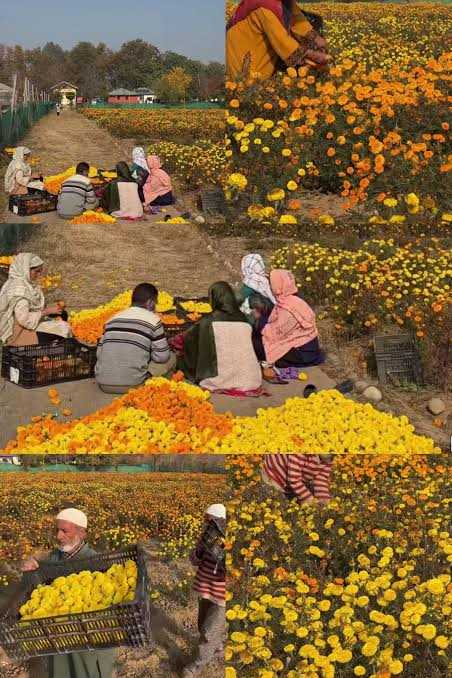
Srinagar, Nov 7: Kashmir could be on the threshold of a new floriculture opportunity, with scientists exploring the region’s potential to emerge as a major supplier of marigold flowers during periods when their availability is limited in other parts of the country.
The CSIR-Indian Institute of Integrative Medicine (CSIR-IIIM), Jammu, is examining the feasibility of introducing and expanding seasonal marigold cultivation in Kashmir. The initiative aims to identify varieties suited to the Valley’s climatic conditions, promote scientific farming practices and connect local growers with markets within Jammu and Kashmir as well as outside the Union Territory.
The idea holds considerable promise for an agricultural economy that has traditionally depended on apple cultivation, saffron, paddy and other conventional crops. By adding commercial floriculture to the farming basket, Kashmir could create another source of income for rural households while making better use of its diverse agro-climatic conditions.
Marigolds enjoy substantial demand across India, particularly during religious ceremonies, festivals, weddings and other social functions. Their bright colours and relatively easy cultivation make them among the most widely used flowers in the country. However, demand and supply fluctuate with seasons, creating opportunities for regions capable of producing flowers when supplies from major growing areas are limited.
Kashmir’s climatic conditions may offer an advantage in this regard. If suitable varieties can be developed and cultivation cycles scientifically regulated, growers could potentially target market windows when marigold availability is relatively low elsewhere.
Dr Zabeer Ahmed, Director of CSIR-IIIM Jammu and CSIR-NBRI Lucknow, has stressed the importance of introducing promising crop varieties and adopting scientific cultivation methods to improve farmers’ earnings, promote entrepreneurship and strengthen the agricultural economy.
Dr Shahid Rasool, Scientist-in-Charge at CSIR-IIIM’s Field Station Bonera in Pulwama, said the institute was assessing the potential of meeting the demand for marigolds in Jammu and Kashmir and other parts of the country. Research is underway to identify and develop varieties capable of performing well under local weather conditions.
The institute also plans to build farmers’ capacity through training and technical guidance and explore ways of integrating floriculture into existing agricultural practices. Such an approach could allow farmers to diversify their income without abandoning traditional crops.
The prospects are not entirely untested in Jammu and Kashmir. Marigold cultivation has already emerged as a source of livelihood in parts of the Chenab Valley. In Doda district, farmers, including women associated with Self-Help Groups, have taken up commercial flower cultivation with support from CSIR-IIIM and the Floriculture Mission. Growers in the Bhaderwah region have also demonstrated that marigold can provide an alternative to conventional maize cultivation.
These experiences offer useful lessons for expanding the activity in Kashmir. However, turning the Valley into a dependable off-season marigold supplier will require more than the identification of suitable varieties. Farmers will need access to quality seeds and planting material, technical assistance, irrigation facilities, post-harvest management, transport and organised marketing channels.
Market linkages will be particularly important. Flowers are perishable commodities, and delays in transportation or the absence of reliable buyers can quickly erode farmers’ returns. Developing collection centres, aggregation facilities and partnerships with wholesale flower markets could help growers secure better prices and reduce wastage.
Agricultural experts have also underlined the need for feasibility studies comparing marigold cultivation with other potential seasonal crops and intercrops, including lavender, saffron, mustard, garlic, onion and cumin. Crop selection must take into account soil health, water availability, local demand and the actual returns farmers can earn.
For Kashmir, the proposed initiative represents an opportunity to broaden the rural economy and create avenues for small farmers, women and young entrepreneurs. If backed by sustained research, field demonstrations, institutional support and assured markets, marigold cultivation could develop into a commercially viable floriculture sector.
The larger challenge is to transform scientific possibilities into practical gains for farmers. With the right planning and market support, Kashmir’s fields may one day supply marigolds to markets across India during the very months when other regions struggle to meet demand.

© Copyright 2023 brighterkashmir.com All Rights Reserved. Quantum Technologies