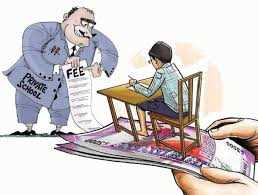
For thousands of economically weaker families in Kashmir, education has turned into a relentless struggle, as private school institutes continue to impose hefty annual fees despite providing minimal or virtually no facilities. Parents allege that schools lacking basic infrastructure are demanding annual charges ranging from Rs 5,000 to even higher, leaving families with shrinking incomes under severe financial strain.
Many parents said they are being forced to withdraw their children from private institutions simply because they can no longer afford the escalating fees. Ironically, several such children are being admitted to government schools, where teachers draw comparatively high salaries but, according to parents, fail to deliver quality education. “We are trapped between expensive private schools and ineffective government schools,” said a parent from Srinagar, expressing anguish over his child’s uncertain future.
The situation has raised serious questions about the functioning of regulatory bodies. The Fee Fixation Committee, meant to regulate school charges and protect parents from exploitation, is accused of existing only on paper. Parents allege that its role has been limited to issuing circulars, with little or no impact on the ground.
Similar criticism has been directed at the Education Department, which parents say has failed to intervene meaningfully despite repeated complaints. Locals point out that officials, who themselves draw substantial salaries from the public exchequer, appear more focused on documentation than on enforcing regulations or providing relief to distressed families.
The Jammu and Kashmir Board of School Education, which claims to have directed private schools to prescribe only government-approved textbooks, has also come under scrutiny. Parents allege that many private schools continue to sell private publications at inflated prices, openly defying official instructions.
“Believe it or not, after paying Rs 5,000 annual fee for my class 7th child, I purchased a book “A parent, while castigating the tall claims made by BOSE, said he was forced to purchase the book Deen-e-Islam for Rs 290 from a shop located just outside the school and run by the same institution. The book, he added, is a private publication recommended by the school despite BOSE’s directions to prescribe only government books.”
“When informed that BOSE has directed private schools to prescribe only government-issued textbooks, the book seller said that BOSE provides merely two or three books, while parents purchase the remaining textbooks from private publications.”
Parents say the cumulative effect of regulatory failure, official inertia and unchecked commercialisation has pushed them into despair. Even the elected government has failed to translate assurances into action, reinforcing perceptions of a collapsed education governance system where corruption thrives and accountability remains elusive.

For thousands of economically weaker families in Kashmir, education has turned into a relentless struggle, as private school institutes continue to impose hefty annual fees despite providing minimal or virtually no facilities. Parents allege that schools lacking basic infrastructure are demanding annual charges ranging from Rs 5,000 to even higher, leaving families with shrinking incomes under severe financial strain.
Many parents said they are being forced to withdraw their children from private institutions simply because they can no longer afford the escalating fees. Ironically, several such children are being admitted to government schools, where teachers draw comparatively high salaries but, according to parents, fail to deliver quality education. “We are trapped between expensive private schools and ineffective government schools,” said a parent from Srinagar, expressing anguish over his child’s uncertain future.
The situation has raised serious questions about the functioning of regulatory bodies. The Fee Fixation Committee, meant to regulate school charges and protect parents from exploitation, is accused of existing only on paper. Parents allege that its role has been limited to issuing circulars, with little or no impact on the ground.
Similar criticism has been directed at the Education Department, which parents say has failed to intervene meaningfully despite repeated complaints. Locals point out that officials, who themselves draw substantial salaries from the public exchequer, appear more focused on documentation than on enforcing regulations or providing relief to distressed families.
The Jammu and Kashmir Board of School Education, which claims to have directed private schools to prescribe only government-approved textbooks, has also come under scrutiny. Parents allege that many private schools continue to sell private publications at inflated prices, openly defying official instructions.
“Believe it or not, after paying Rs 5,000 annual fee for my class 7th child, I purchased a book “A parent, while castigating the tall claims made by BOSE, said he was forced to purchase the book Deen-e-Islam for Rs 290 from a shop located just outside the school and run by the same institution. The book, he added, is a private publication recommended by the school despite BOSE’s directions to prescribe only government books.”
“When informed that BOSE has directed private schools to prescribe only government-issued textbooks, the book seller said that BOSE provides merely two or three books, while parents purchase the remaining textbooks from private publications.”
Parents say the cumulative effect of regulatory failure, official inertia and unchecked commercialisation has pushed them into despair. Even the elected government has failed to translate assurances into action, reinforcing perceptions of a collapsed education governance system where corruption thrives and accountability remains elusive.
© Copyright 2023 brighterkashmir.com All Rights Reserved. Quantum Technologies