
Children must be taught that public property deserves the same respect as private property. Schools should include civic behaviour and environmental ethics as practical lessons rather than theoretical subjects. Religious leaders should emphasise cleanliness, public responsibility and the moral obligation of not harming others through one’s actions. Local administrations must strictly penalise illegal road encroachments, waste dumping and environmental violations.
Kashmir has always been known for its breathtaking landscapes, deep cultural heritage and strong traditions of hospitality. For centuries the collective spirit of society formed the backbone of Kashmiri life. Villages survived harsh winters through cooperation, neighbours stood together in times of grief and communities shared responsibilities without waiting for the administration to intervene. Yet, beneath the visible beauty of the Valley an uncomfortable social reality is emerging the gradual disappearance of civic sense and collective responsibility.
Today one of the greatest challenges confronting Kashmiri society is not merely economic hardship, unemployment or political uncertainty but the growing culture of individualism and social indifference. A dangerous trend has taken root where personal convenience is being prioritised over public welfare. People demand clean surroundings within the boundaries of their homes while contributing to filth and disorder outside their gates. The idea that roads, streams, public paths and shared spaces belong equally to everyone is slowly fading away.
The problem is visible everywhere both in urban towns and rural villages. Roads that should remain open for public movement are turned into private storage spaces. Construction material is dumped for months without concern for commuters. Cow dung is stored on roadsides while people simultaneously complain about sanitation and government negligence. Drainage from kitchens and bathrooms is directly connected to streams and water bodies without even the slightest moral hesitation. The contradiction is glaring society questions the actions of others but rarely pauses for self-introspection.
One of the most visible examples of declining civic responsibility in Kashmir can be seen in the misuse of roads and public spaces. Across many towns and villages people install large modern gates in front of their houses often as symbols of status and prosperity. However when these gates are opened they remain extended outward onto roads, blocking traffic movement and creating unnecessary congestion. Vehicles passing through narrow lanes are forced to stop, reverse or wait simply because someone failed to ensure that their private gate did not interfere with public movement.
This may appear like a small issue but collectively it reflects a deeper mindset. It shows how personal convenience has begun to outweigh public discipline. Roads are not private property. Every obstruction created on a public road affects not one person but an entire community. In congested areas even a few minutes of blockage can delay ambulances, school transport, emergency services or ordinary citizens trying to reach workplaces and hospitals.
The same selfishness becomes more dangerous during emergencies. Across Kashmir, construction material such as sand, bricks, stones and iron rods is often dumped on roads for weeks and sometimes even months. Half the road space gets occupied, forcing vehicles into risky manoeuvres. In normal situations this creates inconvenience. During emergencies, it can become life-threatening.
Imagine a fire incident in a densely populated locality where fire service vehicles struggle to enter because roads are narrowed by illegally dumped material. Imagine an ambulance carrying a critically ill patient getting delayed because somebody used the public road as a private storage yard. In such situations negligence transforms into social irresponsibility. Unfortunately, many people fail to recognise this moral dimension of their actions.
Another deeply troubling issue is the environmental neglect visible across the Valley. Kashmir’s streams, springs and water bodies were once symbols of purity and ecological balance. Today, many of them are turning into channels of waste disposal.
Bathroom outlets, kitchen drainage and household waste water are frequently connected directly to natural streams without any treatment or filtration. What was once clean water supporting agriculture and daily life is increasingly becoming polluted.
This behaviour reflects a serious collapse in environmental ethics. People often raise slogans about protecting Kashmir’s natural beauty yet many contribute directly to its destruction through their daily habits. Civic sense does not begin with speeches or social media activism, it begins with individual conduct. A person who pollutes a stream while talking about environmental preservation is contradicting his own values.
The issue extends beyond environmental pollution and enters the realm of public health. Poor waste management and unhygienic practices contribute to the spread of diseases, foul smells and unhealthy living conditions. In many rural areas, sheds constructed for cattle and livestock are intentionally built facing public roads and pathways. Doors of these sheds remain open, exposing passersby to unbearable smells and unhygienic surroundings. Instead of considering how their actions affect others, many people simply normalise the inconvenience imposed on society.
This growing insensitivity towards shared public life reveals a larger social transformation. Kashmiri society which once revolved around collective values, is increasingly becoming self-centred. People focus on protecting and beautifying their own homes while neglecting the spaces outside their walls. Streets become dirty, drains remain clogged and public spaces deteriorate because everyone assumes that maintaining them is somebody else’s responsibility.
The crisis is not merely administrative, it is moral and cultural. Governments can construct roads, install drainage systems and enforce laws but they cannot create civic consciousness unless society itself values discipline and responsibility. Civic sense is ultimately a reflection of character. A society where people willingly inconvenience others for personal comfort gradually weakens its own social fabric.
One of the most alarming aspects of this decline is the absence of self-accountability. Kashmiris are often quick to criticise government departments, municipal bodies or neighbours for poor civic management. While criticism is sometimes justified. genuine reform cannot happen without self-introspection. Every citizen must ask difficult questions.
Am I contributing positively to my community?
Am I respecting public spaces?
Am I making life easier or harder for others?
Unfortunately, public morality today often functions selectively. People expect clean roads but dump waste irresponsibly. They expect smooth traffic movement but block roads with private vehicles or construction material. They demand efficient emergency response but fail to keep roads accessible. This contradiction lies at the heart of the civic crisis.
Another important factor contributing to this problem is the weakening of social correction mechanisms. In earlier times, communities informally discouraged irresponsible behaviour. Elders, neighbours and local social structures ensured that individuals remained conscious of public norms. Today, such corrections are often absent. People hesitate to question irresponsible behaviour either out of fear of confrontation or because social selfishness itself has become normalised.
Urbanisation has also intensified the issue. Rapid construction without proper planning, shrinking public spaces and rising population density have increased pressure on civic infrastructure. Yet instead of adapting responsibly, many people have responded by becoming more aggressive in protecting personal interests at the expense of collective welfare. Public roads become extensions of private property. Shared spaces become dumping grounds. Community interests become secondary.
The consequences of this civic decline are not only physical but psychological as well. When people continuously witness indiscipline, pollution and selfishness around them, frustration and distrust grow within society. Public cooperation weakens. Respect for rules diminishes further. Over time, disorder itself becomes socially accepted.
However, despite these concerns, change is still possible. Kashmir has historically shown resilience and the ability to rebuild itself during difficult times.
The revival of civic sense must begin at the grassroots level. Families, schools, mosques, educational institutions and local communities all have a role to play in restoring social responsibility.
Children must be taught that public property deserves the same respect as private property. Schools should include civic behaviour and environmental ethics as practical lessons rather than theoretical subjects. Religious leaders should emphasise cleanliness, public responsibility and the moral obligation of not harming others through one’s actions. Local administrations must strictly penalise illegal road encroachments, waste dumping and environmental violations.
Most importantly, society itself must rediscover the value of collective living. Development cannot be measured only through larger houses, expensive gates or modern vehicles. True development is reflected in disciplined behaviour, clean surroundings, respect for public spaces and consideration for others.
A society progresses not when individuals become richer alone but when communities become more responsible together. Kashmir’s future depends not only on infrastructure projects or government schemes but also on whether its people are willing to revive the culture of social responsibility that once defined the Valley.
The roads we block today may one day block help from reaching our own families. The polluted streams we ignore today may tomorrow poison the environment our children inherit. The indifference we show towards society today may eventually weaken the very social bonds that once protected us during difficult times.
Civic sense is not a luxury. It is the foundation of a healthy society. Kashmir urgently needs a cultural shift from selfish convenience towards collective responsibility. Without that transformation, no amount of development can create a truly civilised and harmonious society.
Email:--------------------------wanimudasirnazir@gmail.com

Children must be taught that public property deserves the same respect as private property. Schools should include civic behaviour and environmental ethics as practical lessons rather than theoretical subjects. Religious leaders should emphasise cleanliness, public responsibility and the moral obligation of not harming others through one’s actions. Local administrations must strictly penalise illegal road encroachments, waste dumping and environmental violations.
Kashmir has always been known for its breathtaking landscapes, deep cultural heritage and strong traditions of hospitality. For centuries the collective spirit of society formed the backbone of Kashmiri life. Villages survived harsh winters through cooperation, neighbours stood together in times of grief and communities shared responsibilities without waiting for the administration to intervene. Yet, beneath the visible beauty of the Valley an uncomfortable social reality is emerging the gradual disappearance of civic sense and collective responsibility.
Today one of the greatest challenges confronting Kashmiri society is not merely economic hardship, unemployment or political uncertainty but the growing culture of individualism and social indifference. A dangerous trend has taken root where personal convenience is being prioritised over public welfare. People demand clean surroundings within the boundaries of their homes while contributing to filth and disorder outside their gates. The idea that roads, streams, public paths and shared spaces belong equally to everyone is slowly fading away.
The problem is visible everywhere both in urban towns and rural villages. Roads that should remain open for public movement are turned into private storage spaces. Construction material is dumped for months without concern for commuters. Cow dung is stored on roadsides while people simultaneously complain about sanitation and government negligence. Drainage from kitchens and bathrooms is directly connected to streams and water bodies without even the slightest moral hesitation. The contradiction is glaring society questions the actions of others but rarely pauses for self-introspection.
One of the most visible examples of declining civic responsibility in Kashmir can be seen in the misuse of roads and public spaces. Across many towns and villages people install large modern gates in front of their houses often as symbols of status and prosperity. However when these gates are opened they remain extended outward onto roads, blocking traffic movement and creating unnecessary congestion. Vehicles passing through narrow lanes are forced to stop, reverse or wait simply because someone failed to ensure that their private gate did not interfere with public movement.
This may appear like a small issue but collectively it reflects a deeper mindset. It shows how personal convenience has begun to outweigh public discipline. Roads are not private property. Every obstruction created on a public road affects not one person but an entire community. In congested areas even a few minutes of blockage can delay ambulances, school transport, emergency services or ordinary citizens trying to reach workplaces and hospitals.
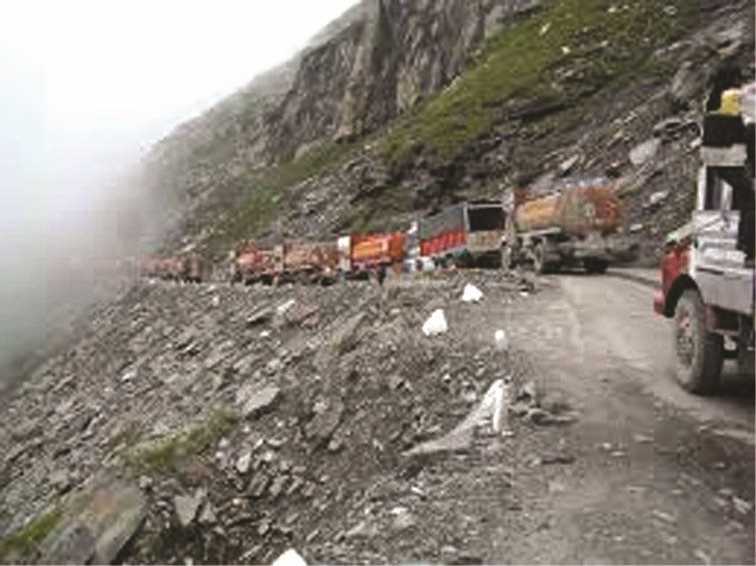
The same selfishness becomes more dangerous during emergencies. Across Kashmir, construction material such as sand, bricks, stones and iron rods is often dumped on roads for weeks and sometimes even months. Half the road space gets occupied, forcing vehicles into risky manoeuvres. In normal situations this creates inconvenience. During emergencies, it can become life-threatening.
Imagine a fire incident in a densely populated locality where fire service vehicles struggle to enter because roads are narrowed by illegally dumped material. Imagine an ambulance carrying a critically ill patient getting delayed because somebody used the public road as a private storage yard. In such situations negligence transforms into social irresponsibility. Unfortunately, many people fail to recognise this moral dimension of their actions.
Another deeply troubling issue is the environmental neglect visible across the Valley. Kashmir’s streams, springs and water bodies were once symbols of purity and ecological balance. Today, many of them are turning into channels of waste disposal.
Bathroom outlets, kitchen drainage and household waste water are frequently connected directly to natural streams without any treatment or filtration. What was once clean water supporting agriculture and daily life is increasingly becoming polluted.
This behaviour reflects a serious collapse in environmental ethics. People often raise slogans about protecting Kashmir’s natural beauty yet many contribute directly to its destruction through their daily habits. Civic sense does not begin with speeches or social media activism, it begins with individual conduct. A person who pollutes a stream while talking about environmental preservation is contradicting his own values.
The issue extends beyond environmental pollution and enters the realm of public health. Poor waste management and unhygienic practices contribute to the spread of diseases, foul smells and unhealthy living conditions. In many rural areas, sheds constructed for cattle and livestock are intentionally built facing public roads and pathways. Doors of these sheds remain open, exposing passersby to unbearable smells and unhygienic surroundings. Instead of considering how their actions affect others, many people simply normalise the inconvenience imposed on society.
This growing insensitivity towards shared public life reveals a larger social transformation. Kashmiri society which once revolved around collective values, is increasingly becoming self-centred. People focus on protecting and beautifying their own homes while neglecting the spaces outside their walls. Streets become dirty, drains remain clogged and public spaces deteriorate because everyone assumes that maintaining them is somebody else’s responsibility.
The crisis is not merely administrative, it is moral and cultural. Governments can construct roads, install drainage systems and enforce laws but they cannot create civic consciousness unless society itself values discipline and responsibility. Civic sense is ultimately a reflection of character. A society where people willingly inconvenience others for personal comfort gradually weakens its own social fabric.
One of the most alarming aspects of this decline is the absence of self-accountability. Kashmiris are often quick to criticise government departments, municipal bodies or neighbours for poor civic management. While criticism is sometimes justified. genuine reform cannot happen without self-introspection. Every citizen must ask difficult questions.
Am I contributing positively to my community?
Am I respecting public spaces?
Am I making life easier or harder for others?
Unfortunately, public morality today often functions selectively. People expect clean roads but dump waste irresponsibly. They expect smooth traffic movement but block roads with private vehicles or construction material. They demand efficient emergency response but fail to keep roads accessible. This contradiction lies at the heart of the civic crisis.
Another important factor contributing to this problem is the weakening of social correction mechanisms. In earlier times, communities informally discouraged irresponsible behaviour. Elders, neighbours and local social structures ensured that individuals remained conscious of public norms. Today, such corrections are often absent. People hesitate to question irresponsible behaviour either out of fear of confrontation or because social selfishness itself has become normalised.
Urbanisation has also intensified the issue. Rapid construction without proper planning, shrinking public spaces and rising population density have increased pressure on civic infrastructure. Yet instead of adapting responsibly, many people have responded by becoming more aggressive in protecting personal interests at the expense of collective welfare. Public roads become extensions of private property. Shared spaces become dumping grounds. Community interests become secondary.
The consequences of this civic decline are not only physical but psychological as well. When people continuously witness indiscipline, pollution and selfishness around them, frustration and distrust grow within society. Public cooperation weakens. Respect for rules diminishes further. Over time, disorder itself becomes socially accepted.
However, despite these concerns, change is still possible. Kashmir has historically shown resilience and the ability to rebuild itself during difficult times.
The revival of civic sense must begin at the grassroots level. Families, schools, mosques, educational institutions and local communities all have a role to play in restoring social responsibility.
Children must be taught that public property deserves the same respect as private property. Schools should include civic behaviour and environmental ethics as practical lessons rather than theoretical subjects. Religious leaders should emphasise cleanliness, public responsibility and the moral obligation of not harming others through one’s actions. Local administrations must strictly penalise illegal road encroachments, waste dumping and environmental violations.
Most importantly, society itself must rediscover the value of collective living. Development cannot be measured only through larger houses, expensive gates or modern vehicles. True development is reflected in disciplined behaviour, clean surroundings, respect for public spaces and consideration for others.
A society progresses not when individuals become richer alone but when communities become more responsible together. Kashmir’s future depends not only on infrastructure projects or government schemes but also on whether its people are willing to revive the culture of social responsibility that once defined the Valley.
The roads we block today may one day block help from reaching our own families. The polluted streams we ignore today may tomorrow poison the environment our children inherit. The indifference we show towards society today may eventually weaken the very social bonds that once protected us during difficult times.
Civic sense is not a luxury. It is the foundation of a healthy society. Kashmir urgently needs a cultural shift from selfish convenience towards collective responsibility. Without that transformation, no amount of development can create a truly civilised and harmonious society.
Email:--------------------------wanimudasirnazir@gmail.com

© Copyright 2023 brighterkashmir.com All Rights Reserved. Quantum Technologies