
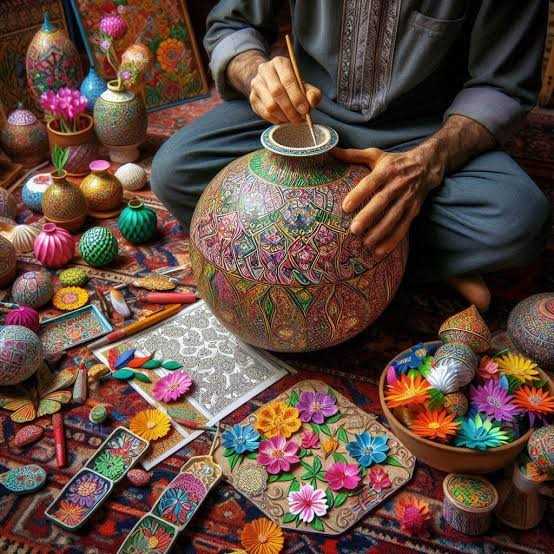
Kashmir is often described through its mountains, gardens and lakes, but there is another side of Kashmir that quietly tells the story of its people—the world of handicrafts. From a finely embroidered shawl to a beautifully carved piece of walnut wood, Kashmiri handicrafts carry the patience, skill and imagination of generations of artisans.
For many families, these crafts are not simply a part of culture. They are a means of earning a living.
Carpet weaving, Pashmina, Sozni embroidery, paper-mache, walnut wood carving and crewel work have remained closely connected with Kashmiri society for generations. In many homes, craftwork is done alongside everyday household responsibilities. The skills are often learned at a young age and passed from one generation to another.
This makes handicrafts an important part of the local economy. A single product involves more than the person who makes it. Raw-material suppliers, spinners, dyers, traders, transporters and shopkeepers may all be connected to the same craft. In this way, the handicraft sector creates a chain of economic activity within local communities.
The contribution of women is particularly important. Many Kashmiri women are involved in embroidery, weaving and other home-based crafts. For them, handicraft work can provide an opportunity to earn while remaining close to their families. A regular income from such work can help households meet daily expenses and can give women a greater role in family financial decisions.
Tourism has also given Kashmiri handicrafts an important market. Visitors coming to Kashmir often look for something that represents the place they have experienced. A Kashmiri shawl, carpet or paper-machine item can become more than a souvenir—it becomes a reminder of the region's culture and craftsmanship. When tourists purchase genuine local products, the benefit can reach the artisans and traders who depend on this sector.
However, the people behind these beautiful products face difficulties. Machine-made goods can be cheaper and faster to produce, while handmade work requires considerable time and patience. The increasing cost of materials and difficulties in reaching customers can also reduce the income of artisans. In some cases, middlemen take a large share of the final price, leaving the original maker with a smaller return.
Another concern is the future of traditional skills. Many young people are looking towards modern professions and may not consider handicrafts a secure career. If younger generations stop learning these skills, Kashmir could gradually lose some of its traditional craftsmanship.
There is therefore a need to make handicrafts economically attractive for the next generation. Better training, fair prices, access to markets and opportunities to sell through digital platforms can make a real difference. Artisans can also benefit from modern designs and packaging without losing the traditional character of their work.
Consumers have a role to play as well. Choosing authentic handmade products and understanding the effort behind them can directly support local artisans. A handmade Kashmiri product should not be valued only for its appearance; the time, skill and human effort behind it also deserve recognition.
Kashmiri handicrafts are ultimately a story of people—their hands, their skills and their hopes. They preserve a cultural tradition while providing income to families across the region. If properly supported and connected with modern markets, this traditional sector can continue to provide livelihoods and remain an important part of Kashmir's economic life.
Saving Kashmir's handicrafts means saving not only an art form, but also the livelihoods and stories of the people who keep that art alive.
Email:-------------------------shaziyahassan019@gmail.com
Author is student of BA at GDC Thindim Kreeri baramulla
Kashmir is often described through its mountains, gardens and lakes, but there is another side of Kashmir that quietly tells the story of its people—the world of handicrafts. From a finely embroidered shawl to a beautifully carved piece of walnut wood, Kashmiri handicrafts carry the patience, skill and imagination of generations of artisans.
For many families, these crafts are not simply a part of culture. They are a means of earning a living.
Carpet weaving, Pashmina, Sozni embroidery, paper-mache, walnut wood carving and crewel work have remained closely connected with Kashmiri society for generations. In many homes, craftwork is done alongside everyday household responsibilities. The skills are often learned at a young age and passed from one generation to another.
This makes handicrafts an important part of the local economy. A single product involves more than the person who makes it. Raw-material suppliers, spinners, dyers, traders, transporters and shopkeepers may all be connected to the same craft. In this way, the handicraft sector creates a chain of economic activity within local communities.
The contribution of women is particularly important. Many Kashmiri women are involved in embroidery, weaving and other home-based crafts. For them, handicraft work can provide an opportunity to earn while remaining close to their families. A regular income from such work can help households meet daily expenses and can give women a greater role in family financial decisions.
Tourism has also given Kashmiri handicrafts an important market. Visitors coming to Kashmir often look for something that represents the place they have experienced. A Kashmiri shawl, carpet or paper-machine item can become more than a souvenir—it becomes a reminder of the region's culture and craftsmanship. When tourists purchase genuine local products, the benefit can reach the artisans and traders who depend on this sector.
However, the people behind these beautiful products face difficulties. Machine-made goods can be cheaper and faster to produce, while handmade work requires considerable time and patience. The increasing cost of materials and difficulties in reaching customers can also reduce the income of artisans. In some cases, middlemen take a large share of the final price, leaving the original maker with a smaller return.
Another concern is the future of traditional skills. Many young people are looking towards modern professions and may not consider handicrafts a secure career. If younger generations stop learning these skills, Kashmir could gradually lose some of its traditional craftsmanship.
There is therefore a need to make handicrafts economically attractive for the next generation. Better training, fair prices, access to markets and opportunities to sell through digital platforms can make a real difference. Artisans can also benefit from modern designs and packaging without losing the traditional character of their work.
Consumers have a role to play as well. Choosing authentic handmade products and understanding the effort behind them can directly support local artisans. A handmade Kashmiri product should not be valued only for its appearance; the time, skill and human effort behind it also deserve recognition.
Kashmiri handicrafts are ultimately a story of people—their hands, their skills and their hopes. They preserve a cultural tradition while providing income to families across the region. If properly supported and connected with modern markets, this traditional sector can continue to provide livelihoods and remain an important part of Kashmir's economic life.
Saving Kashmir's handicrafts means saving not only an art form, but also the livelihoods and stories of the people who keep that art alive.
Email:-------------------------shaziyahassan019@gmail.com
Author is student of BA at GDC Thindim Kreeri baramulla

© Copyright 2023 brighterkashmir.com All Rights Reserved. Quantum Technologies