
BREAKING NEWS
Jammu, Sep 6: Natrang presented a scintillating performance of the highly symbolic Hindi play ‘Teen Apaahij’, written by Dr. Vipin Kumar Aggarwal and directed by Neeraj Kant.
Speaking on the occasion, Natrang Director and Padmashri awardee Balwant Thakur said that intellectually stimulating plays by some of the country’s finest playwrights hold immense value for both performers and spectators. He emphasised that such productions should be performed and watched repeatedly to foster a healthy literary and cultural environment in the city. “Such plays are instrumental in developing imaginative, sensitive and thinking audiences,” he said.
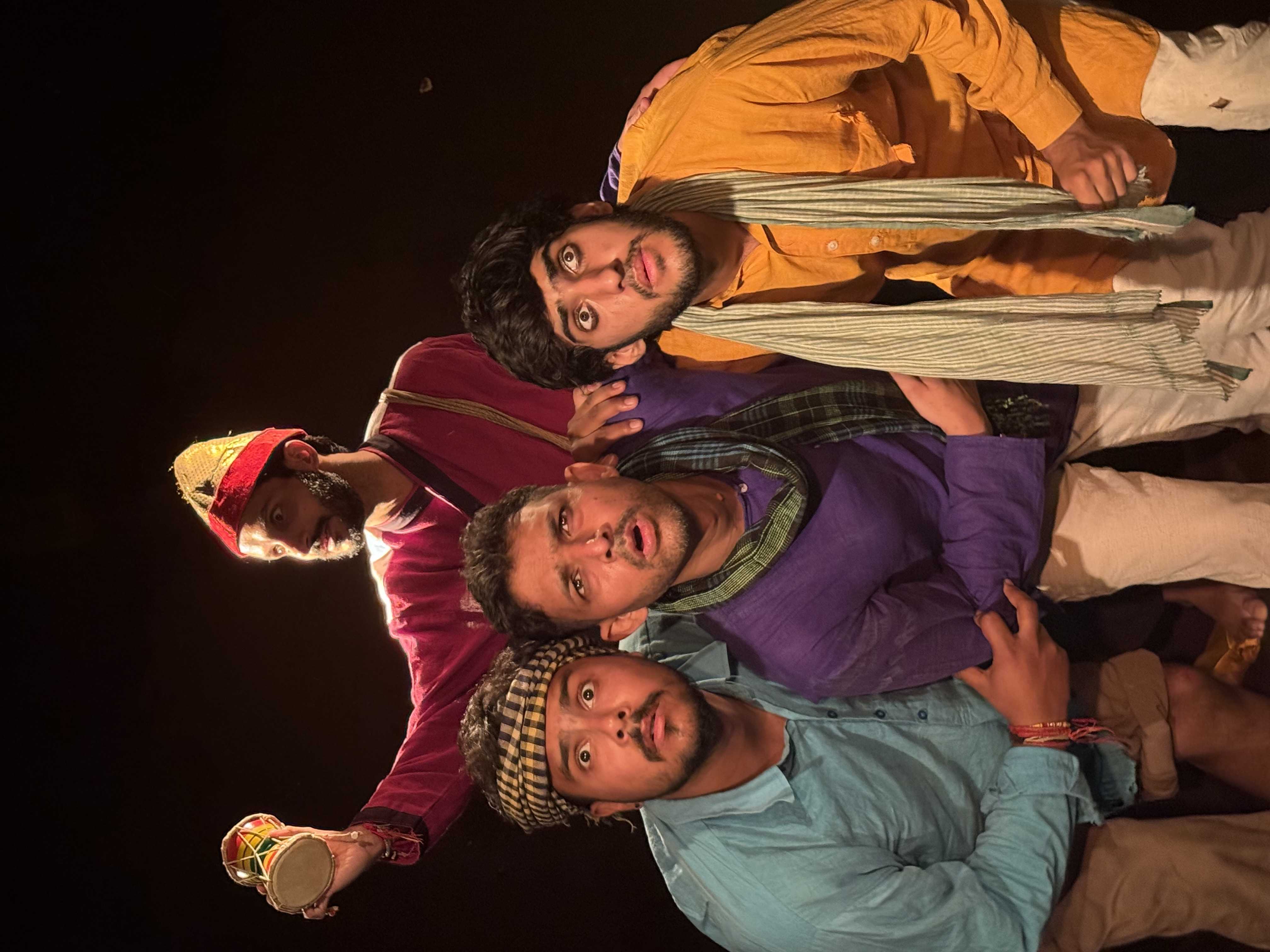
Set at a crossroads, ‘Teen Apaahij’ revolves around three characters Kallu, Khallu and Gallu who sit beneath a lamp post, seemingly doing nothing except passing comments on everything around them. Through a highly symbolic narrative, the playwright exposes the directionless nature of the political, social and spiritual systems that govern contemporary society.
The play portrays how this dysfunctional system has rendered the youth of the country not merely helpless but metaphorically handicapped. The pervasive influence of corruption has, according to the play, seeped into the collective consciousness, creating a poisonous atmosphere in which new ideas, revolutionary thinking and meaningful initiatives struggle to emerge.
The three characters communicate with one another in an apparently incoherent and fragmented manner. Their conversations seem trivial and disconnected, yet beneath the surface lies a persistent sense that something significant is happening around them. Questions concerning the meaning of freedom, hollow political speeches, Indianness, the nation, language and class are debated in ways that appear aimless, even though each of these issues carries deep social significance.
Through this apparent absurdity, the play explores the passivity, meaninglessness, confusion and fatigue that have come to characterise a large section of society. These tendencies, it suggests, are gradually pushing society and the nation towards a state of collective disability. Ultimately, the playwright highlights the paradox of modernisation: while attempting to become modern, society is increasingly losing touch with its human essence and entering an age of metaphorical disability.
Natrang also experimented with this production by introducing a new generation of actors, giving freshers an opportunity to engage with challenging and intellectually demanding theatre. The three principal characters were excellently portrayed by Pawan Verma, Aryan Sharma and Krishay Bhatia. They were supported by Kushal Bhat as the Drum Beater and Neeraj Kant as the Cyclewala.
The lighting design and execution were handled by Neeraj Kant Sharma, while the show was presented by Pawan Verma.
The production once again reflected Natrang’s commitment to presenting meaningful, experimental and thought-provoking theatre while creating opportunities for young performers to explore the possibilities of contemporary stagecraft.
Jammu, Sep 6: Natrang presented a scintillating performance of the highly symbolic Hindi play ‘Teen Apaahij’, written by Dr. Vipin Kumar Aggarwal and directed by Neeraj Kant.
Speaking on the occasion, Natrang Director and Padmashri awardee Balwant Thakur said that intellectually stimulating plays by some of the country’s finest playwrights hold immense value for both performers and spectators. He emphasised that such productions should be performed and watched repeatedly to foster a healthy literary and cultural environment in the city. “Such plays are instrumental in developing imaginative, sensitive and thinking audiences,” he said.
Set at a crossroads, ‘Teen Apaahij’ revolves around three characters Kallu, Khallu and Gallu who sit beneath a lamp post, seemingly doing nothing except passing comments on everything around them. Through a highly symbolic narrative, the playwright exposes the directionless nature of the political, social and spiritual systems that govern contemporary society.
The play portrays how this dysfunctional system has rendered the youth of the country not merely helpless but metaphorically handicapped. The pervasive influence of corruption has, according to the play, seeped into the collective consciousness, creating a poisonous atmosphere in which new ideas, revolutionary thinking and meaningful initiatives struggle to emerge.
The three characters communicate with one another in an apparently incoherent and fragmented manner. Their conversations seem trivial and disconnected, yet beneath the surface lies a persistent sense that something significant is happening around them. Questions concerning the meaning of freedom, hollow political speeches, Indianness, the nation, language and class are debated in ways that appear aimless, even though each of these issues carries deep social significance.
Through this apparent absurdity, the play explores the passivity, meaninglessness, confusion and fatigue that have come to characterise a large section of society. These tendencies, it suggests, are gradually pushing society and the nation towards a state of collective disability. Ultimately, the playwright highlights the paradox of modernisation: while attempting to become modern, society is increasingly losing touch with its human essence and entering an age of metaphorical disability.
Natrang also experimented with this production by introducing a new generation of actors, giving freshers an opportunity to engage with challenging and intellectually demanding theatre. The three principal characters were excellently portrayed by Pawan Verma, Aryan Sharma and Krishay Bhatia. They were supported by Kushal Bhat as the Drum Beater and Neeraj Kant as the Cyclewala.
The lighting design and execution were handled by Neeraj Kant Sharma, while the show was presented by Pawan Verma.
The production once again reflected Natrang’s commitment to presenting meaningful, experimental and thought-provoking theatre while creating opportunities for young performers to explore the possibilities of contemporary stagecraft.

© Copyright 2023 brighterkashmir.com All Rights Reserved. Quantum Technologies