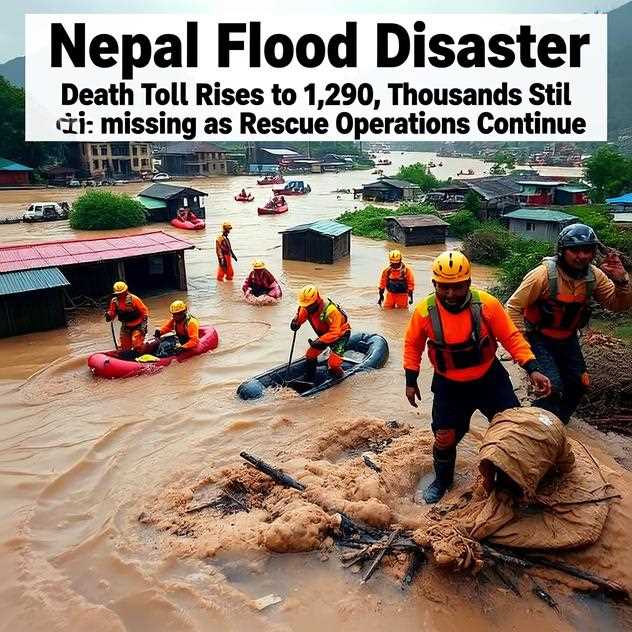
Kathmandu, September 5: Nepal is facing a severe humanitarian crisis as rescue teams continue searching for thousands of people still missing after devastating flash floods and landslides struck the country’s northern regions.
The death toll has risen to 1,344, according to the latest reports on Saturday, while nearly 4,900 people remain unaccounted for. More than 13,000 people have been rescued so far as security forces and international teams continue operations in the worst-hit areas.
The disaster began on August 26 after a major glacial collapse triggered powerful floods carrying water, ice, rocks and mud through areas along the Nepal-Tibet border. The flooding caused widespread destruction of homes, roads, bridges, hydropower facilities and other infrastructure.
One of the biggest rescue challenges is the search for workers believed to be trapped inside hydropower tunnels. Rescue teams from Nepal, India, China and South Korea are working alongside the Nepal Army to reach the affected tunnels.
In a major breakthrough, rescuers recently pulled two workers alive from a tunnel at the Trishuli 3A Hydropower Project after they had been trapped for nine days. A Chinese national was also rescued alive from a hydropower tunnel on Saturday, 10 days after the disaster.
Nepal’s Ministry of Foreign Affairs said search and rescue operations remain active at several hydropower projects, including Langtang, Chilime, Upper Trisuli 1, Upper Trisuli 3A and Upper Trisuli 3B. It said Nepal Army, Nepal Police and Armed Police Force personnel have been fully mobilised.
The ministry’s latest situation update had reported 13,093 people rescued, around 5,083 still missing and 1,287 bodies recovered, while stressing that the figures were being continuously updated as identification and verification continued.
The disaster has also affected foreign nationals. India’s Ministry of External Affairs said 275 Indian nationals remain missing, while 166 Indians have been rescued. India has sent around 95 tonnes of relief material and 54 specialists, including tunnel-rescue, forensic and medical personnel, to support Nepal’s response. Another 1,907 Indian citizens were safely brought into Nepal from Tibet.
Authorities are now facing the difficult task of restoring damaged roads, electricity and telecommunications while continuing the search for missing people. Rescue teams are using drones, specialised equipment and international technical assistance to reach areas that remain inaccessible.
Despite the worsening death toll, the successful rescue of people who survived for days inside flooded and damaged tunnels has renewed hopes that more survivors could still be found.
The focus remains on recovering the missing, identifying the dead, providing emergency relief to affected communities and restoring critical infrastructure across the flood-hit regions.

Kathmandu, September 5: Nepal is facing a severe humanitarian crisis as rescue teams continue searching for thousands of people still missing after devastating flash floods and landslides struck the country’s northern regions.
The death toll has risen to 1,344, according to the latest reports on Saturday, while nearly 4,900 people remain unaccounted for. More than 13,000 people have been rescued so far as security forces and international teams continue operations in the worst-hit areas.
The disaster began on August 26 after a major glacial collapse triggered powerful floods carrying water, ice, rocks and mud through areas along the Nepal-Tibet border. The flooding caused widespread destruction of homes, roads, bridges, hydropower facilities and other infrastructure.
One of the biggest rescue challenges is the search for workers believed to be trapped inside hydropower tunnels. Rescue teams from Nepal, India, China and South Korea are working alongside the Nepal Army to reach the affected tunnels.
In a major breakthrough, rescuers recently pulled two workers alive from a tunnel at the Trishuli 3A Hydropower Project after they had been trapped for nine days. A Chinese national was also rescued alive from a hydropower tunnel on Saturday, 10 days after the disaster.
Nepal’s Ministry of Foreign Affairs said search and rescue operations remain active at several hydropower projects, including Langtang, Chilime, Upper Trisuli 1, Upper Trisuli 3A and Upper Trisuli 3B. It said Nepal Army, Nepal Police and Armed Police Force personnel have been fully mobilised.
The ministry’s latest situation update had reported 13,093 people rescued, around 5,083 still missing and 1,287 bodies recovered, while stressing that the figures were being continuously updated as identification and verification continued.
The disaster has also affected foreign nationals. India’s Ministry of External Affairs said 275 Indian nationals remain missing, while 166 Indians have been rescued. India has sent around 95 tonnes of relief material and 54 specialists, including tunnel-rescue, forensic and medical personnel, to support Nepal’s response. Another 1,907 Indian citizens were safely brought into Nepal from Tibet.
Authorities are now facing the difficult task of restoring damaged roads, electricity and telecommunications while continuing the search for missing people. Rescue teams are using drones, specialised equipment and international technical assistance to reach areas that remain inaccessible.
Despite the worsening death toll, the successful rescue of people who survived for days inside flooded and damaged tunnels has renewed hopes that more survivors could still be found.
The focus remains on recovering the missing, identifying the dead, providing emergency relief to affected communities and restoring critical infrastructure across the flood-hit regions.
© Copyright 2023 brighterkashmir.com All Rights Reserved. Quantum Technologies