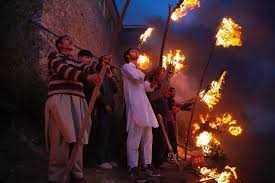
Aishmuqam, April 1: The occasion when fire torches are lit during the evening hours in Aishmuqam and its adjacent areas is known as Phrov. It is a centuries-old tradition that continues to live on with great zeal and reverence. Every year, devotees come from far-off places to participate in the festival and pay homage to Hazrat Sakhi Zainuddin Wali (RA), reflecting their deep spiritual connection and cultural attachment.
It is important to clarify that Phrov is not the day of Urs or Yaum-e-Wisaal of the saint. The Urs is observed separately on the 12th of Wahak according to the Kashmiri calendar and has already been commemorated earlier. The origin of Phrov itself remains somewhat mysterious, and different narratives exist regarding its background.
Some local accounts suggest that there was once a tyrannical figure (often referred to as a “Dev”) in this area who caused harm to many people. According to this belief, when he was finally defeated or killed, people expressed their relief and gratitude by lighting fires—an act which, over time, is said to have evolved into the present-day Phrov celebration.
From an Islamic perspective, such cultural traditions are not discouraged as long as they do not contradict the basic principles of Shariah. History provides examples, such as the people of Habshah, who celebrated certain occasions with traditional dances involving drums and swords. Similar practices continue even today in Saudi Arabia, where traditional sword dances are performed as part of cultural heritage.
However, while acknowledging its value, the festival must be observed with a strong sense of responsibility and adherence to Islamic ethics. People should not gather around the fire with the intention of venerating it. The lighting of fire should not take place during prayer times and offering Salah must always be given priority.
Moreover, the celebration should remain dignified and free from any form of waywardness. Unnecessary mixing of young men and women under the guise of celebration should be avoided. Womenfolk are encouraged to observe the festivities within the bounds of modesty and cultural decorum.
If such ethical guidelines are not maintained, the festival risks losing its essence and turning into an occasion of disorder. Therefore, instead of rejecting the tradition altogether, it is wiser to adopt corrective measures and ensure that it is celebrated in a balanced and respectful manner.
Ultimately, it is the collective responsibility of the people to preserve both the cultural heritage and the moral values associated with it. At the same time, such events are often observed and interpreted by others through various sociological and psychological perspectives, making it even more important to uphold discipline, dignity and faith.

Aishmuqam, April 1: The occasion when fire torches are lit during the evening hours in Aishmuqam and its adjacent areas is known as Phrov. It is a centuries-old tradition that continues to live on with great zeal and reverence. Every year, devotees come from far-off places to participate in the festival and pay homage to Hazrat Sakhi Zainuddin Wali (RA), reflecting their deep spiritual connection and cultural attachment.
It is important to clarify that Phrov is not the day of Urs or Yaum-e-Wisaal of the saint. The Urs is observed separately on the 12th of Wahak according to the Kashmiri calendar and has already been commemorated earlier. The origin of Phrov itself remains somewhat mysterious, and different narratives exist regarding its background.
Some local accounts suggest that there was once a tyrannical figure (often referred to as a “Dev”) in this area who caused harm to many people. According to this belief, when he was finally defeated or killed, people expressed their relief and gratitude by lighting fires—an act which, over time, is said to have evolved into the present-day Phrov celebration.
From an Islamic perspective, such cultural traditions are not discouraged as long as they do not contradict the basic principles of Shariah. History provides examples, such as the people of Habshah, who celebrated certain occasions with traditional dances involving drums and swords. Similar practices continue even today in Saudi Arabia, where traditional sword dances are performed as part of cultural heritage.
However, while acknowledging its value, the festival must be observed with a strong sense of responsibility and adherence to Islamic ethics. People should not gather around the fire with the intention of venerating it. The lighting of fire should not take place during prayer times and offering Salah must always be given priority.
Moreover, the celebration should remain dignified and free from any form of waywardness. Unnecessary mixing of young men and women under the guise of celebration should be avoided. Womenfolk are encouraged to observe the festivities within the bounds of modesty and cultural decorum.
If such ethical guidelines are not maintained, the festival risks losing its essence and turning into an occasion of disorder. Therefore, instead of rejecting the tradition altogether, it is wiser to adopt corrective measures and ensure that it is celebrated in a balanced and respectful manner.
Ultimately, it is the collective responsibility of the people to preserve both the cultural heritage and the moral values associated with it. At the same time, such events are often observed and interpreted by others through various sociological and psychological perspectives, making it even more important to uphold discipline, dignity and faith.
© Copyright 2023 brighterkashmir.com All Rights Reserved. Quantum Technologies