
BREAKING NEWS
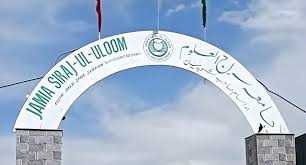
Srinagar, April 28: The allegations of terror links and terror recruitment have come to the fore after authorities declared Darul Uloom Jamia Siraj-ul-Uloom in Shopian as “unlawful entity” under the Unlawful Activities (Prevention) Act, 1967 with official sources claiming that the institution acted as a hub of radicalisation and at least 17 students of the institute had joined terror ranks.
According to official sources, the institution, established in 1994, is accused of having acquired the land “fraudulently under coercion and duress, with suspected complicity of certain revenue officials who appear to have bypassed the prescribed legal procedures. “
The due legal processes were bypassed during the transfer, raising questions about the legitimacy of the institution’s establishment, they said.
Official sources further said that investigations have further revealed that the Darul Uloom was functioning without valid registration from the Jammu and Kashmir Board of School Education (JKBOSE) and lacked mandatory clearance certificates required for such institutions.
Despite these deficiencies, it continued to operate a Fazila college under affiliation with the University of Kashmir, a move now under scrutiny.
Official sources also flagged irregularities in institution’s organisational structure.
“It is registered on the NGO Darpan portal under two separate entities—Siraj-ul-Uloom Educational Society, registered in 2018, and Siraj-ul-Uloom Welfare Foundation, registered in 2025,” they said adding the latter has additionally been incorporated as a company, a step taken to evade statutory oversight and regulatory checks.
The management, according to sources, also deliberately avoided mandatory re-registration under provisions of the Jammu and Kashmir Reorganisation Act. “This was done with full awareness that such re-registration may not be granted due to the institution’s background. Instead, adopting a corporate structure is seen as an attempt to bypass scrutiny and continue operations without obtaining necessary security clearances, reflecting mala-fide intent and conscious evasion of the law.”
The financial dealings of the institution have also come under the scanner.
Official sources have raised concerns over the maintenance of multiple bank accounts and recent changes in authorised signatories.
The continued inflow of funds through tuition fees and donations has triggered suspicion regarding possible concealment, diversion, or misuse of funds, with the legitimacy of such receipts being questioned, they said.
One of the most serious allegations against the institutions pertains to its links with banned Jamaat-e-Islami, the official sources said.
They said several individuals associated with the institution and holding key positions have known affiliations with JeI, creating an environment that may have facilitated ideological indoctrination rather than academic development.
The institution has also been described as a potential hub of radicalisation, with official sources revealing that at least 17 students linked to the Darul Uloom later joined militant ranks.
A list of such individuals, along with details of multiple FIRs registered against them under various provisions of the Unlawful Activities (Prevention) Act, the Indian Penal Code, and the Arms Act, has been cited as part of the case.
The charges against the institution mark a major increase in scrutiny of educational and religious institutions in the UT, especially in the context of national security and efforts to counter radicalisation.
Srinagar, April 28: The allegations of terror links and terror recruitment have come to the fore after authorities declared Darul Uloom Jamia Siraj-ul-Uloom in Shopian as “unlawful entity” under the Unlawful Activities (Prevention) Act, 1967 with official sources claiming that the institution acted as a hub of radicalisation and at least 17 students of the institute had joined terror ranks.
According to official sources, the institution, established in 1994, is accused of having acquired the land “fraudulently under coercion and duress, with suspected complicity of certain revenue officials who appear to have bypassed the prescribed legal procedures. “
The due legal processes were bypassed during the transfer, raising questions about the legitimacy of the institution’s establishment, they said.
Official sources further said that investigations have further revealed that the Darul Uloom was functioning without valid registration from the Jammu and Kashmir Board of School Education (JKBOSE) and lacked mandatory clearance certificates required for such institutions.
Despite these deficiencies, it continued to operate a Fazila college under affiliation with the University of Kashmir, a move now under scrutiny.
Official sources also flagged irregularities in institution’s organisational structure.
“It is registered on the NGO Darpan portal under two separate entities—Siraj-ul-Uloom Educational Society, registered in 2018, and Siraj-ul-Uloom Welfare Foundation, registered in 2025,” they said adding the latter has additionally been incorporated as a company, a step taken to evade statutory oversight and regulatory checks.
The management, according to sources, also deliberately avoided mandatory re-registration under provisions of the Jammu and Kashmir Reorganisation Act. “This was done with full awareness that such re-registration may not be granted due to the institution’s background. Instead, adopting a corporate structure is seen as an attempt to bypass scrutiny and continue operations without obtaining necessary security clearances, reflecting mala-fide intent and conscious evasion of the law.”
The financial dealings of the institution have also come under the scanner.
Official sources have raised concerns over the maintenance of multiple bank accounts and recent changes in authorised signatories.
The continued inflow of funds through tuition fees and donations has triggered suspicion regarding possible concealment, diversion, or misuse of funds, with the legitimacy of such receipts being questioned, they said.
One of the most serious allegations against the institutions pertains to its links with banned Jamaat-e-Islami, the official sources said.
They said several individuals associated with the institution and holding key positions have known affiliations with JeI, creating an environment that may have facilitated ideological indoctrination rather than academic development.
The institution has also been described as a potential hub of radicalisation, with official sources revealing that at least 17 students linked to the Darul Uloom later joined militant ranks.
A list of such individuals, along with details of multiple FIRs registered against them under various provisions of the Unlawful Activities (Prevention) Act, the Indian Penal Code, and the Arms Act, has been cited as part of the case.
The charges against the institution mark a major increase in scrutiny of educational and religious institutions in the UT, especially in the context of national security and efforts to counter radicalisation.

© Copyright 2023 brighterkashmir.com All Rights Reserved. Quantum Technologies