
BREAKING NEWS
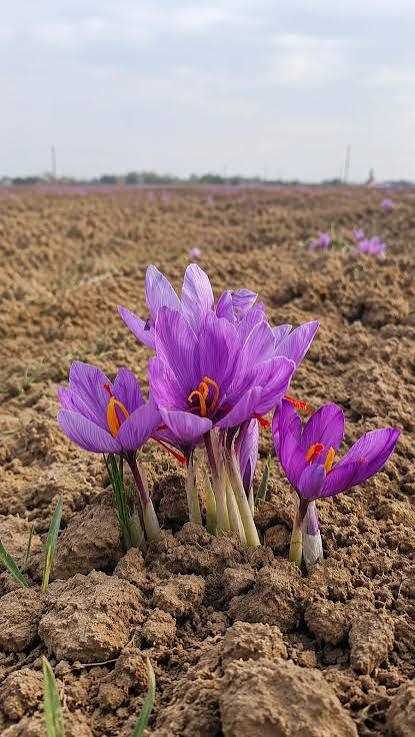
Srinagar, Nov 1: The arrival of November marks the much-awaited saffron harvesting season in Kashmir, as the purple flowers begin carpeting the fields of Pampore and adjoining areas, bringing renewed activity to the Valley’s famed saffron-growing belt.
Known for its rich aroma, distinctive flavour and deep cultural significance, Kashmiri saffron is among the region’s most prized agricultural products. The harvest season is a crucial period for thousands of farming families, particularly in Pampore, popularly known as the saffron town of Kashmir.
The sight of saffron flowers emerging from the soil transforms the Karewa fields into colourful landscapes. Farmers and their families begin collecting the delicate flowers during the early morning hours, when they are fresh and their fragrance is at its strongest.
This year’s harvest has brought cautious optimism after a particularly difficult previous season. Farmers are reporting some improvement in production, although the overall yield remains uncertain as flowering is still developing in several areas. A saffron cultivator from Patlibagh, Irshad Ahmad, said the crop was comparatively better than last year, when production in several fields reportedly declined by nearly 80 per cent.
However, the picture is not uniform across the saffron belt. Growers in several areas have reported below-normal flowering, while fields with better irrigation facilities have shown comparatively encouraging results. This contrast has once again highlighted the vulnerability of saffron cultivation to erratic rainfall and prolonged dry spells.
Saffron cultivation is a labour-intensive process requiring considerable care and patience. The delicate purple flowers are collected by hand, generally during the early morning hours. After harvesting, families separate the three deep-red stigmas from each flower. These are carefully dried and processed to produce the valuable saffron strands sold in the market.
Every stage requires precision, as the quality, colour, aroma and flavour of the final product depend on careful harvesting and post-harvest handling. The short flowering window makes the season particularly demanding for farming families, who must complete the work within a limited period.
Pampore and its adjoining villages, including Lethpora, Chandhara, Konibal, Munpora, Dusoo and Ladhoo, form the traditional heartland of saffron cultivation. The crop is not merely an agricultural commodity here but an inherited livelihood, with generations of families associated with its cultivation and processing.
Yet, the sector continues to face serious challenges. Inadequate irrigation, declining soil moisture, shortage of quality saffron corms, conversion of agricultural land for construction and damage to underground corms by porcupines have emerged as major concerns among growers. Farmers have also called for the restoration of defunct irrigation facilities and stronger protection of traditional saffron-growing land.
The importance of timely irrigation is evident from the experience of progressive farmer Ghulam Mohi-ud-Din Bhat of Munpora, Pampore, who reported harvesting over 100 kilograms of saffron flowers after investing in his own borewell. His experience demonstrates how reliable water availability can improve flowering and productivity.
The Jammu and Kashmir Competitiveness Improvement Project (JKCIP) has also undertaken replanting activities in several saffron-growing areas, with local agricultural officials reporting encouraging results. Growers, however, believe that sustained intervention is necessary to revive ageing and less productive fields.
The National Mission on Saffron, launched in 2011, was aimed at improving productivity through irrigation, quality planting material and scientific cultivation practices. Farmers are seeking renewed attention to these interventions, particularly the restoration of irrigation infrastructure and wider access to quality corms.
Kashmir saffron received the Geographical Indication (GI) tag, recognising its distinctive identity and origin. Protecting this reputation requires better quality control, authentic labelling, improved processing, effective marketing and measures to prevent the sale of adulterated or falsely labelled products.
The establishment of the Saffron Park at Pampore has also created opportunities for scientific processing, grading, packaging and marketing. Greater participation of growers in such facilities can help improve returns and strengthen the crop's position in domestic and international markets.
Saffron cultivation also offers considerable potential for agricultural tourism. Visitors arriving in Kashmir during autumn are drawn to the purple fields, offering an opportunity to connect farming communities with tourism and local markets.
For Kashmir, saffron is much more than the world's most expensive spice. It represents agricultural heritage, cultural identity and the economic security of thousands of families. The current harvest has raised hopes of recovery, but the future of this precious crop will depend on timely irrigation, scientific farming, protection of saffron land and sustained government support.
Preserving Kashmir's red gold is not simply about saving a traditional crop; it is about protecting a legacy that has flourished in the Valley for generations.

© Copyright 2023 brighterkashmir.com All Rights Reserved. Quantum Technologies