Srinagar, May 16: Continuing its grassroots outreach under the newly launched Student Rural Exploration Program (SREP), faculty, staff, and students of Sher-e-Kashmir University of Agricultural Sciences and Technology of Kashmir today visited dozens of adopted villages across the valley, shifting the focus toward driving holistic social change and institutional mobilisation.
Building upon the framework of the Holistic Agriculture Development Programme (HADP-20), the university’s multidisciplinary cohorts moved beyond traditional agricultural fields to engage deeply with rural educational institutions, marking a significant step in bridging the gap between scientific academia and rural society.
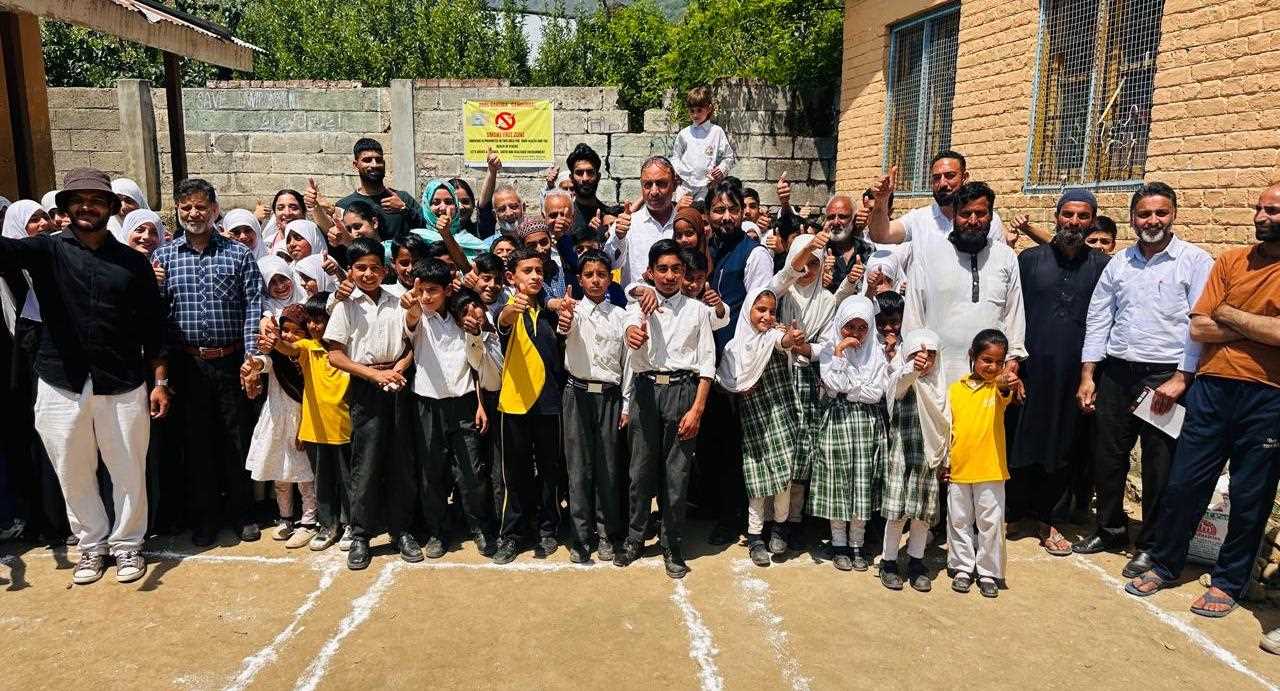
As part of the day’s intensive outreach, SKUAST-K teams visited several government schools to conduct institutional sensitization and social mobilisation campaigns. Recognising that young minds are the most effective vectors for societal transformation, the university experts, scientists, and scholars educated school children, teachers, and local youth about various government welfare schemes, health and hygiene practices, and sustainable livelihood initiatives beneficial to rural society. These interactive sessions were designed to empower the village communities with vital knowledge on nutrition, climate resilience, and modern rural entrepreneurship opportunities from an early age.
In a practical demonstration of its commitment to the rural ecosystem, SKUAST-K also took direct action to improve the infrastructure and aesthetic environment of the visited government schools. Understanding that school gardens serve as vital interactive learning spaces for children, the university teams actively helped multiple institutions restore, design, and maintain their campus lawns and gardens. To ensure the sustainability of these green spaces, the visiting teams were aided with essential gardening tools and maintenance equipment, working hand-in-hand with children to maintain the school gardens.
Commending the teams for their expanded role in rural development, Vice Chancellor, SKUAST-K, Prof Nazir Ahmad Ganai while visiting some of the schools in adopted villages, said that the true measure of agricultural education lies in its ability to uplift the entire rural ecosystem. He emphasised that by entering government schools and upgrading their learning environments, the university is not just gathering data, but actively seeding the minds of the next generation with scientific awareness and environmental stewardship, thereby transforming students into true agents of societal change.
The SREP, which deploys structured teams of undergraduate, postgraduate, and PhD scholars across 300 villages, has now firmly established itself as a fortnightly fixture on the SKUAST-K academic calendar. By documenting local institutional needs alongside agricultural challenges, the university continues to foster a generation of socially empathetic professionals while driving immediate, tangible development at the grassroots level.

Srinagar, May 16: Continuing its grassroots outreach under the newly launched Student Rural Exploration Program (SREP), faculty, staff, and students of Sher-e-Kashmir University of Agricultural Sciences and Technology of Kashmir today visited dozens of adopted villages across the valley, shifting the focus toward driving holistic social change and institutional mobilisation.
Building upon the framework of the Holistic Agriculture Development Programme (HADP-20), the university’s multidisciplinary cohorts moved beyond traditional agricultural fields to engage deeply with rural educational institutions, marking a significant step in bridging the gap between scientific academia and rural society.
As part of the day’s intensive outreach, SKUAST-K teams visited several government schools to conduct institutional sensitization and social mobilisation campaigns. Recognising that young minds are the most effective vectors for societal transformation, the university experts, scientists, and scholars educated school children, teachers, and local youth about various government welfare schemes, health and hygiene practices, and sustainable livelihood initiatives beneficial to rural society. These interactive sessions were designed to empower the village communities with vital knowledge on nutrition, climate resilience, and modern rural entrepreneurship opportunities from an early age.
In a practical demonstration of its commitment to the rural ecosystem, SKUAST-K also took direct action to improve the infrastructure and aesthetic environment of the visited government schools. Understanding that school gardens serve as vital interactive learning spaces for children, the university teams actively helped multiple institutions restore, design, and maintain their campus lawns and gardens. To ensure the sustainability of these green spaces, the visiting teams were aided with essential gardening tools and maintenance equipment, working hand-in-hand with children to maintain the school gardens.
Commending the teams for their expanded role in rural development, Vice Chancellor, SKUAST-K, Prof Nazir Ahmad Ganai while visiting some of the schools in adopted villages, said that the true measure of agricultural education lies in its ability to uplift the entire rural ecosystem. He emphasised that by entering government schools and upgrading their learning environments, the university is not just gathering data, but actively seeding the minds of the next generation with scientific awareness and environmental stewardship, thereby transforming students into true agents of societal change.
The SREP, which deploys structured teams of undergraduate, postgraduate, and PhD scholars across 300 villages, has now firmly established itself as a fortnightly fixture on the SKUAST-K academic calendar. By documenting local institutional needs alongside agricultural challenges, the university continues to foster a generation of socially empathetic professionals while driving immediate, tangible development at the grassroots level.
© Copyright 2023 brighterkashmir.com All Rights Reserved. Quantum Technologies