
BREAKING NEWS
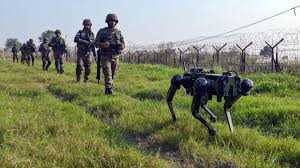
The Union Government’s announcement of a “Smart Border” project along the Pakistan and Bangladesh frontiers marks a significant shift in India’s border management strategy. Speaking on internal security priorities, Union Home Minister Amit Shah outlined a technology-driven approach aimed at curbing infiltration, improving surveillance, and strengthening real-time response mechanisms along two of India’s most sensitive international borders. At its core, the initiative reflects an acknowledgement of a long-standing challenge: traditional border fencing and manpower-intensive patrolling, while essential, are no longer sufficient in dealing with evolving cross-border threats. Smuggling networks, illegal infiltration, and drone-based surveillance evasion require a more integrated and technologically advanced system. The “Smart Border” framework is expected to combine artificial intelligence, sensor-based monitoring, radar systems, high-resolution cameras, and integrated command-and-control centres. The idea is not merely to detect movement but to enable predictive analysis—identifying patterns of infiltration attempts and responding proactively rather than reactively. If implemented effectively, the project could significantly reduce response time for security forces and improve coordination between agencies such as the Border Security Force (BSF), intelligence units, and local law enforcement. It also aligns with India’s broader push towards digitisation and smart infrastructure in governance and security. However, the success of such a system will depend on execution on the ground. Border terrain variations, weather extremes, and technological maintenance challenges could limit effectiveness if not addressed adequately. Equally important is the need for robust training of personnel to interpret and act on digital inputs without over-reliance on automated systems. There is also a strategic dimension. The Pakistan and Bangladesh borders present different security dynamics, requiring customised solutions rather than a uniform technological template. While one border is largely conflict-sensitive, the other is characterised by demographic and migration pressures. A smart system must therefore be flexible, adaptive, and intelligence-led. Ultimately, the “Smart Border” project represents an important evolution in India’s internal security doctrine. It signals a move from static defence to dynamic surveillance. But its real value will lie not in technological ambition alone, but in sustained integration, accountability, and ground-level effectiveness.
The Union Government’s announcement of a “Smart Border” project along the Pakistan and Bangladesh frontiers marks a significant shift in India’s border management strategy. Speaking on internal security priorities, Union Home Minister Amit Shah outlined a technology-driven approach aimed at curbing infiltration, improving surveillance, and strengthening real-time response mechanisms along two of India’s most sensitive international borders. At its core, the initiative reflects an acknowledgement of a long-standing challenge: traditional border fencing and manpower-intensive patrolling, while essential, are no longer sufficient in dealing with evolving cross-border threats. Smuggling networks, illegal infiltration, and drone-based surveillance evasion require a more integrated and technologically advanced system. The “Smart Border” framework is expected to combine artificial intelligence, sensor-based monitoring, radar systems, high-resolution cameras, and integrated command-and-control centres. The idea is not merely to detect movement but to enable predictive analysis—identifying patterns of infiltration attempts and responding proactively rather than reactively. If implemented effectively, the project could significantly reduce response time for security forces and improve coordination between agencies such as the Border Security Force (BSF), intelligence units, and local law enforcement. It also aligns with India’s broader push towards digitisation and smart infrastructure in governance and security. However, the success of such a system will depend on execution on the ground. Border terrain variations, weather extremes, and technological maintenance challenges could limit effectiveness if not addressed adequately. Equally important is the need for robust training of personnel to interpret and act on digital inputs without over-reliance on automated systems. There is also a strategic dimension. The Pakistan and Bangladesh borders present different security dynamics, requiring customised solutions rather than a uniform technological template. While one border is largely conflict-sensitive, the other is characterised by demographic and migration pressures. A smart system must therefore be flexible, adaptive, and intelligence-led. Ultimately, the “Smart Border” project represents an important evolution in India’s internal security doctrine. It signals a move from static defence to dynamic surveillance. But its real value will lie not in technological ambition alone, but in sustained integration, accountability, and ground-level effectiveness.

© Copyright 2023 brighterkashmir.com All Rights Reserved. Quantum Technologies