
BREAKING NEWS
Luxury lifestyles, private jets, yachts and investments in polluting industries are contributing disproportionately to global emissions. Yet the consequences are borne largely by those who contribute least to the crisis. Poor communities struggle for clean drinking water, safe shelter and basic necessities, while excessive consumption continues unchecked among affluent sections.
The world is witnessing an extraordinary contradiction. While science, technology and economic progress have reached unprecedented heights, millions continue to struggle with poverty, hunger, displacement and environmental destruction. The question is simple: why does prosperity remain concentrated in a few hands while the overwhelming majority bears the consequences of global crises?
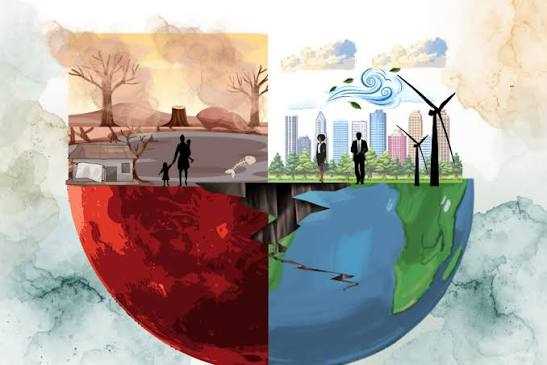
Oxfam's report The Disaster Divide offers a disturbing explanation. It exposes how economic inequality, excessive consumption and the concentration of wealth are deepening the climate crisis. The report highlights that the world's richest 0.1 per cent, approximately eight million people, generate more carbon pollution than the poorest 44 per cent of humanity. This is not merely an environmental imbalance; it is a question of economic justice and human responsibility.
Luxury lifestyles, private jets, yachts and investments in polluting industries are contributing disproportionately to global emissions. Yet the consequences are borne largely by those who contribute least to the crisis. Poor communities struggle for clean drinking water, safe shelter and basic necessities, while excessive consumption continues unchecked among affluent sections.
Climate disasters further expose this inequality. Floods, droughts, heatwaves and other extreme weather events affect everyone, but their consequences are far more devastating for vulnerable communities. Wealthier families can relocate, access insurance and rebuild their lives. Poor households often lose their homes, agricultural land, livestock and livelihoods, sometimes permanently. Oxfam points out that countries with greater economic inequality experience significantly higher flood-related mortality. The report also warns that emissions generated by the richest one per cent could contribute to approximately 1.9 million additional heat-related deaths in the future.
The crisis is not restricted to environmental damage. Economic inequality, unemployment, food insecurity, water scarcity and displacement can deepen social tensions and undermine stability. When the benefits of development are concentrated among a privileged minority while its costs are transferred to ordinary people, social trust inevitably weakens. Oxfam's Destroy and Rebuild Index, examining 217 companies, also raises concerns about businesses potentially profiting from both environmental destruction and subsequent reconstruction.
For India, these warnings carry particular significance. A substantial population depends on agriculture, construction, small businesses and the informal economy. Farmers face erratic rainfall, droughts, floods and rising temperatures. Labourers work under increasingly difficult climatic conditions, while urban settlements remain vulnerable to heatwaves and waterlogging. Climate resilience must therefore become a central component of India's development strategy.
The vision of Viksit Bharat 2047 cannot be realised through economic growth alone. Prosperity must be inclusive, sustainable and accessible to every section of society. Development loses its meaning when metropolitan luxury expands while rural communities struggle for drinking water, irrigation, electricity and sustainable livelihoods.
India needs stronger environmental accountability, responsible industrial practices, renewable energy investment and conservation of forests, water and land. Social security, crop insurance, healthcare and effective rehabilitation mechanisms must protect communities affected by climate disasters. Excessive luxury consumption and highly polluting activities must also carry appropriate environmental and economic accountability.
India's civilisational philosophy offers valuable guidance. Vasudhaiva Kutumbakam reminds humanity that the world is one family, while Sarve Bhavantu Sukhinah envisions collective well-being. Mahatma Gandhi's principle of simple living and high thinking and the Jain philosophy of Aparigraha emphasise restraint, responsible consumption and respect for nature.
Ultimately, climate change is not simply an environmental challenge; it is also a crisis of inequality, accountability and human values. Wealth creation cannot be condemned, but prosperity must carry social responsibility. The resources of the Earth cannot become the exclusive preserve of a privileged few while millions struggle for survival.
The real measure of development is not the wealth accumulated by a handful of individuals, but the dignity, security and opportunities available to ordinary people. A prosperous society must protect its poorest citizens and preserve its natural inheritance for future generations.
Development that destroys nature and disregards human dignity is not progress. It is a pathway to disaster.
Email:--------------mushtaqwani786@gmail.com
Luxury lifestyles, private jets, yachts and investments in polluting industries are contributing disproportionately to global emissions. Yet the consequences are borne largely by those who contribute least to the crisis. Poor communities struggle for clean drinking water, safe shelter and basic necessities, while excessive consumption continues unchecked among affluent sections.
The world is witnessing an extraordinary contradiction. While science, technology and economic progress have reached unprecedented heights, millions continue to struggle with poverty, hunger, displacement and environmental destruction. The question is simple: why does prosperity remain concentrated in a few hands while the overwhelming majority bears the consequences of global crises?
Oxfam's report The Disaster Divide offers a disturbing explanation. It exposes how economic inequality, excessive consumption and the concentration of wealth are deepening the climate crisis. The report highlights that the world's richest 0.1 per cent, approximately eight million people, generate more carbon pollution than the poorest 44 per cent of humanity. This is not merely an environmental imbalance; it is a question of economic justice and human responsibility.
Luxury lifestyles, private jets, yachts and investments in polluting industries are contributing disproportionately to global emissions. Yet the consequences are borne largely by those who contribute least to the crisis. Poor communities struggle for clean drinking water, safe shelter and basic necessities, while excessive consumption continues unchecked among affluent sections.
Climate disasters further expose this inequality. Floods, droughts, heatwaves and other extreme weather events affect everyone, but their consequences are far more devastating for vulnerable communities. Wealthier families can relocate, access insurance and rebuild their lives. Poor households often lose their homes, agricultural land, livestock and livelihoods, sometimes permanently. Oxfam points out that countries with greater economic inequality experience significantly higher flood-related mortality. The report also warns that emissions generated by the richest one per cent could contribute to approximately 1.9 million additional heat-related deaths in the future.
The crisis is not restricted to environmental damage. Economic inequality, unemployment, food insecurity, water scarcity and displacement can deepen social tensions and undermine stability. When the benefits of development are concentrated among a privileged minority while its costs are transferred to ordinary people, social trust inevitably weakens. Oxfam's Destroy and Rebuild Index, examining 217 companies, also raises concerns about businesses potentially profiting from both environmental destruction and subsequent reconstruction.
For India, these warnings carry particular significance. A substantial population depends on agriculture, construction, small businesses and the informal economy. Farmers face erratic rainfall, droughts, floods and rising temperatures. Labourers work under increasingly difficult climatic conditions, while urban settlements remain vulnerable to heatwaves and waterlogging. Climate resilience must therefore become a central component of India's development strategy.
The vision of Viksit Bharat 2047 cannot be realised through economic growth alone. Prosperity must be inclusive, sustainable and accessible to every section of society. Development loses its meaning when metropolitan luxury expands while rural communities struggle for drinking water, irrigation, electricity and sustainable livelihoods.
India needs stronger environmental accountability, responsible industrial practices, renewable energy investment and conservation of forests, water and land. Social security, crop insurance, healthcare and effective rehabilitation mechanisms must protect communities affected by climate disasters. Excessive luxury consumption and highly polluting activities must also carry appropriate environmental and economic accountability.
India's civilisational philosophy offers valuable guidance. Vasudhaiva Kutumbakam reminds humanity that the world is one family, while Sarve Bhavantu Sukhinah envisions collective well-being. Mahatma Gandhi's principle of simple living and high thinking and the Jain philosophy of Aparigraha emphasise restraint, responsible consumption and respect for nature.
Ultimately, climate change is not simply an environmental challenge; it is also a crisis of inequality, accountability and human values. Wealth creation cannot be condemned, but prosperity must carry social responsibility. The resources of the Earth cannot become the exclusive preserve of a privileged few while millions struggle for survival.
The real measure of development is not the wealth accumulated by a handful of individuals, but the dignity, security and opportunities available to ordinary people. A prosperous society must protect its poorest citizens and preserve its natural inheritance for future generations.
Development that destroys nature and disregards human dignity is not progress. It is a pathway to disaster.
Email:--------------mushtaqwani786@gmail.com

© Copyright 2023 brighterkashmir.com All Rights Reserved. Quantum Technologies