
BREAKING NEWS
A remarkable example of agricultural innovation is the establishment of the first-ever Tulip Demonstration cum Feasibility Yard at KVK/MAR&ES Gurez. Conceptualised and implemented by the KVK/MAR&ES team, with input support from the Division of FLA, FoH, SKUAST-K, the initiative successfully demonstrated the flowering potential of tulips under local agro-climatic conditions
Introduction
The true measure of visionary leadership lies not merely in establishing institutions or creating infrastructure, but in transforming lives through knowledge, innovation, inclusive development. of people. In the remote Himalayan landscape of Gurez Valley, the vision and leadership of Prof. Nazir Ahmad Ganai, the Vice-Chancellor, SKUAST-Kashmir, are creating new potential vistas for agricultural transformation, rural prosperity and changing quality of life of the tribal farmers. Gurez, characterised by its breathtaking landscapes, high-altitude environment, harsh winters, short growing season and geographical isolation, presents unique challenges to agricultural development and have remained confirmed to traditional agriculture practices. Recognising the untapped potential of this region, Prof. Ganai has been emphasising for a sustainable development- approach that takes agricultural research beyond formal boundaries facilitating scientific innovation linkage directly to the farmers’ fields. His vision has provided renewed Institutional momentum to Krishi Vigyan Kendra (KVK) Gurez and Mountain Agriculture Research and Extension Station (MAR&ES) Gurez, positioning them as important centres for research, technology validation and dissemination under organic and natural pursuits.
Laying the Foundation for Excellence
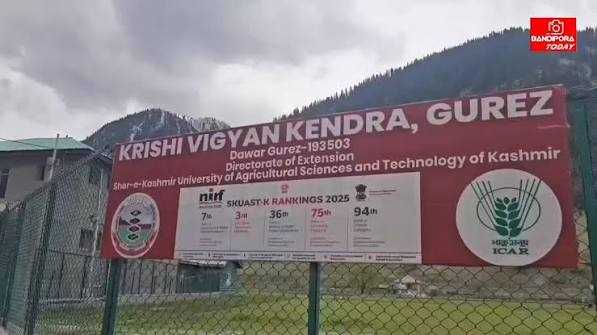
One of the most significant manifestations of his vision has been the establishment and strengthening of KVK Gurez as a dedicated scientific institution serving the agricultural needs of this remote tribal region. Given the support by ATARI (ICAR) Zone-I GoI, the development of its campus at Dawar, supported by modern administrative, laboratory and demonstration facilities, marks an important milestone in extending the university’s institutional presence to the last mile. With the consistent guidance and support of the Director Extension, Prof. Raihana Habib Kanth, and the Director Research, Prof. Syed Zameer Hussain, special emphasis has been placed on transforming KVK Gurez and MAR&ES Gurez into an Extension -Based-Research Institutions. Under the given approach, promising agricultural technologies developed by the SKUAST-Kashmir are first evaluated and validated at MAR&ES under Gurez’s conditions. Subsequently, identified potential technologies are disseminated to the farmers through KVK Gurez through the greater linkage and synergy with the development departments so to ensure that innovations are not merely transferred but are scientifically assessed, locally adapted and translated into practical solutions.
Salvaging the Heritage
Given the input and technical support through ARSS&TSS Pampore, KVK/MAR&ES has made a major breakthrough for successfully cultivating Kala zeera over an area of 0.60 hectares across two stations, more importantly has created history by bringing the farmers across Gurez valley under the ambit of first ever domestication with significant results starting from the first village koragbal Gurez to the very last village of country – Chakwali Tulail. This initiative represents paradigm shift from dependence on natural populations towards conservation oriented commercial cultivation. Branding, labelling, geo-tagging and tuber production at large are other trust areas in this endeavour.
Transforming Agri-Occupation into Agro-Tourism
A remarkable example of agricultural innovation is the establishment of the first-ever Tulip Demonstration cum Feasibility Yard at KVK/MAR&ES Gurez. Conceptualised and implemented by the KVK/MAR&ES team, with input support from the Division of FLA, FoH, SKUAST-K, the initiative successfully demonstrated the flowering potential of tulips under local agro-climatic conditions. Appreciated at the National level through mass media, the initiative is expected to reduce dependency for tulip imports to a great extent by augmenting tulip production at large under Gurez conditions besides shall create new vistas for agro-tourism and employment opportunities.
Unlocking the Himalayan Wealth
SKUAST-Kashmir has been encouraging the scientific promotion of MAPs as an important component of agricultural diversification. KVK Gurez has established a dedicated MAPs Germplasm Bank, conserving more than 40 species for ex-situ conservation, scientific evaluation and identification of commercially promising species. The establishment of an essential oil extraction and distillation facility further strengthens this initiative by providing opportunities for processing and value addition. The broader objective is to develop an integrated medicinal and aromatic plant value chain encompassing scientific cultivation, conservation, processing, product development and market-oriented entrepreneurship. KVK Gurez is also documenting Indigenous Traditional Knowledge (ITK) associated with this wealth engaging various stakeholders for the purpose.
Revival & Promotion of Heritage & Niche Wealth
The agricultural heritage of Gurez is deeply rooted in the traditional knowledge of its indigenous Dard community. Crops such as Kala Zeera, buckwheat, Gurezi Rajmash, Potato, millets, Pea and maize have historically contributed to local food and nutritional security. Salvaging the heritage, KVK/MAR&ES Gurez has prioritised the revival and scientific promotion of traditional crops. The adoption of Dangan village in Bagtore Block for large-scale buckwheat promotion or and taking Kala zeera to the last village of Tulail represents an encouraging step towards restoring traditional cultivation systems. These initiatives aim to connect traditional agricultural wisdom with modern scientific knowledge, strengthening both biodiversity conservation and livelihood security.
Introduction of Novel Interventions
The promotion of improved Wheat variety (SW-03) through seed distribution, demonstrations and technical guidance has been extended over an area of 70 hectares (1400 kanals), benefiting record 700 tribal farming households starting from the heritage village Chorwan up to the last village of Tulail. The technology focuses not only on the production but also profitable return through well-defined buy-back policy.
Establishment of HI-Tech Infrastructure
The extremely short growing season and prolonged winters significantly restrict conventional farming in Gurez. To address these constraints, modern agricultural infrastructure and protected cultivation technologies are being promoted. The establishment of two high-tech polyhouses under HADP-20 at KVK Gurez is an important step towards demonstrating off-season vegetable production with focus on growing cash crops, exotic and off-season vegetables quality planting-material to strengthen nutritional security.
Conclusion
The transformation of agriculture in a geographically isolated tribal region such as Gurez requires more than conventional extension approaches. It demands visionary leadership, institutional commitment, scientific innovation and sustained engagement with farming communities. The leadership of Prof. Nazir Ahmad Ganai coupled by the dedicated support of University’s Extension & Research system, has provided a strong institutional foundation for this transformation.
Email:------------------------kvkgurez@gmail.com

© Copyright 2023 brighterkashmir.com All Rights Reserved. Quantum Technologies