
BREAKING NEWS
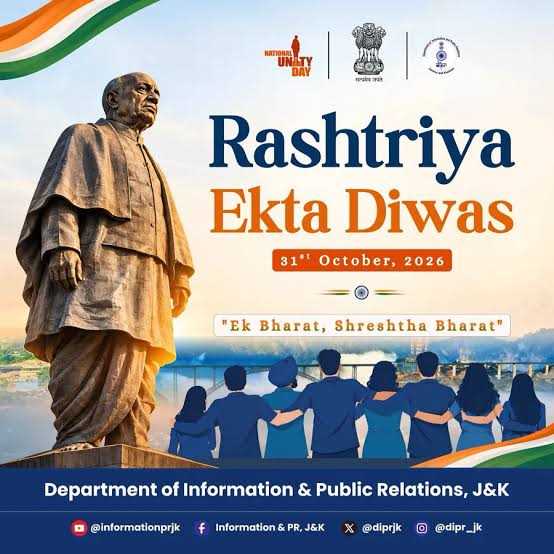
Rashtriya Ekta Diwas, observed every year on October 31 to mark the birth anniversary of Sardar Vallabhbhai Patel, is more than a ceremonial tribute to the Iron Man of India. It is a reminder that national unity is the foundation of a strong, stable and progressive nation. Patel played a historic role in integrating hundreds of princely states into the Indian Union after Independence. His determination, political vision and commitment to national integrity helped shape modern India. His legacy carries a powerful message: diversity must never become a source of division. In a country as vast and diverse as India, unity cannot be imposed; it must be nurtured through mutual respect, equal opportunities, constitutional values and a shared sense of belonging. Language, religion, region and culture may differ, but the commitment to the nation's democratic and constitutional framework must remain common. Rashtriya Ekta Diwas assumes particular significance in Jammu and Kashmir, where peace, stability and development are closely linked with public participation and social harmony. The region's progress depends not merely on infrastructure or economic growth but also on trust, reconciliation and opportunities for its younger generation. Every citizen must feel secure, respected and included in the national journey. The participation of police personnel, security forces, students and ordinary citizens in Unity Day programmes reflects the collective responsibility of safeguarding national integrity. However, unity should not remain confined to parades, speeches and pledges. It must be reflected in everyday conduct, public institutions and the way society treats people from different backgrounds. National security is important, but lasting unity also requires addressing unemployment, educational inequalities, social discrimination and regional imbalances. Young people need opportunities, not slogans; communities need dialogue, not distrust. The strength of India lies in its ability to accommodate differences while remaining united by constitutional principles. At a time when misinformation, communal polarisation and divisive narratives can weaken social bonds, citizens must exercise responsibility and reject forces that seek to create mistrust. Patriotism is not measured by words alone; it is demonstrated through respect for the Constitution, civic responsibility and service to society. Sardar Patel's vision remains relevant because nation-building is an ongoing process. Every generation must protect the unity he helped establish and strengthen the democratic values that sustain it. Unity is not uniformity. India's real strength lies in its diversity, its constitutional spirit and its collective resolve to move forward as one nation.
Rashtriya Ekta Diwas, observed every year on October 31 to mark the birth anniversary of Sardar Vallabhbhai Patel, is more than a ceremonial tribute to the Iron Man of India. It is a reminder that national unity is the foundation of a strong, stable and progressive nation. Patel played a historic role in integrating hundreds of princely states into the Indian Union after Independence. His determination, political vision and commitment to national integrity helped shape modern India. His legacy carries a powerful message: diversity must never become a source of division. In a country as vast and diverse as India, unity cannot be imposed; it must be nurtured through mutual respect, equal opportunities, constitutional values and a shared sense of belonging. Language, religion, region and culture may differ, but the commitment to the nation's democratic and constitutional framework must remain common. Rashtriya Ekta Diwas assumes particular significance in Jammu and Kashmir, where peace, stability and development are closely linked with public participation and social harmony. The region's progress depends not merely on infrastructure or economic growth but also on trust, reconciliation and opportunities for its younger generation. Every citizen must feel secure, respected and included in the national journey. The participation of police personnel, security forces, students and ordinary citizens in Unity Day programmes reflects the collective responsibility of safeguarding national integrity. However, unity should not remain confined to parades, speeches and pledges. It must be reflected in everyday conduct, public institutions and the way society treats people from different backgrounds. National security is important, but lasting unity also requires addressing unemployment, educational inequalities, social discrimination and regional imbalances. Young people need opportunities, not slogans; communities need dialogue, not distrust. The strength of India lies in its ability to accommodate differences while remaining united by constitutional principles. At a time when misinformation, communal polarisation and divisive narratives can weaken social bonds, citizens must exercise responsibility and reject forces that seek to create mistrust. Patriotism is not measured by words alone; it is demonstrated through respect for the Constitution, civic responsibility and service to society. Sardar Patel's vision remains relevant because nation-building is an ongoing process. Every generation must protect the unity he helped establish and strengthen the democratic values that sustain it. Unity is not uniformity. India's real strength lies in its diversity, its constitutional spirit and its collective resolve to move forward as one nation.

© Copyright 2023 brighterkashmir.com All Rights Reserved. Quantum Technologies