
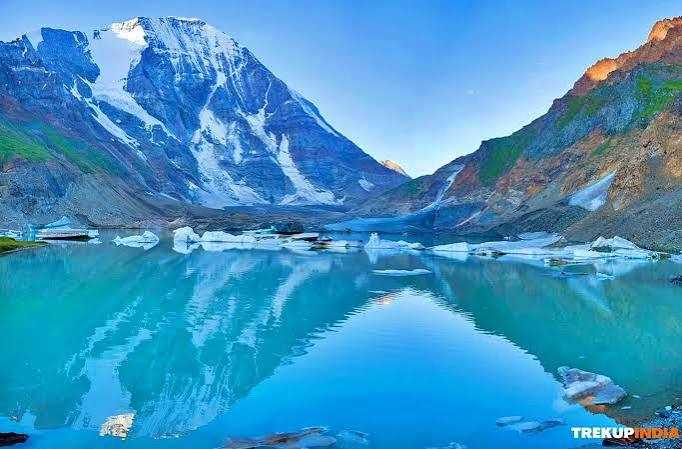
Srinagar, Aug 31: A glacial lake in Jammu and Kashmir’s remote Warwan basin is emerging as a significant climate-linked hazard, with new research warning that an avalanche-triggered outburst could set off a chain of flooding, debris flows and infrastructure damage downstream.
The warning comes from a study titled “Unreported mass movements and future hazard in the Warwan basin, Jammu and Kashmir, Western Himalaya,” which examines the changing glacier, lake and slope conditions in the Fariabad watershed. Researchers have highlighted the interaction of retreating glaciers, expanding glacial lakes, avalanches and unstable terrain as a growing risk in the region.
One of the study’s major concerns is Lake-B, whose surface area expanded from approximately 0.075 sq km in 1999 to 0.306 sq km in 2024—a rise of nearly 308 per cent. The expansion has increased the volume of water potentially exposed to sudden disturbance from an avalanche or other mass movement.
The wider Fariabad watershed contains 272 glaciers covering about 314.6 sq km, while the number and extent of glacial lakes have also changed over the years. Researchers say the evolving landscape demands closer attention because hazards that were once geographically isolated can now interact with one another.
The area has already witnessed major avalanche activity. In 2005, an avalanche originating near GL-B travelled several kilometres but stopped short of the then-smaller lake. Researchers caution that the considerably expanded lake could respond differently if a comparable event occurs today.
Computer modelling examined three possible avalanche-triggered GLOF scenarios. Under the most severe scenario, involving a 25-million-cubic-metre rock-ice avalanche, the simulated peak discharge immediately below the lake reached around 2,214 cubic metres per second. The model indicated that nearly 97.5 per cent of the lake’s stored water could potentially be released.
The implications could extend well beyond the immediate lake zone. The study identifies Youdu and Qaderna among settlements potentially exposed to inundation, while roads, bridges and buildings could also face damage.
Around nine bridges and 40 buildings fall within portions of the modelled exposure area, highlighting the vulnerability created by settlements and infrastructure located along mountain valleys and river corridors.
More worrying is the possibility that an outburst could become a debris-flow event. Sediment accumulated through avalanches, glacier retreat and erosion could be swept downstream along with floodwater, increasing the destructive potential of the event.
The researchers cite a September 2020 incident involving GL-A, when an avalanche struck a proglacial lake and triggered a GLOF accompanied by downstream debris movement. The episode illustrates how one mountain disturbance can rapidly activate several interconnected hazards.
The potential consequences are not restricted to isolated villages. Hydropower infrastructure situated downstream could also be exposed to extreme flood and debris flows, raising concerns for both local communities and critical infrastructure.
The researchers, however, do not suggest that a GLOF is imminent or inevitable. Instead, their modelling demonstrates what could happen under defined triggering conditions and underscores the need to prepare before such an event occurs.
They recommend continuous monitoring of glaciers and glacial lakes, early-warning systems, community preparedness and integrated hazard mapping. Such measures could provide crucial response time for communities living along vulnerable downstream corridors.
The Warwan study ultimately underlines a changing Himalayan reality. Glacier retreat is not merely shrinking ice—it is reshaping the geography of disaster risk. For Jammu and Kashmir, monitoring high-altitude lakes and identifying vulnerable settlements and infrastructure must therefore become an integral part of climate-resilient development.
Srinagar, Aug 31: A glacial lake in Jammu and Kashmir’s remote Warwan basin is emerging as a significant climate-linked hazard, with new research warning that an avalanche-triggered outburst could set off a chain of flooding, debris flows and infrastructure damage downstream.
The warning comes from a study titled “Unreported mass movements and future hazard in the Warwan basin, Jammu and Kashmir, Western Himalaya,” which examines the changing glacier, lake and slope conditions in the Fariabad watershed. Researchers have highlighted the interaction of retreating glaciers, expanding glacial lakes, avalanches and unstable terrain as a growing risk in the region.
One of the study’s major concerns is Lake-B, whose surface area expanded from approximately 0.075 sq km in 1999 to 0.306 sq km in 2024—a rise of nearly 308 per cent. The expansion has increased the volume of water potentially exposed to sudden disturbance from an avalanche or other mass movement.
The wider Fariabad watershed contains 272 glaciers covering about 314.6 sq km, while the number and extent of glacial lakes have also changed over the years. Researchers say the evolving landscape demands closer attention because hazards that were once geographically isolated can now interact with one another.
The area has already witnessed major avalanche activity. In 2005, an avalanche originating near GL-B travelled several kilometres but stopped short of the then-smaller lake. Researchers caution that the considerably expanded lake could respond differently if a comparable event occurs today.
Computer modelling examined three possible avalanche-triggered GLOF scenarios. Under the most severe scenario, involving a 25-million-cubic-metre rock-ice avalanche, the simulated peak discharge immediately below the lake reached around 2,214 cubic metres per second. The model indicated that nearly 97.5 per cent of the lake’s stored water could potentially be released.
The implications could extend well beyond the immediate lake zone. The study identifies Youdu and Qaderna among settlements potentially exposed to inundation, while roads, bridges and buildings could also face damage.
Around nine bridges and 40 buildings fall within portions of the modelled exposure area, highlighting the vulnerability created by settlements and infrastructure located along mountain valleys and river corridors.
More worrying is the possibility that an outburst could become a debris-flow event. Sediment accumulated through avalanches, glacier retreat and erosion could be swept downstream along with floodwater, increasing the destructive potential of the event.
The researchers cite a September 2020 incident involving GL-A, when an avalanche struck a proglacial lake and triggered a GLOF accompanied by downstream debris movement. The episode illustrates how one mountain disturbance can rapidly activate several interconnected hazards.
The potential consequences are not restricted to isolated villages. Hydropower infrastructure situated downstream could also be exposed to extreme flood and debris flows, raising concerns for both local communities and critical infrastructure.
The researchers, however, do not suggest that a GLOF is imminent or inevitable. Instead, their modelling demonstrates what could happen under defined triggering conditions and underscores the need to prepare before such an event occurs.
They recommend continuous monitoring of glaciers and glacial lakes, early-warning systems, community preparedness and integrated hazard mapping. Such measures could provide crucial response time for communities living along vulnerable downstream corridors.
The Warwan study ultimately underlines a changing Himalayan reality. Glacier retreat is not merely shrinking ice—it is reshaping the geography of disaster risk. For Jammu and Kashmir, monitoring high-altitude lakes and identifying vulnerable settlements and infrastructure must therefore become an integral part of climate-resilient development.

© Copyright 2023 brighterkashmir.com All Rights Reserved. Quantum Technologies