
BREAKING NEWS
In a dark room, when a candle is lit, it slowly pushes away the darkness and fills the space with light. In the same way, when a new life is born into a family, that little child becomes a candle that illuminates our lives. As the child grows, begins to smile, babble, and finally speak, that light becomes brighter and more meaningful. This is the law of nature. In humans, so-called social animals, communication is not just a skill; it is the very foundation of life itself.
In a dark room, when a candle is lit, it slowly pushes away the darkness and fills the space with light. In the same way, when a new life is born into a family, that little child becomes a candle that illuminates our lives. As the child grows, begins to smile, babble, and finally speak, that light becomes brighter and more meaningful. This is the law of nature. In humans, so-called social animals, communication is not just a skill; it is the very foundation of life itself.
When a baby comes into our home, the mercy of Allah knocks at our door. Prophet Muhammad (SAW) beautifully said that children are the flowers of Jannah (Heaven). There is deep philosophy behind this saying: flowers need care, nourishment, and attention to spread their fragrance. Similarly, children need more than just good food, fine clothes, and a luxurious life. They need proper nurturing of their minds, hearts, emotions, and abilities. They need love that is spoken, not streamed.
The very first and most important skill we must teach a child is communication. In my perspective, communication is the root skill behind every other skill. Without it, learning becomes difficult, social bonding weakens, and emotional growth suffers. No doubt, parents today are trying their best in a fast and demanding world. But in this age of digitalization, we are unknowingly replacing human interaction with technology. Instead of communicating with our children, we are letting screens communicate with them. Instead of our voices shaping their language, glowing devices are shaping their silence.
Naturally, babies begin their communication journey with simple sounds. By around six months, they start babbling “ba-ba” or “ma-ma.” Between nine to twelve months, they use simple words and gestures. By eighteen months, they can understand basic instructions and respond to familiar voices. This is how nature designed language learning, through listening, observing, imitating, and interacting. A child learns language not from a screen but from faces, expressions, tones, smiles, and emotional connection.
Just one decade ago, who were the teachers of a child’s first words? Parents, grandparents, and near and dear ones. Grandparents would take babies in their laps and hum soft words like “Allah hu,” “ho ho karyo,” “baba,” “mama.” These were the first gentle attempts to shape language. In joint family systems, elders would tell stories at night, sing folk songs, and play sound-imitating games. Family members would sit in circles, make different sounds, and joyfully observe how the child responded. This was not just play, it was powerful training in communication, culture, and emotional bonding.
Children grew up hearing their mother tongue, learning its rhythm, sounds, emotions, and expressions. Parents were keen to teach culture, language, and manners through daily interaction. A child learned to greet, to listen, to reply, and to express feelings simply by living in a communicative environment. All of this built strong communication skills naturally, without any artificial tools.
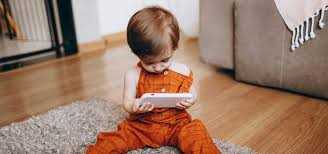
Today, however, the lap of parents has been replaced by the lap of a mobile phone. The device has taken over storytelling, lullabies, feeding time, and even playtime. We are now witnessing a new world of toddlers, children who are quiet not because they are calm or content, but because they are glued to screens. Silence, which we often mistake for peace, is slowly becoming a sign of developmental neglect.
Many children today refuse to eat even a single bite unless a mobile phone is placed in front of them playing reels or cartoons. Some parents proudly say, “My child won’t eat without the phone,” as if it is a cute habit or a smart trick. What we see as convenience is actually harming their natural development. We are training our children to associate basic life activities with artificial stimulation instead of human connection.
Now it is common to see babies of 6–12 months saying words like “mobile” instead of “mama” or “baba.” What they speak is often unclear, mixed, and beyond our understanding. Many toddlers are unable to speak their mother tongue properly, and they struggle even with other languages. Screen addiction is not only affecting their physical growth but also their cognitive, emotional, and linguistic development. Their attention spans are shrinking, their patience is weakening, and their ability to form meaningful social bonds is silently eroding.
Scientific research strongly supports these worrying observations. Large-scale studies have found that mobile device screen time of one hour or more per day is significantly associated with poorer language development among toddlers. High screen time increases the risk of both language comprehension difficulties and expressive speech delays. Each additional 30 minutes of handheld screen time can raise the risk of expressive speech delay. Children spending more than two hours daily on screens show increased risks of struggling to form words and sentences.
Experts also note that reading frequently to a child can help improve comprehension, but it cannot fully compensate for the loss of real-life interaction. Screens replace vital face-to-face conversations needed for learning communication. This leads to reduced vocabulary, weaker social skills, shorter attention spans, difficulty learning new words, and emotional detachment. A screen can show images and sounds, but it cannot respond with love, patience, or emotional understanding.
When our children start screaming and crying instead of talking in our laps, and we hand them a mobile phone to silence them, we are unknowingly killing their natural development. We say we don’t have time to talk to them, but we always have time to give them a phone. We choose the easier path today, forgetting the heavier consequences tomorrow.
We must understand that we are shaping the future generation. If we fail to give our children real human interaction, warmth, stories, songs, and conversations, we cannot expect them to grow into confident communicators, empathetic individuals, or emotionally stable adults. A child who is not spoken to becomes a child who cannot speak properly, not just in words, but in emotions, confidence, and relationships.
To be a responsible parent today means limiting screen time strictly, especially for toddlers. It means talking to children frequently, even if they cannot reply clearly. It means reading stories aloud, singing lullabies, encouraging play, imitation, and conversation. It means letting grandparents and family members interact with children. It means teaching them their mother tongue with love and patience. Above all, it means being emotionally present, not digitally distracted.
Children are not born with screens in their hands; they are born with hearts ready to connect and minds ready to learn. Communication is the candle that lights their life. If we replace that candle with a glowing screen, we risk leaving their inner world in darkness.
Let us bring back lullabies, stories, conversations, and human warmth into our homes. Let us be present in our children’s lives, not replaced by devices. Only then can we truly honour the blessing Allah has given us in the form of our children.
Email:-----------------------tawheed.biotech12@gmail.com
In a dark room, when a candle is lit, it slowly pushes away the darkness and fills the space with light. In the same way, when a new life is born into a family, that little child becomes a candle that illuminates our lives. As the child grows, begins to smile, babble, and finally speak, that light becomes brighter and more meaningful. This is the law of nature. In humans, so-called social animals, communication is not just a skill; it is the very foundation of life itself.
In a dark room, when a candle is lit, it slowly pushes away the darkness and fills the space with light. In the same way, when a new life is born into a family, that little child becomes a candle that illuminates our lives. As the child grows, begins to smile, babble, and finally speak, that light becomes brighter and more meaningful. This is the law of nature. In humans, so-called social animals, communication is not just a skill; it is the very foundation of life itself.
When a baby comes into our home, the mercy of Allah knocks at our door. Prophet Muhammad (SAW) beautifully said that children are the flowers of Jannah (Heaven). There is deep philosophy behind this saying: flowers need care, nourishment, and attention to spread their fragrance. Similarly, children need more than just good food, fine clothes, and a luxurious life. They need proper nurturing of their minds, hearts, emotions, and abilities. They need love that is spoken, not streamed.
The very first and most important skill we must teach a child is communication. In my perspective, communication is the root skill behind every other skill. Without it, learning becomes difficult, social bonding weakens, and emotional growth suffers. No doubt, parents today are trying their best in a fast and demanding world. But in this age of digitalization, we are unknowingly replacing human interaction with technology. Instead of communicating with our children, we are letting screens communicate with them. Instead of our voices shaping their language, glowing devices are shaping their silence.
Naturally, babies begin their communication journey with simple sounds. By around six months, they start babbling “ba-ba” or “ma-ma.” Between nine to twelve months, they use simple words and gestures. By eighteen months, they can understand basic instructions and respond to familiar voices. This is how nature designed language learning, through listening, observing, imitating, and interacting. A child learns language not from a screen but from faces, expressions, tones, smiles, and emotional connection.
Just one decade ago, who were the teachers of a child’s first words? Parents, grandparents, and near and dear ones. Grandparents would take babies in their laps and hum soft words like “Allah hu,” “ho ho karyo,” “baba,” “mama.” These were the first gentle attempts to shape language. In joint family systems, elders would tell stories at night, sing folk songs, and play sound-imitating games. Family members would sit in circles, make different sounds, and joyfully observe how the child responded. This was not just play, it was powerful training in communication, culture, and emotional bonding.
Children grew up hearing their mother tongue, learning its rhythm, sounds, emotions, and expressions. Parents were keen to teach culture, language, and manners through daily interaction. A child learned to greet, to listen, to reply, and to express feelings simply by living in a communicative environment. All of this built strong communication skills naturally, without any artificial tools.
Today, however, the lap of parents has been replaced by the lap of a mobile phone. The device has taken over storytelling, lullabies, feeding time, and even playtime. We are now witnessing a new world of toddlers, children who are quiet not because they are calm or content, but because they are glued to screens. Silence, which we often mistake for peace, is slowly becoming a sign of developmental neglect.
Many children today refuse to eat even a single bite unless a mobile phone is placed in front of them playing reels or cartoons. Some parents proudly say, “My child won’t eat without the phone,” as if it is a cute habit or a smart trick. What we see as convenience is actually harming their natural development. We are training our children to associate basic life activities with artificial stimulation instead of human connection.
Now it is common to see babies of 6–12 months saying words like “mobile” instead of “mama” or “baba.” What they speak is often unclear, mixed, and beyond our understanding. Many toddlers are unable to speak their mother tongue properly, and they struggle even with other languages. Screen addiction is not only affecting their physical growth but also their cognitive, emotional, and linguistic development. Their attention spans are shrinking, their patience is weakening, and their ability to form meaningful social bonds is silently eroding.
Scientific research strongly supports these worrying observations. Large-scale studies have found that mobile device screen time of one hour or more per day is significantly associated with poorer language development among toddlers. High screen time increases the risk of both language comprehension difficulties and expressive speech delays. Each additional 30 minutes of handheld screen time can raise the risk of expressive speech delay. Children spending more than two hours daily on screens show increased risks of struggling to form words and sentences.
Experts also note that reading frequently to a child can help improve comprehension, but it cannot fully compensate for the loss of real-life interaction. Screens replace vital face-to-face conversations needed for learning communication. This leads to reduced vocabulary, weaker social skills, shorter attention spans, difficulty learning new words, and emotional detachment. A screen can show images and sounds, but it cannot respond with love, patience, or emotional understanding.
When our children start screaming and crying instead of talking in our laps, and we hand them a mobile phone to silence them, we are unknowingly killing their natural development. We say we don’t have time to talk to them, but we always have time to give them a phone. We choose the easier path today, forgetting the heavier consequences tomorrow.
We must understand that we are shaping the future generation. If we fail to give our children real human interaction, warmth, stories, songs, and conversations, we cannot expect them to grow into confident communicators, empathetic individuals, or emotionally stable adults. A child who is not spoken to becomes a child who cannot speak properly, not just in words, but in emotions, confidence, and relationships.
To be a responsible parent today means limiting screen time strictly, especially for toddlers. It means talking to children frequently, even if they cannot reply clearly. It means reading stories aloud, singing lullabies, encouraging play, imitation, and conversation. It means letting grandparents and family members interact with children. It means teaching them their mother tongue with love and patience. Above all, it means being emotionally present, not digitally distracted.
Children are not born with screens in their hands; they are born with hearts ready to connect and minds ready to learn. Communication is the candle that lights their life. If we replace that candle with a glowing screen, we risk leaving their inner world in darkness.
Let us bring back lullabies, stories, conversations, and human warmth into our homes. Let us be present in our children’s lives, not replaced by devices. Only then can we truly honour the blessing Allah has given us in the form of our children.
Email:-----------------------tawheed.biotech12@gmail.com

© Copyright 2023 brighterkashmir.com All Rights Reserved. Quantum Technologies