
BREAKING NEWS
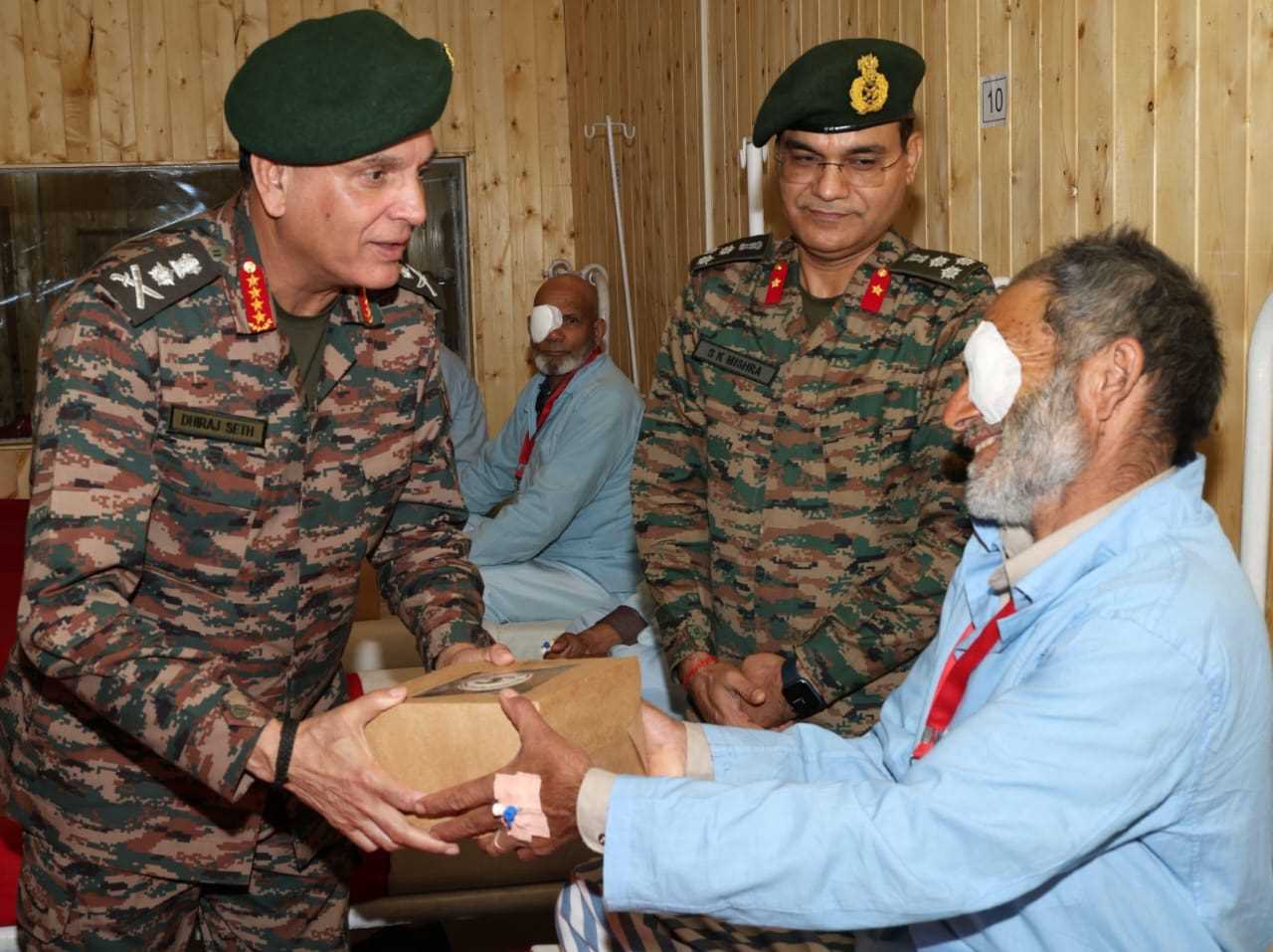
Tangdhar, Sep 25: Army chief General Dhiraj Seth on Friday visited Tangdhar and interacted with Army veterans during the closing ceremony of the Tangdhar phase of Operation Drishti, a specialised cataract surgery initiative aimed at taking advanced eye care to civilians and veterans in remote and border areas of Kashmir.
He was accompanied by Northern Command Commander Lt General Pratik Sharma and Chinar Corps Commander Lieutenant General Balbir Singh, Major General Rakesh Nair, General Officer Commanding, 28 Infantry Division, and Brigadier Dr Sanjay Kumar Mishra, Head of Ophthalmology at Army Hospital, Research and Referral, New Delhi and other officers.
General Seth acknowledged the contribution of Army veterans and assured them of continued support.
His visit coincided with the completion of first phase of the initiative at the Underground Forward Surgical Centre of the former 328 Field Hospital in Tangdhar, where around 200 patients were scheduled to undergo cataract surgeries on September 24 and 25.
The wider outreach programme identified around 400 patients through screening camps conducted in Tangdhar, Uri, Bandipora, Khanabal, Kangan, Dawar and Baramulla. The remaining patients are scheduled to undergo surgery at 92 Base Hospital, Badami Bagh Cantonment, Srinagar, during the second phase.
The specialised surgical team was led by Brigadier Dr Sanjay Kumar Mishra, who said the programme was developed through coordinated efforts of Army Hospital, Research and Referral, 92 Base Hospital Srinagar and 328 Field Hospital Tangdhar.
Speaking to the media, Brigadier Mishra said the initial phase was undertaken by the 92 Base Hospital team, led by Brigadier B. V. Rao, Commandant of the hospital.
Following the response from beneficiaries and identification of additional patients requiring specialised treatment, the Army expanded the programme into a larger surgical camp.
A specialised ophthalmology team from Army Hospital, Research and Referral, New Delhi, subsequently travelled to Tangdhar with advanced diagnostic and microsurgical equipment, along with specialised intraocular lenses required for cataract procedures.
Around 110 patients underwent surgery on the first day of the main camp, taking the total number operated upon to nearly 130 when the initial procedures were included. Another 88 patients were scheduled for surgery on the following day.
Brigadier Mishra said the initiative was particularly significant for Tangdhar and adjoining border areas, where access to specialised healthcare can involve considerable travel and expense. The underground surgical facility at the former 328 Field Hospital provided an established operation theatre environment for conducting the procedures safely and efficiently.
“This is not the end. This is a beginning,” he said, indicating that similar specialised medical outreach programmes could be extended to other remote areas of Kashmir.
For beneficiaries, the initiative brought more than medical treatment closer to home—it reduced the burden of travelling to distant hospitals and helped families avoid additional expenses on transportation and accommodation.
Ghulam Jilani, a Tangdhar resident, said patients underwent medical tests before surgery and post-operative examinations afterwards.
He thanked the Army for providing surgery, medicines, food and transportation support.
Mohammad Maqbool of Dildar village said his wife had been suffering from an eye ailment for two to three years but limited income and cost of travelling outside the area had made specialised treatment difficult.
Another beneficiary, Sarwar Mir, appreciated the treatment and arrangements at the camp, saying similar procedures at private facilities could have imposed a significant financial burden on families with limited means.
Patients and attendants also appreciated the provision of medicines, food, tea and transportation assistance, saying the arrangements enabled them to undergo treatment without additional expenditure.
Operation Drishti is being conducted under Army’s wider healthcare outreach initiative, Operation Sadbhavana, with the objective of taking specialised medical services closer to civilians and veterans in remote and underserved areas.
Army said the programme also demonstrated the importance of coordination among its medical institutions, with 92 Base Hospital, 328 Field Hospital and Army Hospital, Research and Referral, New Delhi, contributing at different stages.
The initiative was supported by senior Army leadership, including Defence Minister Rajnath Singh, Chief of the Army Staff General Dhiraj Seth, Northern Command Commander Lieutenant General Pratik Sharma and Chinar Corps Commander Lieutenant General Balbir Singh.
Tangdhar, Sep 25: Army chief General Dhiraj Seth on Friday visited Tangdhar and interacted with Army veterans during the closing ceremony of the Tangdhar phase of Operation Drishti, a specialised cataract surgery initiative aimed at taking advanced eye care to civilians and veterans in remote and border areas of Kashmir.
He was accompanied by Northern Command Commander Lt General Pratik Sharma and Chinar Corps Commander Lieutenant General Balbir Singh, Major General Rakesh Nair, General Officer Commanding, 28 Infantry Division, and Brigadier Dr Sanjay Kumar Mishra, Head of Ophthalmology at Army Hospital, Research and Referral, New Delhi and other officers.
General Seth acknowledged the contribution of Army veterans and assured them of continued support.
His visit coincided with the completion of first phase of the initiative at the Underground Forward Surgical Centre of the former 328 Field Hospital in Tangdhar, where around 200 patients were scheduled to undergo cataract surgeries on September 24 and 25.
The wider outreach programme identified around 400 patients through screening camps conducted in Tangdhar, Uri, Bandipora, Khanabal, Kangan, Dawar and Baramulla. The remaining patients are scheduled to undergo surgery at 92 Base Hospital, Badami Bagh Cantonment, Srinagar, during the second phase.
The specialised surgical team was led by Brigadier Dr Sanjay Kumar Mishra, who said the programme was developed through coordinated efforts of Army Hospital, Research and Referral, 92 Base Hospital Srinagar and 328 Field Hospital Tangdhar.
Speaking to the media, Brigadier Mishra said the initial phase was undertaken by the 92 Base Hospital team, led by Brigadier B. V. Rao, Commandant of the hospital.
Following the response from beneficiaries and identification of additional patients requiring specialised treatment, the Army expanded the programme into a larger surgical camp.
A specialised ophthalmology team from Army Hospital, Research and Referral, New Delhi, subsequently travelled to Tangdhar with advanced diagnostic and microsurgical equipment, along with specialised intraocular lenses required for cataract procedures.
Around 110 patients underwent surgery on the first day of the main camp, taking the total number operated upon to nearly 130 when the initial procedures were included. Another 88 patients were scheduled for surgery on the following day.
Brigadier Mishra said the initiative was particularly significant for Tangdhar and adjoining border areas, where access to specialised healthcare can involve considerable travel and expense. The underground surgical facility at the former 328 Field Hospital provided an established operation theatre environment for conducting the procedures safely and efficiently.
“This is not the end. This is a beginning,” he said, indicating that similar specialised medical outreach programmes could be extended to other remote areas of Kashmir.
For beneficiaries, the initiative brought more than medical treatment closer to home—it reduced the burden of travelling to distant hospitals and helped families avoid additional expenses on transportation and accommodation.
Ghulam Jilani, a Tangdhar resident, said patients underwent medical tests before surgery and post-operative examinations afterwards.
He thanked the Army for providing surgery, medicines, food and transportation support.
Mohammad Maqbool of Dildar village said his wife had been suffering from an eye ailment for two to three years but limited income and cost of travelling outside the area had made specialised treatment difficult.
Another beneficiary, Sarwar Mir, appreciated the treatment and arrangements at the camp, saying similar procedures at private facilities could have imposed a significant financial burden on families with limited means.
Patients and attendants also appreciated the provision of medicines, food, tea and transportation assistance, saying the arrangements enabled them to undergo treatment without additional expenditure.
Operation Drishti is being conducted under Army’s wider healthcare outreach initiative, Operation Sadbhavana, with the objective of taking specialised medical services closer to civilians and veterans in remote and underserved areas.
Army said the programme also demonstrated the importance of coordination among its medical institutions, with 92 Base Hospital, 328 Field Hospital and Army Hospital, Research and Referral, New Delhi, contributing at different stages.
The initiative was supported by senior Army leadership, including Defence Minister Rajnath Singh, Chief of the Army Staff General Dhiraj Seth, Northern Command Commander Lieutenant General Pratik Sharma and Chinar Corps Commander Lieutenant General Balbir Singh.

© Copyright 2023 brighterkashmir.com All Rights Reserved. Quantum Technologies