
BREAKING NEWS
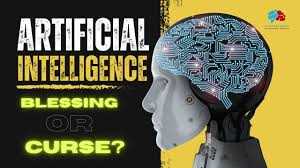
The concept of Artificial Intelligence (AI) has quickly become one of the forceful elements redesigning the scientific research process in all disciplines. On one side, AI-based tools are altering the manner in which science is practiced, whether it is in the acceleration of drug discovery or model decoding of notoriously difficult climatic events. But, in addition to its astonishing potential, AI also casts some very important questions of reliability, ethics and the nature of scientific investigation. This duality raises a serious question: Is the artificial intelligence a blessing or a curse to scientific research?
It is hardly questionable that AI has turned out to be a great contribution to the contemporary science. It has one of the biggest advantages in managing huge volumes of data- a feature that is usually difficult to manage with the traditional research methods. In other sciences like genomics, astronomy, materials science and particle physics, researchers produce terabytes of data each day. Artificial intelligence algorithm can quickly examine patterns, discover correlations, and create insights of value that would require human beings years to discover.
AI has proved to have tremendous potential in the fields of healthcare and life science. Disease outcomes, medical imaging, and drug development have become the domains where machine learning models are in use to predict and accelerate the development of drugs. The use of AI during the COVID-19 pandemic helped in virus spread modelling, identification of potential drug candidates, and vaccine research. The use of AI to conserve time, cut costs, and eventually improve society is emphasized with such applications.
Materials and energy research is another area where AI is coming in handy. Scientists can predict the material properties, create environmentally friendly alternatives, and optimise energy conversion systems with the help of AI. Through minimizing the process of experimentation, AI will assist researchers identify the most promising solutions and thus accelerate the innovation process whilst also saving on resources.
Nonetheless, even with these benefits, AI does not lack any issues and threats. A significant issue is that many AI models are black box in nature. Algorithms can be used to provide accurate predictions but in most cases cannot answer why a specific result was achieved. Such a lack of transparency is incompatible with the very principle of science reproducibility and comprehension. In case scientists only use AI-generated information, without understanding the process behind it, the rigor of science can be violated.
Data bias is another burning problem. The quality of AIs only goes as far as the quality of the data on which they have been trained. Any unbalanced or incomplete data may result in erroneous decisions and support the status quo or give false outcomes. In topics like medical research or environmental policy, these mistakes can have some significant real-life implications.
Ethical issues are also overshadowing. The issues of data privacy, intellectual property, and accountable AI usage are becoming more and more topical. The increase in the application of AI generated text and images in academic writing has generated issues regarding authorship, originality, and academic integrity. This may destroy the credibility of the scientific publications unless the misuse of AI tools is properly guided.
It is also feared that excessive reliance on AI can kill human creativity and critical thinking. Curiosity, intuition and capability to question assumptions are true values of science that can never be replicated in machines. Provided that AI takes the shape of a replacement, rather than a complement to human thought, then it is possible that the nature of scientific inquiry becomes endangered.
So, is AI a boon or a bane? The solution is somewhere in the middle. Artificial intelligence is neither evil nor good, the effect is determined by the way it is created or controlled and applied. Used in a way that is responsible, artificial intelligence can be an effective aid, one that can support human intelligence and not displace it.
Strong ethical frameworks, open algorithms and the interdisciplinary cooperation are all needed to make AI a blessing. The collaboration between scientists, policymakers and educators should be aimed at providing clear guidelines that will encourage responsible innovation and accountability. It is also vital to instruct researchers on how to use AI tools, their weaknesses and implications.
The future of scientific research is characterized by a change, in which AI must not be regarded as a competitor but rather a collaborator. Artificial intelligence has the power to aid science in going faster, deeper, and more sustainably without losing its human essence with careful supervision and wise incorporation.
Email:-----------------randeep.e13927@cumail.in
The concept of Artificial Intelligence (AI) has quickly become one of the forceful elements redesigning the scientific research process in all disciplines. On one side, AI-based tools are altering the manner in which science is practiced, whether it is in the acceleration of drug discovery or model decoding of notoriously difficult climatic events. But, in addition to its astonishing potential, AI also casts some very important questions of reliability, ethics and the nature of scientific investigation. This duality raises a serious question: Is the artificial intelligence a blessing or a curse to scientific research?
It is hardly questionable that AI has turned out to be a great contribution to the contemporary science. It has one of the biggest advantages in managing huge volumes of data- a feature that is usually difficult to manage with the traditional research methods. In other sciences like genomics, astronomy, materials science and particle physics, researchers produce terabytes of data each day. Artificial intelligence algorithm can quickly examine patterns, discover correlations, and create insights of value that would require human beings years to discover.
AI has proved to have tremendous potential in the fields of healthcare and life science. Disease outcomes, medical imaging, and drug development have become the domains where machine learning models are in use to predict and accelerate the development of drugs. The use of AI during the COVID-19 pandemic helped in virus spread modelling, identification of potential drug candidates, and vaccine research. The use of AI to conserve time, cut costs, and eventually improve society is emphasized with such applications.
Materials and energy research is another area where AI is coming in handy. Scientists can predict the material properties, create environmentally friendly alternatives, and optimise energy conversion systems with the help of AI. Through minimizing the process of experimentation, AI will assist researchers identify the most promising solutions and thus accelerate the innovation process whilst also saving on resources.
Nonetheless, even with these benefits, AI does not lack any issues and threats. A significant issue is that many AI models are black box in nature. Algorithms can be used to provide accurate predictions but in most cases cannot answer why a specific result was achieved. Such a lack of transparency is incompatible with the very principle of science reproducibility and comprehension. In case scientists only use AI-generated information, without understanding the process behind it, the rigor of science can be violated.
Data bias is another burning problem. The quality of AIs only goes as far as the quality of the data on which they have been trained. Any unbalanced or incomplete data may result in erroneous decisions and support the status quo or give false outcomes. In topics like medical research or environmental policy, these mistakes can have some significant real-life implications.
Ethical issues are also overshadowing. The issues of data privacy, intellectual property, and accountable AI usage are becoming more and more topical. The increase in the application of AI generated text and images in academic writing has generated issues regarding authorship, originality, and academic integrity. This may destroy the credibility of the scientific publications unless the misuse of AI tools is properly guided.
It is also feared that excessive reliance on AI can kill human creativity and critical thinking. Curiosity, intuition and capability to question assumptions are true values of science that can never be replicated in machines. Provided that AI takes the shape of a replacement, rather than a complement to human thought, then it is possible that the nature of scientific inquiry becomes endangered.
So, is AI a boon or a bane? The solution is somewhere in the middle. Artificial intelligence is neither evil nor good, the effect is determined by the way it is created or controlled and applied. Used in a way that is responsible, artificial intelligence can be an effective aid, one that can support human intelligence and not displace it.
Strong ethical frameworks, open algorithms and the interdisciplinary cooperation are all needed to make AI a blessing. The collaboration between scientists, policymakers and educators should be aimed at providing clear guidelines that will encourage responsible innovation and accountability. It is also vital to instruct researchers on how to use AI tools, their weaknesses and implications.
The future of scientific research is characterized by a change, in which AI must not be regarded as a competitor but rather a collaborator. Artificial intelligence has the power to aid science in going faster, deeper, and more sustainably without losing its human essence with careful supervision and wise incorporation.
Email:-----------------randeep.e13927@cumail.in

© Copyright 2023 brighterkashmir.com All Rights Reserved. Quantum Technologies