
BREAKING NEWS
In an age where convenience defines modern life, the story of Ghulam Mohammad, affectionately known as “Mohmud,” from the remote village of Kandi in Baramulla district, stands as a quiet yet powerful testament to human resilience and dignity.
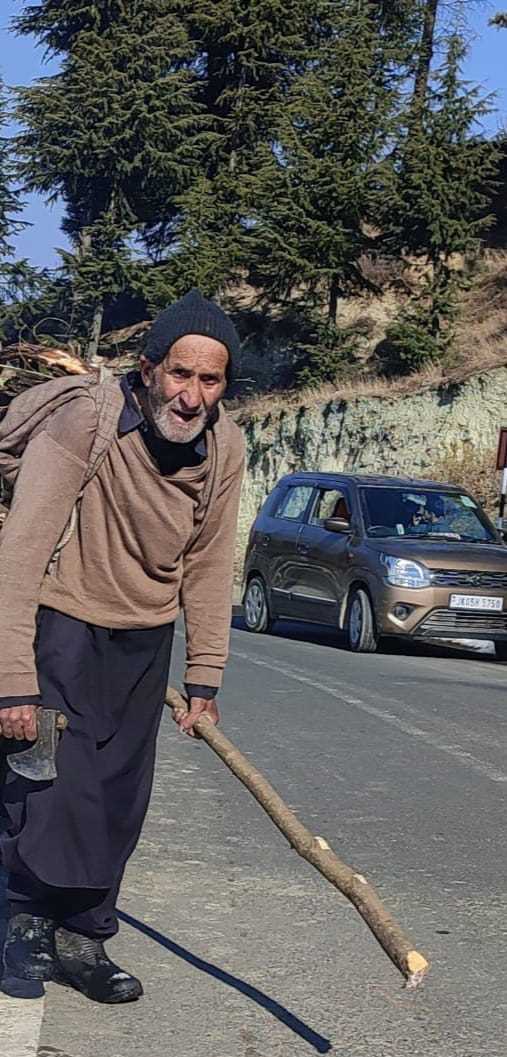
At over 70 years of age, Mohmud begins his day before sunrise, preparing a modest bundle of goods—often firewood and sets out on foot for a 12-kilometer journey to the nearest market. With a weathered walking stick in hand and a resolve carved by decades of hardship, he treads the winding paths and uneven terrain, driven not by choice, but by necessity.
For Mohmud, this daily trek is not a matter of fitness or routine—it is survival. The modest earnings he makes from selling his goods are the lifeline for his household. In a region where economic opportunities are scarce and social safety nets thin, his labor is the only means to put food on the table.
“I’ve done this for years,” he says with a faint smile. “It’s not easy, but what else can I do? My family depends on me.”
His story is not unique in rural Kashmir, where many elderly individuals continue to shoulder the burden of livelihood in the absence of pensions, employment, or consistent support. Yet, Mohmud’s perseverance has struck a chord with many who have come to know of his journey—both literal and metaphorical.
Local residents often express admiration for his spirit. “He never complains,” says a fellow vendor. “Rain, snow, or sun—he’s always there, sitting quietly with his goods. He’s an inspiration.”
In a world increasingly driven by technology and speed, Mohmud’s life may seem like a relic of the past. But for many in rural India, this is the present reality—a daily struggle marked by grit, sacrifice, and unwavering commitment to family.
His story is a reminder that heroism doesn’t always wear a uniform or make headlines. Sometimes, it walks 12 kilometers each day, with a sack of goods and a heart full of purpose.
In an age where convenience defines modern life, the story of Ghulam Mohammad, affectionately known as “Mohmud,” from the remote village of Kandi in Baramulla district, stands as a quiet yet powerful testament to human resilience and dignity.
At over 70 years of age, Mohmud begins his day before sunrise, preparing a modest bundle of goods—often firewood and sets out on foot for a 12-kilometer journey to the nearest market. With a weathered walking stick in hand and a resolve carved by decades of hardship, he treads the winding paths and uneven terrain, driven not by choice, but by necessity.
For Mohmud, this daily trek is not a matter of fitness or routine—it is survival. The modest earnings he makes from selling his goods are the lifeline for his household. In a region where economic opportunities are scarce and social safety nets thin, his labor is the only means to put food on the table.
“I’ve done this for years,” he says with a faint smile. “It’s not easy, but what else can I do? My family depends on me.”
His story is not unique in rural Kashmir, where many elderly individuals continue to shoulder the burden of livelihood in the absence of pensions, employment, or consistent support. Yet, Mohmud’s perseverance has struck a chord with many who have come to know of his journey—both literal and metaphorical.
Local residents often express admiration for his spirit. “He never complains,” says a fellow vendor. “Rain, snow, or sun—he’s always there, sitting quietly with his goods. He’s an inspiration.”
In a world increasingly driven by technology and speed, Mohmud’s life may seem like a relic of the past. But for many in rural India, this is the present reality—a daily struggle marked by grit, sacrifice, and unwavering commitment to family.
His story is a reminder that heroism doesn’t always wear a uniform or make headlines. Sometimes, it walks 12 kilometers each day, with a sack of goods and a heart full of purpose.

© Copyright 2023 brighterkashmir.com All Rights Reserved. Quantum Technologies