
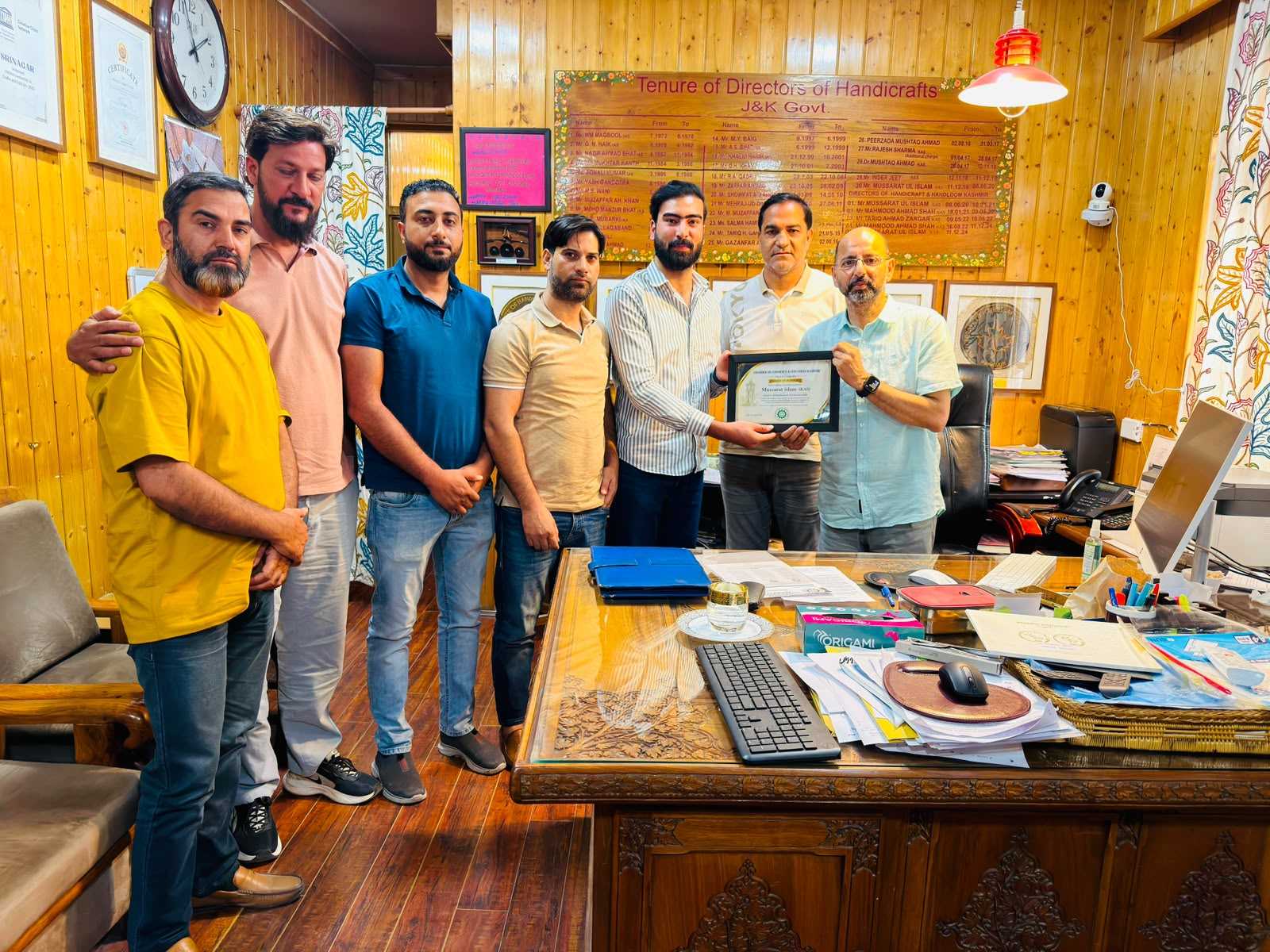
Srinagar, August 8: A delegation of the Chamber of Commerce & Industries Kashmir (CCIK), led by Joint Secretary Aatif Khan, met Director Handicrafts & Handloom Kashmir Masrat-ul-Islam (JKAS) and submitted a memorandum highlighting key concerns facing the handicrafts sector.
The delegation called for proper GI tagging and certification of handmade and machine-made products across all traditional crafts, not just Pashmina. It also sought urgent measures to revive Kashmir’s struggling carpet industry and demanded a fixed wage policy for artisans, noting that low earnings are discouraging younger generations from pursuing traditional crafts.
Responding to the concerns, Director Handicrafts & Handloom Kashmir Masrat-ul-Islam said the department has already formulated policies concerning fixed wages and artisan welfare. He said the proposed measures are expected to improve artisans’ earnings and working conditions and encourage youth to continue with traditional crafts. The policies, he added, are currently awaiting necessary government approvals for implementation.
On the carpet industry, the Director said the department plans to promote the production of affordable, quality and market-competitive carpets. The initiative, he said, would help revive the sector, generate employment and strengthen Kashmir’s presence in domestic and international markets.
The CCIK delegation appreciated the department’s response and assured its cooperation in taking the proposed initiatives forward.
The delegation comprised CCIK Chief Coordinator Ashiq Bhat, Executive Committee Members Zahoor and Adil, and members Suhail and Shabir, besides Joint Secretary Aatif Khan.
CCIK reiterated its commitment to protecting artisans’ interests, promoting genuine Kashmiri handicrafts and working with the department to ensure sustainable growth and preservation of the region’s rich craft heritage.

Srinagar, August 8: A delegation of the Chamber of Commerce & Industries Kashmir (CCIK), led by Joint Secretary Aatif Khan, met Director Handicrafts & Handloom Kashmir Masrat-ul-Islam (JKAS) and submitted a memorandum highlighting key concerns facing the handicrafts sector.
The delegation called for proper GI tagging and certification of handmade and machine-made products across all traditional crafts, not just Pashmina. It also sought urgent measures to revive Kashmir’s struggling carpet industry and demanded a fixed wage policy for artisans, noting that low earnings are discouraging younger generations from pursuing traditional crafts.
Responding to the concerns, Director Handicrafts & Handloom Kashmir Masrat-ul-Islam said the department has already formulated policies concerning fixed wages and artisan welfare. He said the proposed measures are expected to improve artisans’ earnings and working conditions and encourage youth to continue with traditional crafts. The policies, he added, are currently awaiting necessary government approvals for implementation.
On the carpet industry, the Director said the department plans to promote the production of affordable, quality and market-competitive carpets. The initiative, he said, would help revive the sector, generate employment and strengthen Kashmir’s presence in domestic and international markets.
The CCIK delegation appreciated the department’s response and assured its cooperation in taking the proposed initiatives forward.
The delegation comprised CCIK Chief Coordinator Ashiq Bhat, Executive Committee Members Zahoor and Adil, and members Suhail and Shabir, besides Joint Secretary Aatif Khan.
CCIK reiterated its commitment to protecting artisans’ interests, promoting genuine Kashmiri handicrafts and working with the department to ensure sustainable growth and preservation of the region’s rich craft heritage.

© Copyright 2023 brighterkashmir.com All Rights Reserved. Quantum Technologies