
BREAKING NEWS
Srinagar, June 10: In a major policy push to tackle substance abuse, Chief Secretary Atal Dulloo has initiated a comprehensive Rehabilitation and Socio-Economic Reintegration Framework aimed at ensuring long-term recovery and reintegration of drug abuse victims in Jammu and Kashmir.
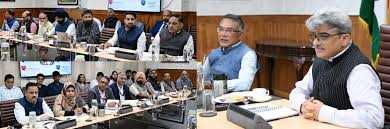
The framework, discussed in a high-level meeting attended by senior officials from the Home, Finance, Social Welfare, School Education and Skill Development departments, focuses on moving beyond detoxification to a structured recovery model combining medical care, counselling, education, skill development and employment support.
The proposed system will be based on Individual Reintegration Plans (IRPs), customized for each beneficiary to ensure tailored rehabilitation and sustained recovery. The Chief Secretary stressed that the model should first be implemented on a pilot basis through IMHANS Srinagar and one additional district before being scaled across the Union Territory.
Under the framework, Addiction Treatment Facilities (ATFs) will operate through a coordinated system involving psychiatrists, counsellors, ASHA workers and social workers. ASHA workers will assist in treatment adherence and follow-ups, while social workers will support beneficiaries in recovery, motivation and reintegration into society.
The plan also integrates beneficiaries with self-employment schemes, livelihood programmes, education continuation and Centrally Sponsored Schemes to promote economic independence and reduce relapse risk.
Additional Chief Secretary Finance Shailendra Kumar assured full support for implementation and advised refinement of the framework to ensure better outcomes for affected individuals.
Principal Secretary Home Chandraker Bharti said the initiative is structured around six key objectives, including a complete rehabilitation cycle, seamless transition from treatment to reintegration, relapse prevention, mentor-led handholding, inter-departmental coordination and ensuring stable recovery before exit from the system.
Commissioner Secretary Social Welfare Sarmad Hafeez said the rehabilitation process will be implemented in three phases—treatment and stabilization, socio-economic reintegration, and sustained monitoring with long-term support.
A key feature of the programme is mentor-led guidance, where each beneficiary will be assigned a dedicated mentor responsible for continuous monitoring, coordination and support through physical, telephonic and digital follow-ups.
Head of IMHANS Srinagar, Prof. (Dr.) Arshid Hussain, presented the clinical framework and the institution’s “Circle of Care” model, along with capacity-building and training plans for personnel involved in the programme.
Officials said the initiative aims to create a sustainable, evidence-based rehabilitation system that ensures recovery, dignity and long-term socio-economic stability for individuals affected by drug addiction in the region.
Srinagar, June 10: In a major policy push to tackle substance abuse, Chief Secretary Atal Dulloo has initiated a comprehensive Rehabilitation and Socio-Economic Reintegration Framework aimed at ensuring long-term recovery and reintegration of drug abuse victims in Jammu and Kashmir.
The framework, discussed in a high-level meeting attended by senior officials from the Home, Finance, Social Welfare, School Education and Skill Development departments, focuses on moving beyond detoxification to a structured recovery model combining medical care, counselling, education, skill development and employment support.
The proposed system will be based on Individual Reintegration Plans (IRPs), customized for each beneficiary to ensure tailored rehabilitation and sustained recovery. The Chief Secretary stressed that the model should first be implemented on a pilot basis through IMHANS Srinagar and one additional district before being scaled across the Union Territory.
Under the framework, Addiction Treatment Facilities (ATFs) will operate through a coordinated system involving psychiatrists, counsellors, ASHA workers and social workers. ASHA workers will assist in treatment adherence and follow-ups, while social workers will support beneficiaries in recovery, motivation and reintegration into society.
The plan also integrates beneficiaries with self-employment schemes, livelihood programmes, education continuation and Centrally Sponsored Schemes to promote economic independence and reduce relapse risk.
Additional Chief Secretary Finance Shailendra Kumar assured full support for implementation and advised refinement of the framework to ensure better outcomes for affected individuals.
Principal Secretary Home Chandraker Bharti said the initiative is structured around six key objectives, including a complete rehabilitation cycle, seamless transition from treatment to reintegration, relapse prevention, mentor-led handholding, inter-departmental coordination and ensuring stable recovery before exit from the system.
Commissioner Secretary Social Welfare Sarmad Hafeez said the rehabilitation process will be implemented in three phases—treatment and stabilization, socio-economic reintegration, and sustained monitoring with long-term support.
A key feature of the programme is mentor-led guidance, where each beneficiary will be assigned a dedicated mentor responsible for continuous monitoring, coordination and support through physical, telephonic and digital follow-ups.
Head of IMHANS Srinagar, Prof. (Dr.) Arshid Hussain, presented the clinical framework and the institution’s “Circle of Care” model, along with capacity-building and training plans for personnel involved in the programme.
Officials said the initiative aims to create a sustainable, evidence-based rehabilitation system that ensures recovery, dignity and long-term socio-economic stability for individuals affected by drug addiction in the region.

© Copyright 2023 brighterkashmir.com All Rights Reserved. Quantum Technologies