
BREAKING NEWS
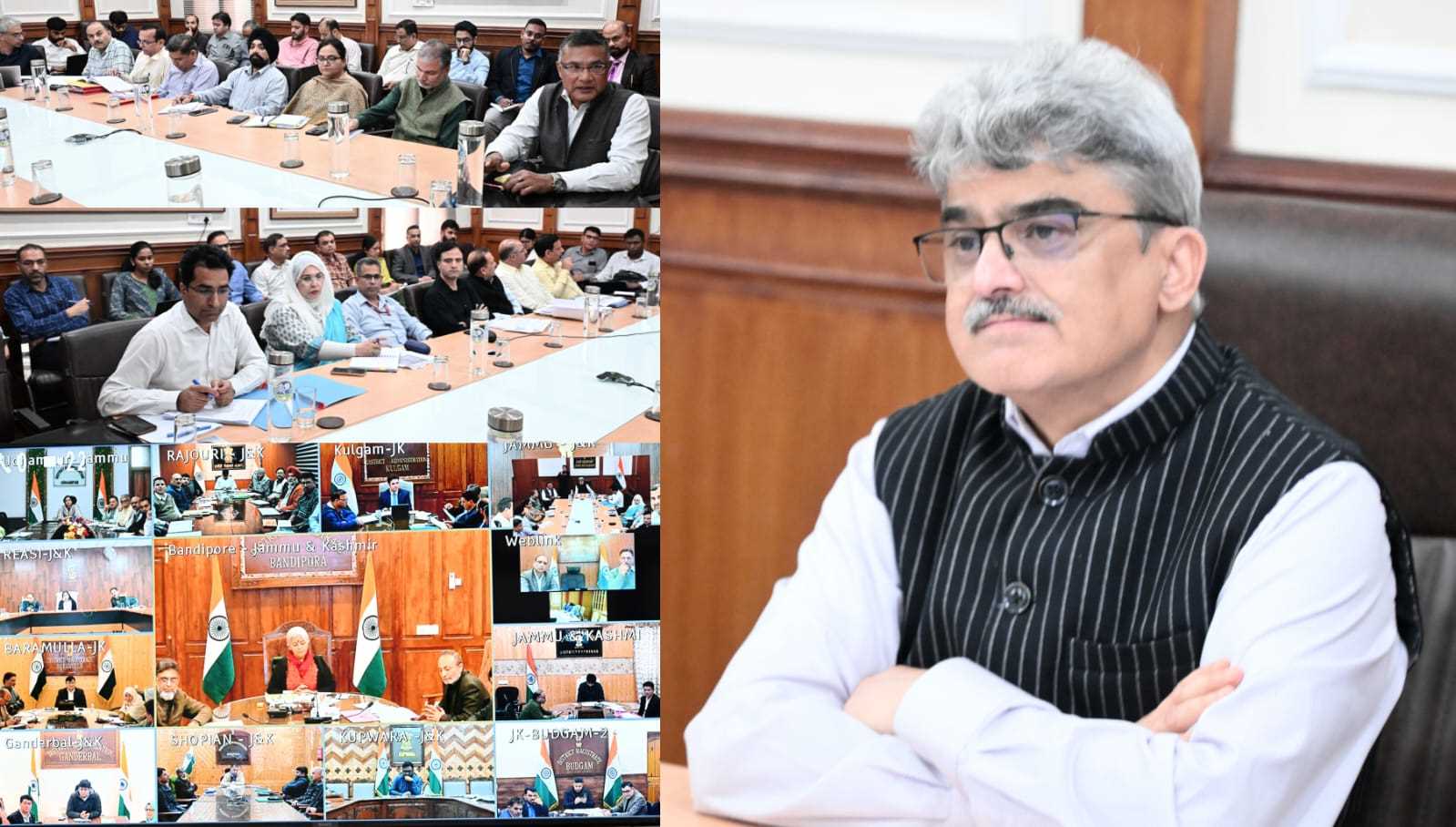
The Chief Secretary of Jammu & Kashmir, Atal Dulloo, chaired a high level review meeting today to assess the progress of two major agriculture sector interventions — the Competitiveness Improvement of Agriculture & Allied Sectors Project (JKCIP) and the Kisan Khidmat Ghar (KKG) programme — which aim to strengthen agriculture and allied livelihoods across the Union Territory.
The meeting was attended by the Additional Chief Secretary (Agriculture Production Department), the Managing Director of the Holistic Agriculture Development Programme (HADP), heads of key agriculture department organisations and other senior officials. Deputy Commissioners of all districts joined via video conferencing.
Chief Secretary Dulloo stressed the importance of effective ground level implementation and continuous monitoring to ensure that the intended benefits of the programmes reach farmers in a time bound manner. He instructed the Deputy Commissioners to actively engage with farmers and beneficiaries, identify and remove bottlenecks, and ensure timely issue resolution to maximise public benefit.
He further emphasised the need for field visits by senior officers to collect first hand feedback from farmers, and underlined the importance of inclusive participation — specifically ensuring that women, youth and vulnerable communities receive their due share of benefits under the schemes. The officers were urged to collaborate closely with women’s Self Help Groups (SHGs) under the J&K Rural Livelihoods Mission (JKRLM) and to leverage the “Mission YUVA” database to reach out to youth and vulnerable groups through targeted awareness campaigns.
The Chief Secretary also directed steps to streamline approval processes for farmers — highlighting that faster decision making at District Level Committees (DLCs) will enhance convenience and encourage greater participation. He asked the Deputy Commissioners to review approval rates at the DLCs and identify areas for improvement.
Speaking during the meeting, ACS (APD) Shailendra Kumar said that the scheme targets 90 identified blocks across J&K, with women beneficiaries constituting 47 %, youth 30 % and vulnerable communities 10 %. He noted that the initiative aims to promote climate smart and market led production, develop a robust agribusiness ecosystem, and extend targeted support to vulnerable groups to significantly uplift their incomes.
He revealed that since the scheme portal opened in June this year, applications worth ₹ 47 crore have been approved via the DLCs in just the previous month, showing growing creditworthiness and beneficiary interest. The annual work plan for the current financial year is set at ₹ 150 crore.
MD HADP, Sandeep Kumar, informed that the programme aims to cover approximately 90,000 women households, 1.29 lakh youth and 30,000 vulnerable households. So far 20,873 registrations have been received, 20,006 applications submitted and 9,823 approvals granted. These include 13,907 applications under the Climate Smart & Market led Production component, 989 under Agribusiness Ecosystem Development, and 5,110 from vulnerable community members. The scheme has helped establish 436 functional units covering 7,156 kanals of land, with overall approval rates of 54 % in Jammu Division and 47 % in Kashmir Division.
To build awareness and capacity, 264 rural credit workshops have been organised across 90 blocks, engaging over 22,000 participants including 3,100 women. These outreach programmes—run under the themes “MAATI” (for women), “Yuva Vani” (for youth) and “Karvaan” (for vulnerable communities)—aim to enhance participation and uptake of scheme benefits.
Reviewing the JKCIP project, officials noted that while some components have progressed strongly, others still lag. For example, the Area Expansion component has achieved 43 % of its target (16,459 kanals) so far; full hiring of FPO Development Officers (100 %) and exposure visits (87 %) show promise. Some other components such as water management systems, protected cultivation, and mushroom/sheep units show achievement rates ranging from 32 % to 81 %.
The Chief Secretary directed all stakeholders involved with both programmes to ensure close coordination, timely implementation and expedited action to achieve desired outcomes—namely enhanced farmer incomes, climate resilience and sustainable agriculture across J&K.
These flagship initiatives reflect the UT government's intent to transform the agricultural economy: moving beyond subsistence farming towards a market oriented, climate smart, value addition model that benefits women, youth and vulnerable communities alike.
The Chief Secretary of Jammu & Kashmir, Atal Dulloo, chaired a high level review meeting today to assess the progress of two major agriculture sector interventions — the Competitiveness Improvement of Agriculture & Allied Sectors Project (JKCIP) and the Kisan Khidmat Ghar (KKG) programme — which aim to strengthen agriculture and allied livelihoods across the Union Territory.
The meeting was attended by the Additional Chief Secretary (Agriculture Production Department), the Managing Director of the Holistic Agriculture Development Programme (HADP), heads of key agriculture department organisations and other senior officials. Deputy Commissioners of all districts joined via video conferencing.
Chief Secretary Dulloo stressed the importance of effective ground level implementation and continuous monitoring to ensure that the intended benefits of the programmes reach farmers in a time bound manner. He instructed the Deputy Commissioners to actively engage with farmers and beneficiaries, identify and remove bottlenecks, and ensure timely issue resolution to maximise public benefit.
He further emphasised the need for field visits by senior officers to collect first hand feedback from farmers, and underlined the importance of inclusive participation — specifically ensuring that women, youth and vulnerable communities receive their due share of benefits under the schemes. The officers were urged to collaborate closely with women’s Self Help Groups (SHGs) under the J&K Rural Livelihoods Mission (JKRLM) and to leverage the “Mission YUVA” database to reach out to youth and vulnerable groups through targeted awareness campaigns.
The Chief Secretary also directed steps to streamline approval processes for farmers — highlighting that faster decision making at District Level Committees (DLCs) will enhance convenience and encourage greater participation. He asked the Deputy Commissioners to review approval rates at the DLCs and identify areas for improvement.
Speaking during the meeting, ACS (APD) Shailendra Kumar said that the scheme targets 90 identified blocks across J&K, with women beneficiaries constituting 47 %, youth 30 % and vulnerable communities 10 %. He noted that the initiative aims to promote climate smart and market led production, develop a robust agribusiness ecosystem, and extend targeted support to vulnerable groups to significantly uplift their incomes.
He revealed that since the scheme portal opened in June this year, applications worth ₹ 47 crore have been approved via the DLCs in just the previous month, showing growing creditworthiness and beneficiary interest. The annual work plan for the current financial year is set at ₹ 150 crore.
MD HADP, Sandeep Kumar, informed that the programme aims to cover approximately 90,000 women households, 1.29 lakh youth and 30,000 vulnerable households. So far 20,873 registrations have been received, 20,006 applications submitted and 9,823 approvals granted. These include 13,907 applications under the Climate Smart & Market led Production component, 989 under Agribusiness Ecosystem Development, and 5,110 from vulnerable community members. The scheme has helped establish 436 functional units covering 7,156 kanals of land, with overall approval rates of 54 % in Jammu Division and 47 % in Kashmir Division.
To build awareness and capacity, 264 rural credit workshops have been organised across 90 blocks, engaging over 22,000 participants including 3,100 women. These outreach programmes—run under the themes “MAATI” (for women), “Yuva Vani” (for youth) and “Karvaan” (for vulnerable communities)—aim to enhance participation and uptake of scheme benefits.
Reviewing the JKCIP project, officials noted that while some components have progressed strongly, others still lag. For example, the Area Expansion component has achieved 43 % of its target (16,459 kanals) so far; full hiring of FPO Development Officers (100 %) and exposure visits (87 %) show promise. Some other components such as water management systems, protected cultivation, and mushroom/sheep units show achievement rates ranging from 32 % to 81 %.
The Chief Secretary directed all stakeholders involved with both programmes to ensure close coordination, timely implementation and expedited action to achieve desired outcomes—namely enhanced farmer incomes, climate resilience and sustainable agriculture across J&K.
These flagship initiatives reflect the UT government's intent to transform the agricultural economy: moving beyond subsistence farming towards a market oriented, climate smart, value addition model that benefits women, youth and vulnerable communities alike.

© Copyright 2023 brighterkashmir.com All Rights Reserved. Quantum Technologies