
BREAKING NEWS
The traditional belief that a degree guarantees a successful career is gradually fading. In earlier times, academic qualifications were valuable because relatively few people possessed them.
For decades, education has been viewed as the most reliable path to a successful life. It symbolized knowledge, achievement, and a secure future. Parents firmly believed that good academic performance would naturally lead to career success. The common assumption was that studying hard would result in excellent grades, which would then open the doors to stable employment. A university degree was often seen as a direct bridge between education and work.
Today, however, the situation is changing. Across the world, millions of young people complete years of education and earn advanced qualifications, yet many struggle to find suitable employment. The growing gap between education and employability has become one of the major challenges of our time. This does not mean education is losing its value; rather, the meaning of education is evolving. In a technology-driven, innovative, and rapidly changing world, possessing knowledge alone is no longer enough. The ability to apply that knowledge has become equally important.
The traditional belief that a degree guarantees a successful career is gradually fading. In earlier times, academic qualifications were valuable because relatively few people possessed them. As higher education became more accessible, the number of graduates entering the job market increased significantly. While this expansion has benefited society, it has also intensified competition. Today, a degree is often viewed as a basic requirement rather than a distinguishing achievement. Employers seek individuals who can solve problems, communicate effectively, adapt to change, and contribute meaningfully to the workplace. The focus is no longer only on what a person knows but also on what they can create, improve, and accomplish.
One of the key reasons behind this widening gap is the disconnect between classroom learning and workplace expectations. Traditional education systems often emphasize examinations, theoretical knowledge, and academic performance. Students are trained to memorize concepts and perform well in tests, but they may not always learn how to apply that knowledge in practical situations. The professional world, however, demands creativity, teamwork, leadership, critical thinking, decision-making, and the ability to handle unexpected challenges. Books can provide knowledge, but real-life success depends on how effectively that knowledge is used. A student with excellent grades may struggle due to weak communication skills, while another may understand theories but fail to solve practical problems. This gap between learning and application has become a major concern in modern education.
The rapid pace of technological advancement has made employability skills even more important. Globalization, digital platforms, automation, and artificial intelligence are transforming industries at an unprecedented rate. Some traditional jobs are disappearing, while entirely new career opportunities are emerging. As a result, the skills demanded today are often very different from those required only a few years ago. Abilities that were once highly valued may no longer be relevant. Professionals must therefore continue learning throughout their lives, updating their skills and adapting to new realities. The idea that education ends with graduation is becoming outdated. In today's world, learning is a lifelong process. Those who fail to adapt and acquire new skills risk falling behind in an ever-changing environment.
The impact of this situation is especially visible among young graduates. Behind every unemployment statistic lies a story of ambition, effort, and hope. Many students spend years preparing for careers that promise independence and stability. However, when they discover that their qualifications alone may not be enough, disappointment and uncertainty often follow. After investing years in education, finding it difficult to secure meaningful employment can be deeply discouraging. Many young people begin to question whether they have done enough or whether the education system has adequately prepared them. This raises an important question: should education prepare students merely for examinations, or should it prepare them for life itself?
The solution does not lie in reducing the importance of academic degrees. Formal education remains essential because it provides the foundation of knowledge and understanding required in fields such as science, medicine, engineering, education, and many other professions. However, academic qualifications must be complemented by practical skills and real-world experience. Education should combine knowledge, application, and innovation. Students should be encouraged to participate in internships, research projects, industry collaborations, and skill-development programs that connect classroom learning with practical realities. Educational institutions must focus not only on producing graduates but also on developing capable individuals who can think independently, solve problems, and contribute positively to society.
Students themselves also have a responsibility in this process. In today's highly competitive environment, waiting until graduation to develop professional skills can be a disadvantage. Young people must understand that a degree is not the final destination but merely the beginning of their journey. Communication, teamwork, creativity, adaptability, and continuous self-improvement have become essential qualities for success. A person who is willing to learn and evolve often has greater opportunities than someone who relies solely on formal qualifications. The future belongs to those who combine knowledge with the willingness to grow beyond what they already know.
The meaning of success is changing as well. Earlier, success was often measured by grades, degrees, and job titles. Today, it is increasingly associated with innovation, problem-solving, emotional intelligence, and the ability to create a meaningful impact. A qualification may reflect what someone has learned in the past, but skills demonstrate what that person can achieve in the future. Society needs individuals who can think critically, create solutions, and turn ideas into reality, rather than merely accumulate certificates.
The widening gap between education and employability is not only a challenge for students; it is also a challenge for society as a whole. A nation's progress depends not just on how many people are educated, but also on how effectively education prepares them for the future. Education systems must evolve with changing times. They should move beyond rote learning and place greater emphasis on creativity, practical application, and lifelong learning.
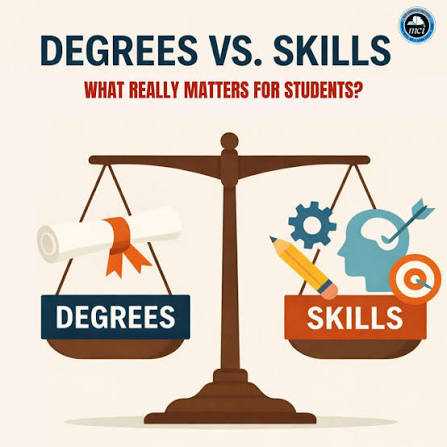
Ultimately, a degree remains valuable, but it is not the complete answer. True education is about developing confidence, curiosity, adaptability, and the courage to face uncertainty. A degree may open doors, but skills determine how far a person can go. The future will belong not simply to those who are educated, but to those who continue learning, adapting, and growing beyond their qualifications.
Email:------------mushtaqwani@gmail.com
The traditional belief that a degree guarantees a successful career is gradually fading. In earlier times, academic qualifications were valuable because relatively few people possessed them.
For decades, education has been viewed as the most reliable path to a successful life. It symbolized knowledge, achievement, and a secure future. Parents firmly believed that good academic performance would naturally lead to career success. The common assumption was that studying hard would result in excellent grades, which would then open the doors to stable employment. A university degree was often seen as a direct bridge between education and work.
Today, however, the situation is changing. Across the world, millions of young people complete years of education and earn advanced qualifications, yet many struggle to find suitable employment. The growing gap between education and employability has become one of the major challenges of our time. This does not mean education is losing its value; rather, the meaning of education is evolving. In a technology-driven, innovative, and rapidly changing world, possessing knowledge alone is no longer enough. The ability to apply that knowledge has become equally important.
The traditional belief that a degree guarantees a successful career is gradually fading. In earlier times, academic qualifications were valuable because relatively few people possessed them. As higher education became more accessible, the number of graduates entering the job market increased significantly. While this expansion has benefited society, it has also intensified competition. Today, a degree is often viewed as a basic requirement rather than a distinguishing achievement. Employers seek individuals who can solve problems, communicate effectively, adapt to change, and contribute meaningfully to the workplace. The focus is no longer only on what a person knows but also on what they can create, improve, and accomplish.
One of the key reasons behind this widening gap is the disconnect between classroom learning and workplace expectations. Traditional education systems often emphasize examinations, theoretical knowledge, and academic performance. Students are trained to memorize concepts and perform well in tests, but they may not always learn how to apply that knowledge in practical situations. The professional world, however, demands creativity, teamwork, leadership, critical thinking, decision-making, and the ability to handle unexpected challenges. Books can provide knowledge, but real-life success depends on how effectively that knowledge is used. A student with excellent grades may struggle due to weak communication skills, while another may understand theories but fail to solve practical problems. This gap between learning and application has become a major concern in modern education.
The rapid pace of technological advancement has made employability skills even more important. Globalization, digital platforms, automation, and artificial intelligence are transforming industries at an unprecedented rate. Some traditional jobs are disappearing, while entirely new career opportunities are emerging. As a result, the skills demanded today are often very different from those required only a few years ago. Abilities that were once highly valued may no longer be relevant. Professionals must therefore continue learning throughout their lives, updating their skills and adapting to new realities. The idea that education ends with graduation is becoming outdated. In today's world, learning is a lifelong process. Those who fail to adapt and acquire new skills risk falling behind in an ever-changing environment.
The impact of this situation is especially visible among young graduates. Behind every unemployment statistic lies a story of ambition, effort, and hope. Many students spend years preparing for careers that promise independence and stability. However, when they discover that their qualifications alone may not be enough, disappointment and uncertainty often follow. After investing years in education, finding it difficult to secure meaningful employment can be deeply discouraging. Many young people begin to question whether they have done enough or whether the education system has adequately prepared them. This raises an important question: should education prepare students merely for examinations, or should it prepare them for life itself?
The solution does not lie in reducing the importance of academic degrees. Formal education remains essential because it provides the foundation of knowledge and understanding required in fields such as science, medicine, engineering, education, and many other professions. However, academic qualifications must be complemented by practical skills and real-world experience. Education should combine knowledge, application, and innovation. Students should be encouraged to participate in internships, research projects, industry collaborations, and skill-development programs that connect classroom learning with practical realities. Educational institutions must focus not only on producing graduates but also on developing capable individuals who can think independently, solve problems, and contribute positively to society.
Students themselves also have a responsibility in this process. In today's highly competitive environment, waiting until graduation to develop professional skills can be a disadvantage. Young people must understand that a degree is not the final destination but merely the beginning of their journey. Communication, teamwork, creativity, adaptability, and continuous self-improvement have become essential qualities for success. A person who is willing to learn and evolve often has greater opportunities than someone who relies solely on formal qualifications. The future belongs to those who combine knowledge with the willingness to grow beyond what they already know.
The meaning of success is changing as well. Earlier, success was often measured by grades, degrees, and job titles. Today, it is increasingly associated with innovation, problem-solving, emotional intelligence, and the ability to create a meaningful impact. A qualification may reflect what someone has learned in the past, but skills demonstrate what that person can achieve in the future. Society needs individuals who can think critically, create solutions, and turn ideas into reality, rather than merely accumulate certificates.
The widening gap between education and employability is not only a challenge for students; it is also a challenge for society as a whole. A nation's progress depends not just on how many people are educated, but also on how effectively education prepares them for the future. Education systems must evolve with changing times. They should move beyond rote learning and place greater emphasis on creativity, practical application, and lifelong learning.
Ultimately, a degree remains valuable, but it is not the complete answer. True education is about developing confidence, curiosity, adaptability, and the courage to face uncertainty. A degree may open doors, but skills determine how far a person can go. The future will belong not simply to those who are educated, but to those who continue learning, adapting, and growing beyond their qualifications.
Email:------------mushtaqwani@gmail.com

© Copyright 2023 brighterkashmir.com All Rights Reserved. Quantum Technologies