
BREAKING NEWS
But Harud is not only a season of colours. It is also a season of collection and preparation. Kashmiri farmers gather the treasures of their fields and orchards and carefully preserve them for the long, cold months ahead. Apples, walnuts, maize, rice and other harvests become symbols of hard work and hope
There are moments when nature does not merely change—it speaks. There are seasons that do not simply arrive and depart; they leave behind a feeling, a memory, and a message. Harud, the autumn of Kashmir, is one such season.
The Almighty created this universe with countless colours. The flowers, the mountains, the skies, the forests and the waters—all seem to carry a divine palette. Perhaps these colours are a glimpse of the beauty that awaits us beyond this temporary world. And if a small piece of this earth can hold such beauty, one can only wonder how magnificent the eternal paradise must be.
It is rightly said:
"اگر فردوس بر روئے زمین است
ہمیں است و ہمیں است و ہمیں است۔
“If there is a paradise on earth, it is here, it is here, it is here.”
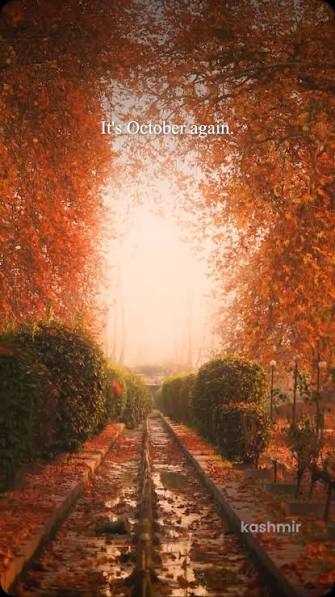
Every year, Harud proves it once again. Nature seems to take out its finest colours and dress Kashmir like a bride preparing for a grand farewell. Spring arrives in green, summer paints the landscape with countless shades, but autumn—Harud—comes with a palette of crimson red, fiery orange, golden yellow, amber and rust. The mighty Chinar trees become the greatest artists of this season, changing their attire leaf by leaf until the entire landscape appears to be part of a living painting.
The mountains turn golden. The fields change their appearance. The clear blue sky becomes a vast canvas, and at night the stars shine like pearls scattered across it.
For a moment, one feels that Kashmir is no longer merely a place—it has become a wonderland.
But Harud is not only a season of colours. It is also a season of collection and preparation. Kashmiri farmers gather the treasures of their fields and orchards and carefully preserve them for the long, cold months ahead. Apples, walnuts, maize, rice and other harvests become symbols of hard work and hope. Every household seems busy preparing for winter. Interestingly, Harud does not change only the colours of nature; it changes the colours of our homes and our lives. Summer curtains are replaced with warmer ones. Light clothes disappear into cupboards and woollens come out. Shops begin displaying winter necessities. Homes start preparing for the cold. Even schools seem to acquire a different character as the landscape around them transforms. Everywhere one looks, there is a subtle change. People love to sit in the gentle autumn sunshine, enjoying what may be the last warm embraces of the sun before winter arrives. The sunlight of Harud feels special—as if nature is deliberately asking us to pause, sit quietly and enjoy the moment. The lakes, rivers and springs also seem to participate in this transformation. Their waters become clearer, while colourful pebbles at their beds become visible. Migratory birds arrive from distant lands, turning Kashmir into their seasonal home. They seem to come here not merely to escape the cold elsewhere, but to celebrate the extraordinary beauty of this valley.
Yet, beneath all this beauty, Harud carries a quiet philosophy of life. There is something strangely emotional about autumn. The trees are at their most beautiful when they are preparing to lose their leaves. The Chinar does not become less beautiful because its leaves are falling; rather, its farewell becomes part of its beauty. It reminds me of an old Kashmiri expression:
"بوڈُن ترٛاو، شَکْل مَگَر مَرِت"
The old man has grown handsome—but only after death.
Perhaps Harud carries the same paradox. It becomes most beautiful while announcing its own departure.
The golden leaves glitter in the sunlight, but they also whisper that winter is approaching. The crimson landscape attracts every eye, yet it quietly tells us that this colourful chapter will soon close.
Soon, the white blanket of winter will cover the land. It may look like an ending—the way a white shroud covers a departed body. But Kashmir teaches us something deeper: nothing truly ends in nature.
The fallen leaves become part of the soil. The soil nourishes new life. Winter rests over the valley, and then spring returns with fresh green leaves, new flowers and new colours. Perhaps that is the greatest lesson of Harud.
Life, too, is a cycle of colours. We arrive in this temporary world with our own colours. We experience childhood, youth, achievements, relationships, happiness, sorrow and old age. With time, our colours change. Like the leaves of a Chinar, we eventually have to let go. But the departure of one season prepares the way for another. Harud therefore is not merely autumn. It is a mirror of human life—beautiful, colourful, temporary and meaningful. As I look at Kashmir dressed in crimson, gold and amber, I feel that nature is telling us something very gently:
“Enjoy my colours while they last. Nothing in this world remains the same forever.”
And perhaps that is why Harud touches the heart differently. It does not simply say goodbye to summer.
It quietly reminds us that every beautiful thing has a time to arrive, a time to shine, and a time to depart.
Yet, somewhere beyond the falling leaves, spring is already waiting.
Email:-------------------------tawheed.biotech12@gmail.com

© Copyright 2023 brighterkashmir.com All Rights Reserved. Quantum Technologies