
BREAKING NEWS
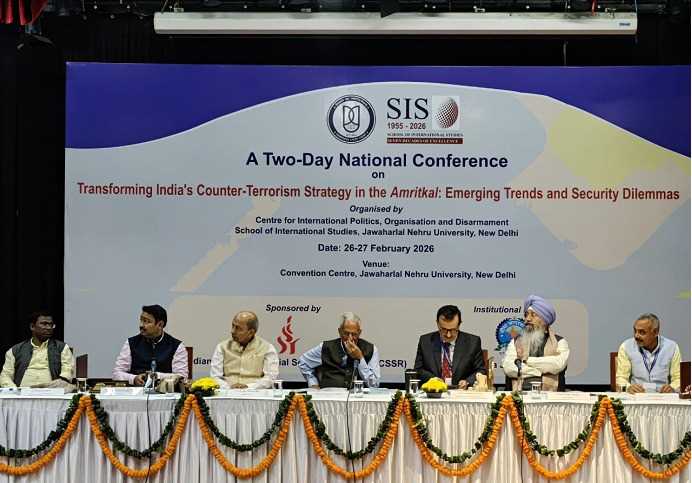
New Delhi, Mar 3: The Centre for International Politics, Organisation and Disarmament (CIPOD), School of International Studies, Jawaharlal Nehru University (JNU), New Delhi, organised a Two-Day National Conference titled “Transforming India’s Counter-Terrorism Strategy in the Amrit Kaal: Emerging Trends and Security Dilemmas” on 26-27 February 2026, at JNU.
The Chief Guest was Padma Shri Prakash Singh, Former Director General of Border Security Forces (BSF); Sardar Iqbal Singh Lalpura; Shri Ashok Kumar, Vice Chancellor Haryana Sport University; Let Gen Nitin Kohli (Retd), President Seema Jagran Manch; Prof Amitabh Mattoo, Dean, SIS, JNU; Prof. Ranvijay, Chairperson, CIPOD; Let Gen Sanjay Kulkarni (Retd), former DG Infantry and Siachen Pioneer; Shri Rashmi Ranjan Swain, former DGP Jammu & Kashmir; Ms. Anjana Sinha, former IG Communication, Andhra Pradesh, among several other dignitaries invited. Dr Prasanta Sahoo, Associate Professor, CIPOD, was the convenor of this conference.
The conference brought together leading scholars, experts, policymakers, practitioners, and young scholars to critically analyse and deliberate on the changing nature of terrorism and the emerging challenges confronting India’s national security architecture in the context of Amrit Kaal - India’s envisioned transition towards becoming a developed and resilient nation by 2047.
The sessions highlighted the changing character of terrorism marked by technological innovation, online radicalisation, hybrid warfare, cross-border networks - emphasising the need for a development strategy to move together with a security strategy. Analysing the ‘zero-tolerance policy’, the speakers discussed the recently released National Counter-terrorism policy and strategy called: ‘PRAHAAR’, which stands for P- Prevention; R- response; A- Aggregating Internal Capacities; H- Human Rights and Rule of Law; A- Attenuating Enabling Conditions; A- aligning international efforts; R- Recovery and Resilience.
Speakers emphasised the need for a multidimensional counter-terrorism strategy and across thematic sessions, participants examined key issues including: Historical Evolution of India's Counter-Terrorism Framework and Institutional Architecture; Transformation of India’s Counter-Terror Strategy in the Amrit Kaal; Technology, Cyber Terrorism, and Counter-Radicalisation Strategies; Legal Frameworks, Human Rights Concerns, and Accountability; Cross-Border Terrorism and Regional Security Architecture; Pahalgam Terror Attack, ‘Operation Sindoor’, and Afterwards; International cooperation and India’s role in global counter-terrorism diplomacy; Women in the Shadow of Terrorism and Related Violence: As Victims.
The discussions underscored that counter-terrorism in the contemporary era requires moving beyond reactive security responses toward preventive and resilience-based approaches. It was pointed out that counter-terrorism must extend beyond eliminating individual militants to dismantling the broader ecosystem that sustains extremism: financial networks, ideological indoctrination, digital propaganda, and governance vacuums. A coherent definition of terrorism, effective legal enforcement, international cooperation, technological preparedness, good governance, and value-based education together form the pillars of a sustainable strategy.
The conference concluded that India’s counter-terrorism strategy in the Amrit Kaal must combine strategic foresight, technological innovation, and international partnerships to effectively respond to complex, hybrid security threats. The conference also provided an important academic platform for young researchers and scholars to present empirical and policy-oriented research, fostering dialogue between academia and practitioners in the field of security studies.
New Delhi, Mar 3: The Centre for International Politics, Organisation and Disarmament (CIPOD), School of International Studies, Jawaharlal Nehru University (JNU), New Delhi, organised a Two-Day National Conference titled “Transforming India’s Counter-Terrorism Strategy in the Amrit Kaal: Emerging Trends and Security Dilemmas” on 26-27 February 2026, at JNU.
The Chief Guest was Padma Shri Prakash Singh, Former Director General of Border Security Forces (BSF); Sardar Iqbal Singh Lalpura; Shri Ashok Kumar, Vice Chancellor Haryana Sport University; Let Gen Nitin Kohli (Retd), President Seema Jagran Manch; Prof Amitabh Mattoo, Dean, SIS, JNU; Prof. Ranvijay, Chairperson, CIPOD; Let Gen Sanjay Kulkarni (Retd), former DG Infantry and Siachen Pioneer; Shri Rashmi Ranjan Swain, former DGP Jammu & Kashmir; Ms. Anjana Sinha, former IG Communication, Andhra Pradesh, among several other dignitaries invited. Dr Prasanta Sahoo, Associate Professor, CIPOD, was the convenor of this conference.
The conference brought together leading scholars, experts, policymakers, practitioners, and young scholars to critically analyse and deliberate on the changing nature of terrorism and the emerging challenges confronting India’s national security architecture in the context of Amrit Kaal - India’s envisioned transition towards becoming a developed and resilient nation by 2047.
The sessions highlighted the changing character of terrorism marked by technological innovation, online radicalisation, hybrid warfare, cross-border networks - emphasising the need for a development strategy to move together with a security strategy. Analysing the ‘zero-tolerance policy’, the speakers discussed the recently released National Counter-terrorism policy and strategy called: ‘PRAHAAR’, which stands for P- Prevention; R- response; A- Aggregating Internal Capacities; H- Human Rights and Rule of Law; A- Attenuating Enabling Conditions; A- aligning international efforts; R- Recovery and Resilience.
Speakers emphasised the need for a multidimensional counter-terrorism strategy and across thematic sessions, participants examined key issues including: Historical Evolution of India's Counter-Terrorism Framework and Institutional Architecture; Transformation of India’s Counter-Terror Strategy in the Amrit Kaal; Technology, Cyber Terrorism, and Counter-Radicalisation Strategies; Legal Frameworks, Human Rights Concerns, and Accountability; Cross-Border Terrorism and Regional Security Architecture; Pahalgam Terror Attack, ‘Operation Sindoor’, and Afterwards; International cooperation and India’s role in global counter-terrorism diplomacy; Women in the Shadow of Terrorism and Related Violence: As Victims.
The discussions underscored that counter-terrorism in the contemporary era requires moving beyond reactive security responses toward preventive and resilience-based approaches. It was pointed out that counter-terrorism must extend beyond eliminating individual militants to dismantling the broader ecosystem that sustains extremism: financial networks, ideological indoctrination, digital propaganda, and governance vacuums. A coherent definition of terrorism, effective legal enforcement, international cooperation, technological preparedness, good governance, and value-based education together form the pillars of a sustainable strategy.
The conference concluded that India’s counter-terrorism strategy in the Amrit Kaal must combine strategic foresight, technological innovation, and international partnerships to effectively respond to complex, hybrid security threats. The conference also provided an important academic platform for young researchers and scholars to present empirical and policy-oriented research, fostering dialogue between academia and practitioners in the field of security studies.

© Copyright 2023 brighterkashmir.com All Rights Reserved. Quantum Technologies