The materials indicate a work of great ambition, and also ask what the limits to proximity are, what is the danger of narrative over-identification, and what is the difficulty of writing critically about a subject that has lived so long, so publicly, and so multi-facedly?
A Statesman and a Seeker: The Extraordinary Life and Legacy of Karan Singh (Speaking Tiger Books), by Harbans Singh, offers an eye-opening view of a biographical project that seeks to strike a balance between admiration and analysis, access and independence, and narrative and documentary.
The manuscript, including a copy of the cover, internal proofs, chapters, and final considerations, permits a substantive academic evaluation of both the life under narration and the narration style. They also reveal the implicit contradictions of the official biography, a genre that in India has vacillated between celebration and disavowal.
The materials indicate a work of great ambition, and also ask what the limits to proximity are, what is the danger of narrative over-identification, and what is the difficulty of writing critically about a subject that has lived so long, so publicly, and so multi-facedly?
Architecture of an Authorised Life
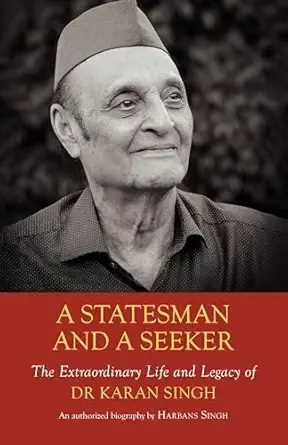
The book's paratextual framing is very impressive. The title presupposes the duality that Harbans Singh wants to discuss, namely, the statesmanship and spiritual seeking, and the subtitle promises the extraordinary life and legacy, the expression that already hints at a certain degree of the celebratory motive.
The biography's legitimacy is driven home by the cover materials, the use of family photographs, courtesy acknowledgements, and the collaboration with the subject's personal archive, which helps strengthen the impression that the project was done with full family approval. It is a valuable access, but it imposes on the biographer the responsibility of demonstrating interpretive independence.
The publisher, Speaking Tiger Books, has established a reputation for serious non-fiction, and the production values that are apparent in the draft pages, such as meticulous design, extensive pagination, and an apparent adherence to narrative detail, are indicative of a book aimed at both general and scholarly audiences. The domestic evidence, spanning pages 36-466, shows a mass of work that supports a lengthy curve of political, personal, and philosophical growth.
Childhood of the Prince
The first chapter is one of the brightest, which recreates the kingdom of Jammu and Kashmir's royal era in such detail that it is atmospheric and revelatory. The young Karan Singh, who was called “Tiger” at the early age of four, a title that many of his friends and even Jawaharlal Nehru called him, even in adulthood, is introduced as a child who was influenced by privilege, discipline, and a well-nurtured Anglicised childhood.
Both the aesthetic and ideological atmosphere of his early years are captured by the account of life at Taley Manzil, where there was a commanding view of the Zabarwan range of mountains and where a highly regimented timetable was maintained, with no Indian food or sweets to be offered.
The virtue of the biography is its power to demonstrate how these early experiences, British guardians, Indian tutors, elaborate security measures, and first impressions of nationalist spirit, created a personality that would travel between worlds.
But the story, at times, risks romanticising the princely world as innocent and beautiful, without critiquing the structural inequalities that perpetuated it. It is recorded that the boys had a full company of servants who doubled as their playfellows, but the consequences of such a social arrangement have not been explored sufficiently.
Democratic shock of Doon School
The move to the Doon School is introduced as a break-making experience. The prince, who is eleven years old and used to having retainers and living in regimented comfort, is now forced to make his own bed, polish his own shoes, and clean up the entire room.
This is set against the backdrop of a democratic awakening, a moment when the young Karan Singh begins to realise the need for citizenship rather than inherited privilege. The biography takes this shift sensitively, but sometimes slips to the mythologising side of this genre, where the adoption of democratic norms is not discussed as a struggle, but as an organic development.
Political Apprenticeship
The most extensive and analytical part of the draft materials is the account of Karan Singh's political career in Kashmir. He becomes Regent at eighteen, when he is hardly out of a strange illness which had kept him bedridden more than a year, plunging him into the mire of post-Partition politics.
Of great interest is the reconstruction of the Praja Parishad agitation of 1952-53 given in the biography. In a letter he writes to Nehru, telling him that an overwhelming majority of the Jammu Province appears to be vehemently in support of the agitation, Karan Singh demonstrates a young leader trying to reconcile competing regional identities and national interests.
The description of the removal of Sheikh Abdullah in 1953 is also based on the internal communications and political intrigue. The story suggests that Abdullah was a prisoner of his own perception of a superpower leader, whereas Karan Singh becomes a constitutional player in a tense political environment. However, the biography's framing sometimes veers toward excessive closeness to the subject and makes his deeds appear both righteous and visionary, without engaging with the wider historiography of the era.
The seeker within
The spiritual aspect of Karan Singh's life, as indicated in the book's title, receives extended coverage throughout the book. The passing of Sri Krishnaprem -- the second Guru of Sri Krishnaprem -- "Gogalda" -- is not rushed, and the advice that was given, including the similarity that one should never lose the light that is there within him, gives an idea of the philosophical system on which the later writings and actions of Sri Krishnaprem were based.
This portrait of inner seeking is enhanced by the presence of Madhav Ashish, with whom he would talk about politics, relationships, dreams, and books, well into the night.
However, this part also reveals one possible weakness of the authorised biography: the tendency to regard the subject's spiritual development with awe rather than with the necessary objectivity. The story embraces the capacity of such relationships to change without questioning how they affected the political choices or the discourse of the masses.
Limits of Governance
The chapters in the 1965 Indo-Pakistan War provide a chilling report of a lack of intelligence and political judgment. According to the biography, all the sophistication of intelligence agencies was not able to make anyone notice that there was a diabolical operation launched by Pakistan.
The contrast between the birthday party held at Oberoi Palace Hotel and the news of intruders in Srinagar accentuates the elites' lack of touch with reality.
This part is among the most neutral, as it recognises the seriousness of the situation during the crisis and the weaknesses of the political leadership in handling it. It also offers unique insight into vulnerability, as Karan Singh is torn between personal loss and social responsibility.
The question of perspective
Subsequent chapters, especially those about the demise of Yasho Rajya Lakshmi, are composed with clear emotional clarity. The respectful treatment of her as a confidante, a guide and stabilising presence is done with respect, and the story of her last days, how she chose to leave the hospital, her death at home, is sincerely heartfelt. The fact that the biography describes her relationship with laborers of other castes, such as her trust in a servant from an oppressed caste, adds complexity to the story.
The final meditations, in which Karan Singh identifies himself as a prince, a patient, and an optimist who has lived through sickness, political instability, and personal tragedy, are philosophically close to the land of self-mythology and, at the same time, tend to be overly personal.
The biographer reproduces these passages in extenso, and although they are no doubt strong stuff, they also show how difficult it is to maintain an objective perspective when the subject is eloquent, perceptive, and accustomed to making his own history.
Powers and weaknesses
Harbans Singh is an academic and journalist with experience in both fields, and his knowledge of Kashmir's history is evident in the draft materials. His previous writing in the area lends his analysis credibility, and his style is usually straightforward, descriptive, and sensitive to the context. The authorisation of the biography, though, inevitably does not leave the lines of the biography without any influence.
Although the work is not uneasy in its lapses to failure, even the 1984 electoral loss, it is generally sympathetic, at times even deferential.
The difficulty of the biography that is completed will be to maintain the balance between access and autonomy, admiration and criticism. The work in the materials indicates it will be a full and lavish piece, yet the critical touch sometimes slips, especially when the voice of the subject itself takes possession of the story.
A life of Contradictions
The pieces that are provided are a portrait of a biography that is grand in nature and beautiful in form, and yet so engrossed in knowing its subject on many levels- political, personal, and spiritual. Karan Singh is somebody so complicated: the son of the prince who grew up in the environment of colonial modernity, the young Regent who had to struggle with the politics of betrayal in Kashmir, the spiritualist who followed the path of his unusual teachers, the political thinker who had to contemplate democracy, his identity, and his mortality.
The most powerful aspect of the biography is that it manages to maintain these identities without reducing them to a single storyline. Its nearest danger is that it is too close to its subject, and does occasionally preclude that incisiveness of criticism which a life of such moment requires.
But even within these limitations, the draft materials indicate work which will have its own value to the study of the modern Indian political biography, and which can supply the student of history and the non-scholarly reader alike with a portrait of a man who has lived and continues to live between history, philosophy, and the life of the people.
Email: daanishinterview@gmail.com

The materials indicate a work of great ambition, and also ask what the limits to proximity are, what is the danger of narrative over-identification, and what is the difficulty of writing critically about a subject that has lived so long, so publicly, and so multi-facedly?
A Statesman and a Seeker: The Extraordinary Life and Legacy of Karan Singh (Speaking Tiger Books), by Harbans Singh, offers an eye-opening view of a biographical project that seeks to strike a balance between admiration and analysis, access and independence, and narrative and documentary.
The manuscript, including a copy of the cover, internal proofs, chapters, and final considerations, permits a substantive academic evaluation of both the life under narration and the narration style. They also reveal the implicit contradictions of the official biography, a genre that in India has vacillated between celebration and disavowal.
The materials indicate a work of great ambition, and also ask what the limits to proximity are, what is the danger of narrative over-identification, and what is the difficulty of writing critically about a subject that has lived so long, so publicly, and so multi-facedly?
Architecture of an Authorised Life
The book's paratextual framing is very impressive. The title presupposes the duality that Harbans Singh wants to discuss, namely, the statesmanship and spiritual seeking, and the subtitle promises the extraordinary life and legacy, the expression that already hints at a certain degree of the celebratory motive.
The biography's legitimacy is driven home by the cover materials, the use of family photographs, courtesy acknowledgements, and the collaboration with the subject's personal archive, which helps strengthen the impression that the project was done with full family approval. It is a valuable access, but it imposes on the biographer the responsibility of demonstrating interpretive independence.
The publisher, Speaking Tiger Books, has established a reputation for serious non-fiction, and the production values that are apparent in the draft pages, such as meticulous design, extensive pagination, and an apparent adherence to narrative detail, are indicative of a book aimed at both general and scholarly audiences. The domestic evidence, spanning pages 36-466, shows a mass of work that supports a lengthy curve of political, personal, and philosophical growth.
Childhood of the Prince
The first chapter is one of the brightest, which recreates the kingdom of Jammu and Kashmir's royal era in such detail that it is atmospheric and revelatory. The young Karan Singh, who was called “Tiger” at the early age of four, a title that many of his friends and even Jawaharlal Nehru called him, even in adulthood, is introduced as a child who was influenced by privilege, discipline, and a well-nurtured Anglicised childhood.
Both the aesthetic and ideological atmosphere of his early years are captured by the account of life at Taley Manzil, where there was a commanding view of the Zabarwan range of mountains and where a highly regimented timetable was maintained, with no Indian food or sweets to be offered.
The virtue of the biography is its power to demonstrate how these early experiences, British guardians, Indian tutors, elaborate security measures, and first impressions of nationalist spirit, created a personality that would travel between worlds.
But the story, at times, risks romanticising the princely world as innocent and beautiful, without critiquing the structural inequalities that perpetuated it. It is recorded that the boys had a full company of servants who doubled as their playfellows, but the consequences of such a social arrangement have not been explored sufficiently.
Democratic shock of Doon School
The move to the Doon School is introduced as a break-making experience. The prince, who is eleven years old and used to having retainers and living in regimented comfort, is now forced to make his own bed, polish his own shoes, and clean up the entire room.
This is set against the backdrop of a democratic awakening, a moment when the young Karan Singh begins to realise the need for citizenship rather than inherited privilege. The biography takes this shift sensitively, but sometimes slips to the mythologising side of this genre, where the adoption of democratic norms is not discussed as a struggle, but as an organic development.
Political Apprenticeship
The most extensive and analytical part of the draft materials is the account of Karan Singh's political career in Kashmir. He becomes Regent at eighteen, when he is hardly out of a strange illness which had kept him bedridden more than a year, plunging him into the mire of post-Partition politics.
Of great interest is the reconstruction of the Praja Parishad agitation of 1952-53 given in the biography. In a letter he writes to Nehru, telling him that an overwhelming majority of the Jammu Province appears to be vehemently in support of the agitation, Karan Singh demonstrates a young leader trying to reconcile competing regional identities and national interests.
The description of the removal of Sheikh Abdullah in 1953 is also based on the internal communications and political intrigue. The story suggests that Abdullah was a prisoner of his own perception of a superpower leader, whereas Karan Singh becomes a constitutional player in a tense political environment. However, the biography's framing sometimes veers toward excessive closeness to the subject and makes his deeds appear both righteous and visionary, without engaging with the wider historiography of the era.
The seeker within
The spiritual aspect of Karan Singh's life, as indicated in the book's title, receives extended coverage throughout the book. The passing of Sri Krishnaprem -- the second Guru of Sri Krishnaprem -- "Gogalda" -- is not rushed, and the advice that was given, including the similarity that one should never lose the light that is there within him, gives an idea of the philosophical system on which the later writings and actions of Sri Krishnaprem were based.
This portrait of inner seeking is enhanced by the presence of Madhav Ashish, with whom he would talk about politics, relationships, dreams, and books, well into the night.
However, this part also reveals one possible weakness of the authorised biography: the tendency to regard the subject's spiritual development with awe rather than with the necessary objectivity. The story embraces the capacity of such relationships to change without questioning how they affected the political choices or the discourse of the masses.
Limits of Governance
The chapters in the 1965 Indo-Pakistan War provide a chilling report of a lack of intelligence and political judgment. According to the biography, all the sophistication of intelligence agencies was not able to make anyone notice that there was a diabolical operation launched by Pakistan.
The contrast between the birthday party held at Oberoi Palace Hotel and the news of intruders in Srinagar accentuates the elites' lack of touch with reality.
This part is among the most neutral, as it recognises the seriousness of the situation during the crisis and the weaknesses of the political leadership in handling it. It also offers unique insight into vulnerability, as Karan Singh is torn between personal loss and social responsibility.
The question of perspective
Subsequent chapters, especially those about the demise of Yasho Rajya Lakshmi, are composed with clear emotional clarity. The respectful treatment of her as a confidante, a guide and stabilising presence is done with respect, and the story of her last days, how she chose to leave the hospital, her death at home, is sincerely heartfelt. The fact that the biography describes her relationship with laborers of other castes, such as her trust in a servant from an oppressed caste, adds complexity to the story.
The final meditations, in which Karan Singh identifies himself as a prince, a patient, and an optimist who has lived through sickness, political instability, and personal tragedy, are philosophically close to the land of self-mythology and, at the same time, tend to be overly personal.
The biographer reproduces these passages in extenso, and although they are no doubt strong stuff, they also show how difficult it is to maintain an objective perspective when the subject is eloquent, perceptive, and accustomed to making his own history.
Powers and weaknesses
Harbans Singh is an academic and journalist with experience in both fields, and his knowledge of Kashmir's history is evident in the draft materials. His previous writing in the area lends his analysis credibility, and his style is usually straightforward, descriptive, and sensitive to the context. The authorisation of the biography, though, inevitably does not leave the lines of the biography without any influence.
Although the work is not uneasy in its lapses to failure, even the 1984 electoral loss, it is generally sympathetic, at times even deferential.
The difficulty of the biography that is completed will be to maintain the balance between access and autonomy, admiration and criticism. The work in the materials indicates it will be a full and lavish piece, yet the critical touch sometimes slips, especially when the voice of the subject itself takes possession of the story.
A life of Contradictions
The pieces that are provided are a portrait of a biography that is grand in nature and beautiful in form, and yet so engrossed in knowing its subject on many levels- political, personal, and spiritual. Karan Singh is somebody so complicated: the son of the prince who grew up in the environment of colonial modernity, the young Regent who had to struggle with the politics of betrayal in Kashmir, the spiritualist who followed the path of his unusual teachers, the political thinker who had to contemplate democracy, his identity, and his mortality.
The most powerful aspect of the biography is that it manages to maintain these identities without reducing them to a single storyline. Its nearest danger is that it is too close to its subject, and does occasionally preclude that incisiveness of criticism which a life of such moment requires.
But even within these limitations, the draft materials indicate work which will have its own value to the study of the modern Indian political biography, and which can supply the student of history and the non-scholarly reader alike with a portrait of a man who has lived and continues to live between history, philosophy, and the life of the people.
Email: daanishinterview@gmail.com
© Copyright 2023 brighterkashmir.com All Rights Reserved. Quantum Technologies