
BREAKING NEWS
Srinagar, Aug 28: Kashmir’s celebrated orchards are increasingly caught in a difficult land-use battle as expanding settlements, commercial activity and infrastructure development steadily put pressure on agricultural land.
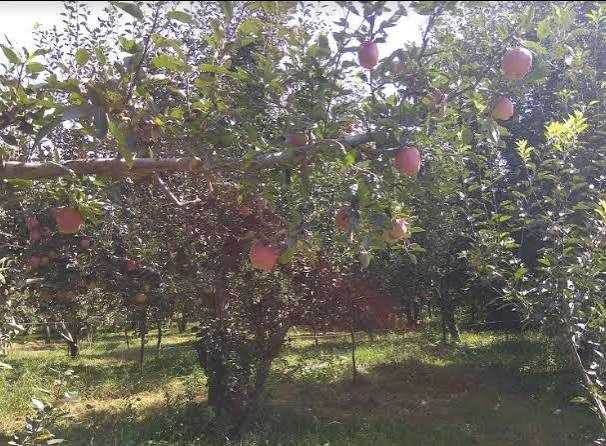
For generations, horticulture has remained one of the main pillars of Kashmir’s rural economy. Apple orchards, in particular, provide livelihoods to thousands of farming families while supporting a vast network of labourers, transporters, traders, packers, cold-storage operators and other businesses. But the rapid expansion of built-up areas is changing the Valley’s landscape and raising concerns over the future of its productive farmland.
The conflict is not simply between orchards and buildings. It reflects a larger challenge of balancing economic growth with food security, environmental sustainability and the preservation of Kashmir’s agricultural heritage.
As towns and cities expand, orchard land located close to roads and urban centres has become increasingly attractive for residential and commercial construction. Rising land values can make the conversion of agricultural plots financially tempting for landowners, particularly where farming incomes are uncertain or production costs are rising.
The consequences, however, extend well beyond individual properties. Every converted orchard represents a permanent reduction in the Valley’s agricultural base. Fragmentation of farmland can also make remaining orchards less economically viable and disrupt traditional agricultural landscapes.
Horticulture is among the most important components of Kashmir’s rural economy. The sector provides direct and indirect employment to a large population and generates substantial economic activity every year. Apple production, along with other fruits, has also helped establish Kashmir as an important horticultural region in the country.
The loss of orchard land therefore raises questions about the Valley’s future capacity to produce food and generate rural incomes.
Urban expansion also creates environmental concerns. Orchards contribute to green cover, absorb carbon, regulate local temperatures and help maintain soil and water systems. Their replacement by concrete surfaces can increase pressure on drainage networks, intensify flooding risks and reduce the ecological resilience of rapidly growing settlements.
The challenge is particularly visible around Srinagar and other expanding urban centres, where the distinction between rural and urban land is becoming increasingly blurred.
Authorities have introduced planning regulations and land-use controls to manage unplanned development, but effective enforcement remains crucial. A planning framework is meaningful only when violations are detected promptly and action is taken consistently.
At the same time, simply restricting construction may not be enough. Farmers need viable economic alternatives and incentives to retain productive orchards. Better market access, modern storage facilities, scientific orchard management, crop diversification, insurance and value addition can improve returns from horticulture and reduce the financial pressure that encourages land conversion.
Urban planners must also identify sufficient land for housing and commercial development so that legitimate growth does not place disproportionate pressure on agricultural areas.
The solution lies in planned urbanisation rather than unchecked expansion. Existing built-up areas can be redeveloped more efficiently, vertical growth can be encouraged where appropriate, and infrastructure can be directed towards designated urban zones instead of productive agricultural land.
Kashmir cannot afford to view orchards merely as vacant plots waiting for development. They are productive assets, economic lifelines and part of the Valley’s ecological identity.
The land-use battle is ultimately about deciding what kind of Kashmir future generations will inherit: a Valley where economic growth is built on carefully planned development, or one where short-term construction gradually consumes the agricultural landscape that sustains it.
Protecting orchards while accommodating necessary development will require political will, scientific planning, strict enforcement and meaningful support for farmers. Kashmir needs growth—but growth that leaves room for its orchards to survive.
Srinagar, Aug 28: Kashmir’s celebrated orchards are increasingly caught in a difficult land-use battle as expanding settlements, commercial activity and infrastructure development steadily put pressure on agricultural land.
For generations, horticulture has remained one of the main pillars of Kashmir’s rural economy. Apple orchards, in particular, provide livelihoods to thousands of farming families while supporting a vast network of labourers, transporters, traders, packers, cold-storage operators and other businesses. But the rapid expansion of built-up areas is changing the Valley’s landscape and raising concerns over the future of its productive farmland.
The conflict is not simply between orchards and buildings. It reflects a larger challenge of balancing economic growth with food security, environmental sustainability and the preservation of Kashmir’s agricultural heritage.
As towns and cities expand, orchard land located close to roads and urban centres has become increasingly attractive for residential and commercial construction. Rising land values can make the conversion of agricultural plots financially tempting for landowners, particularly where farming incomes are uncertain or production costs are rising.
The consequences, however, extend well beyond individual properties. Every converted orchard represents a permanent reduction in the Valley’s agricultural base. Fragmentation of farmland can also make remaining orchards less economically viable and disrupt traditional agricultural landscapes.
Horticulture is among the most important components of Kashmir’s rural economy. The sector provides direct and indirect employment to a large population and generates substantial economic activity every year. Apple production, along with other fruits, has also helped establish Kashmir as an important horticultural region in the country.
The loss of orchard land therefore raises questions about the Valley’s future capacity to produce food and generate rural incomes.
Urban expansion also creates environmental concerns. Orchards contribute to green cover, absorb carbon, regulate local temperatures and help maintain soil and water systems. Their replacement by concrete surfaces can increase pressure on drainage networks, intensify flooding risks and reduce the ecological resilience of rapidly growing settlements.
The challenge is particularly visible around Srinagar and other expanding urban centres, where the distinction between rural and urban land is becoming increasingly blurred.
Authorities have introduced planning regulations and land-use controls to manage unplanned development, but effective enforcement remains crucial. A planning framework is meaningful only when violations are detected promptly and action is taken consistently.
At the same time, simply restricting construction may not be enough. Farmers need viable economic alternatives and incentives to retain productive orchards. Better market access, modern storage facilities, scientific orchard management, crop diversification, insurance and value addition can improve returns from horticulture and reduce the financial pressure that encourages land conversion.
Urban planners must also identify sufficient land for housing and commercial development so that legitimate growth does not place disproportionate pressure on agricultural areas.
The solution lies in planned urbanisation rather than unchecked expansion. Existing built-up areas can be redeveloped more efficiently, vertical growth can be encouraged where appropriate, and infrastructure can be directed towards designated urban zones instead of productive agricultural land.
Kashmir cannot afford to view orchards merely as vacant plots waiting for development. They are productive assets, economic lifelines and part of the Valley’s ecological identity.
The land-use battle is ultimately about deciding what kind of Kashmir future generations will inherit: a Valley where economic growth is built on carefully planned development, or one where short-term construction gradually consumes the agricultural landscape that sustains it.
Protecting orchards while accommodating necessary development will require political will, scientific planning, strict enforcement and meaningful support for farmers. Kashmir needs growth—but growth that leaves room for its orchards to survive.

© Copyright 2023 brighterkashmir.com All Rights Reserved. Quantum Technologies