
BREAKING NEWS
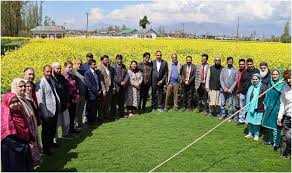
Khudwani, April 6:The Mountain Research Centre for Field Crops (MRCFC), Khudwani, today celebrated “Sarson/Tilhan Day” with a large gathering of scientists, officers, and farmers from across Kulgam and Anantnag. Vice Chancellor, SKUAST-K, Prof. Nazir Ahmad Ganie was the Chief Guest, while Mr. Shahzad Alam, Deputy Commissioner Kulgam, graced the occasion as Guest of Honour. Senior university officers—including Director Research, Prof. Haroon Rashid Naik, Director Extension, Prof. Raihana Habib Kanth, Heads of KVK Kulgam and KVK Anantnag, scientists of SKUAST-K, and officers of the Agriculture Department—were also in attendance.
In his address, the Vice Chancellor praised the Centre for its sustained scientific contributions since its establishment in 1942. He noted that MRCFC-Khudwani has played a decisive role in varietal development in rice, wheat, and oilseeds—introducing 23 rice, 7 oilseed, and 3 wheat varieties along with complete production and protection technologies. These innovations, he said, have raised Kashmir’s rice productivity from 1 tonne per hectare in the 1960s to nearly 10 tonnes today, a change he termed “nothing short of historic.” Highlighting Kashmir’s unique advantage in Brown Sarson, he emphasized that this oilseed is produced exclusively in the Valley due to its distinctive agro-climatic conditions. He added that breeding and technological interventions have increased oilseed yields from 8 to 12 quintals per hectare, while the cultivated area has expanded from 38,000 ha to 1.1 lakh ha within five years. “These achievements reflect strong research–extension partnership with the Department of Agriculture and the KVKs,” he noted. The Vice Chancellor urged farmers to adopt improved technologies and strive for 200% cropping intensity, higher SRR/VRR, and expanded seed production to help reduce edible oil imports by 25% in the next two years. He commended the Centre for meeting 100% of the Valley’s breeder seed requirement and half of its foundation seed demand, and appreciated its advances in sustainable pest and disease management, germplasm conservation, and agronomic research, encouraging wider dissemination of these strengths.
During his field visit, Mr. Shahzad Alam, Deputy Commissioner Kulgam was briefed about the ongoing research programme, including 20 trials—five under national AICRP initiatives—and the maintenance of nearly 150 germplasm lines. He inspected the Bio-Input Laboratory, appreciating its role in promoting sustainable agriculture, Genomics lab, and the Soil Health Laboratory, where he was briefed on soil health research and the distribution of Soil Health Cards to farmers. He assured full support from the district administration to the Research Centre and farmers, adding that youth should take advantage of various centrally sponsored schemes for livelihood generation.
Director Research, Prof. Haroon Rashid Naik, highlighted the pivotal role of MRCFC-bred varieties in strengthening food and nutritional security across J&K. He stressed the substantial untapped potential of the region’s oilseed sector and called for elevating both quality and productivity to global standards. Director Extension, Prof. Raihana Habib Kanth, outlined the University’s extension network and reaffirmed its commitment to farmer training and capacity development.
Earlier, Dr. Najeeb R. Sofi presented an overview of the Centre’s major research contributions, milestones, and ongoing priorities, noting its foundational role in rice, wheat, and oilseed research since its establishment in 1942. He highlighted that, over the past three years, the Centre has trained nearly 1,000 farmers and 250 officers in production technologies, crop improvement, post-harvest management, soil health, marketing, and related areas—strengthening capacity building across the region. Expressing gratitude to all dignitaries, Dr. Sofi offered special thanks to Professor Nazir Ahmad Ganie for his leadership in realizing the long-awaited South Campus, describing it as a significant milestone in the University’s growth and a development warmly welcomed by the entire academic community.
The event concluded with a renewed commitment to advancing oilseed research, seed production, and farmer-oriented technologies across the Valley. Stakeholders expressed confidence that the collective efforts of SKUAST-K, the Agriculture Department, and the farming community will accelerate Jammu & Kashmir’s path toward oilseed self-sufficiency.
Khudwani, April 6:The Mountain Research Centre for Field Crops (MRCFC), Khudwani, today celebrated “Sarson/Tilhan Day” with a large gathering of scientists, officers, and farmers from across Kulgam and Anantnag. Vice Chancellor, SKUAST-K, Prof. Nazir Ahmad Ganie was the Chief Guest, while Mr. Shahzad Alam, Deputy Commissioner Kulgam, graced the occasion as Guest of Honour. Senior university officers—including Director Research, Prof. Haroon Rashid Naik, Director Extension, Prof. Raihana Habib Kanth, Heads of KVK Kulgam and KVK Anantnag, scientists of SKUAST-K, and officers of the Agriculture Department—were also in attendance.
In his address, the Vice Chancellor praised the Centre for its sustained scientific contributions since its establishment in 1942. He noted that MRCFC-Khudwani has played a decisive role in varietal development in rice, wheat, and oilseeds—introducing 23 rice, 7 oilseed, and 3 wheat varieties along with complete production and protection technologies. These innovations, he said, have raised Kashmir’s rice productivity from 1 tonne per hectare in the 1960s to nearly 10 tonnes today, a change he termed “nothing short of historic.” Highlighting Kashmir’s unique advantage in Brown Sarson, he emphasized that this oilseed is produced exclusively in the Valley due to its distinctive agro-climatic conditions. He added that breeding and technological interventions have increased oilseed yields from 8 to 12 quintals per hectare, while the cultivated area has expanded from 38,000 ha to 1.1 lakh ha within five years. “These achievements reflect strong research–extension partnership with the Department of Agriculture and the KVKs,” he noted. The Vice Chancellor urged farmers to adopt improved technologies and strive for 200% cropping intensity, higher SRR/VRR, and expanded seed production to help reduce edible oil imports by 25% in the next two years. He commended the Centre for meeting 100% of the Valley’s breeder seed requirement and half of its foundation seed demand, and appreciated its advances in sustainable pest and disease management, germplasm conservation, and agronomic research, encouraging wider dissemination of these strengths.
During his field visit, Mr. Shahzad Alam, Deputy Commissioner Kulgam was briefed about the ongoing research programme, including 20 trials—five under national AICRP initiatives—and the maintenance of nearly 150 germplasm lines. He inspected the Bio-Input Laboratory, appreciating its role in promoting sustainable agriculture, Genomics lab, and the Soil Health Laboratory, where he was briefed on soil health research and the distribution of Soil Health Cards to farmers. He assured full support from the district administration to the Research Centre and farmers, adding that youth should take advantage of various centrally sponsored schemes for livelihood generation.
Director Research, Prof. Haroon Rashid Naik, highlighted the pivotal role of MRCFC-bred varieties in strengthening food and nutritional security across J&K. He stressed the substantial untapped potential of the region’s oilseed sector and called for elevating both quality and productivity to global standards. Director Extension, Prof. Raihana Habib Kanth, outlined the University’s extension network and reaffirmed its commitment to farmer training and capacity development.
Earlier, Dr. Najeeb R. Sofi presented an overview of the Centre’s major research contributions, milestones, and ongoing priorities, noting its foundational role in rice, wheat, and oilseed research since its establishment in 1942. He highlighted that, over the past three years, the Centre has trained nearly 1,000 farmers and 250 officers in production technologies, crop improvement, post-harvest management, soil health, marketing, and related areas—strengthening capacity building across the region. Expressing gratitude to all dignitaries, Dr. Sofi offered special thanks to Professor Nazir Ahmad Ganie for his leadership in realizing the long-awaited South Campus, describing it as a significant milestone in the University’s growth and a development warmly welcomed by the entire academic community.
The event concluded with a renewed commitment to advancing oilseed research, seed production, and farmer-oriented technologies across the Valley. Stakeholders expressed confidence that the collective efforts of SKUAST-K, the Agriculture Department, and the farming community will accelerate Jammu & Kashmir’s path toward oilseed self-sufficiency.

© Copyright 2023 brighterkashmir.com All Rights Reserved. Quantum Technologies