
BREAKING NEWS
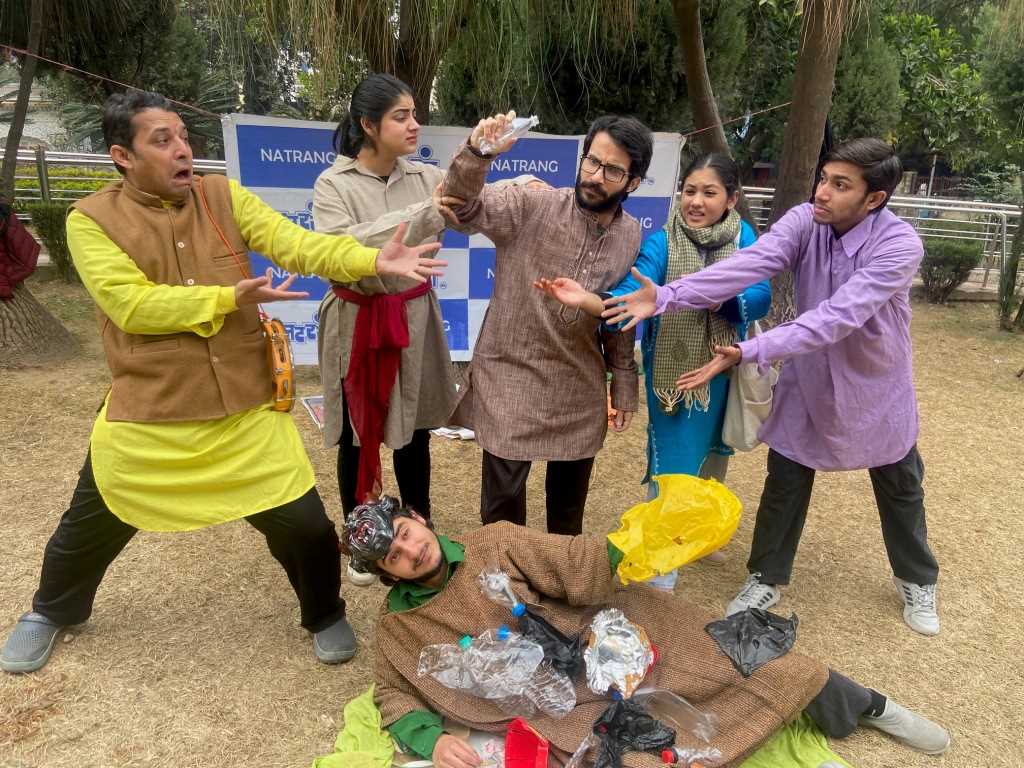
Natrang staged its new socially relevant production ‘Swachh Gram’ here today at Rani Park, Jammu, as part of its ongoing weekly theatre initiative, Sunday Theatre. Written and directed by renowned theatre personality Neeraj Kant, the play was conceived as a vibrant street performance aimed at sensitising citizens towards cleanliness, environmental responsibility, and the harmful impact of irresponsible waste disposal.
Blending humour, symbolism, and striking visual elements, the play effectively communicated the urgent need for civic sense and collective participation in maintaining a clean and healthy environment. The performance strongly resonated with the audience, drawing attention to everyday habits that contribute to pollution and public inconvenience.
The narrative opens on a busy street where people casually litter without concern. A character named Pappu eats a banana and throws the peel on the road. An elderly man cautions him, reminding him that public spaces belong to everyone, but Pappu dismisses the advice. Soon after, Meena enters the scene, narrowly avoiding a fall due to the banana peel. Angered, she disposes of it properly in a dustbin, while the narrator highlights the irony of people ignoring dustbins even when they are easily accessible.
In another sequence, Pappu once again displays negligence by discarding dirty disposable bottles on the street. The elderly man and Meena attempt to explain how such unhygienic practices spread filth and disease. A child begins coughing due to the garbage nearby, reinforcing the seriousness of the issue. Meena stresses that behavioural change is possible through awareness and responsibility, prompting Pappu to reflect on his actions.
Days later, a visible transformation occurs in Pappu’s attitude. When he fails to find a dustbin, he chooses to carry his waste in his bag instead of throwing it on the road. His change is acknowledged and appreciated by the elderly man and Meena. Pappu takes a pledge to never litter again and commits himself to stopping others from doing so. The characters collectively vow to keep their surroundings clean in the interest of a better India.
The play then moves to another locality plagued by plastic waste. Mohan casually throws a plastic bottle on the road, triggering the dramatic entry of Mother Earth, who appears distressed by the damage inflicted upon her by human actions. Soon after, the Plastic Monster emerges, boasting that humans themselves create him and then suffer because plastic does not decompose.
Suman enters carrying a cloth bag and a reusable bottle, explaining to Mohan the importance of reducing plastic usage by opting for sustainable alternatives. He demonstrates how plastic bottles and containers can be reused innovatively and how waste can be recycled by handing it over to scrap dealers. As awareness grows among the characters, the Plastic Monster gradually loses his strength.
The play concludes with all characters taking a collective pledge to adopt the principles of Reduce, Reuse, and Recycle in daily life. The audience is reminded of segregate waste, dry-waste in blue bins and wet-waste in green bins, prepare compost from kitchen waste, and actively contribute to keeping homes, streets, and the nation clean. The performance ends on a powerful note, reaffirming that a truly clean India can only be achieved through the committed participation of every citizen.
Actors who outshined in their respective performances and left an impact of their acting included Neeraj Kant, Pawan Verma, Kananpreet Kaur, Priyal Ashok Gupta, Kartik Kumar, Aadesh Dhar and Kushal Bhat. The music of the play was scored by Mohd. Yaseen
Natrang staged its new socially relevant production ‘Swachh Gram’ here today at Rani Park, Jammu, as part of its ongoing weekly theatre initiative, Sunday Theatre. Written and directed by renowned theatre personality Neeraj Kant, the play was conceived as a vibrant street performance aimed at sensitising citizens towards cleanliness, environmental responsibility, and the harmful impact of irresponsible waste disposal.
Blending humour, symbolism, and striking visual elements, the play effectively communicated the urgent need for civic sense and collective participation in maintaining a clean and healthy environment. The performance strongly resonated with the audience, drawing attention to everyday habits that contribute to pollution and public inconvenience.
The narrative opens on a busy street where people casually litter without concern. A character named Pappu eats a banana and throws the peel on the road. An elderly man cautions him, reminding him that public spaces belong to everyone, but Pappu dismisses the advice. Soon after, Meena enters the scene, narrowly avoiding a fall due to the banana peel. Angered, she disposes of it properly in a dustbin, while the narrator highlights the irony of people ignoring dustbins even when they are easily accessible.
In another sequence, Pappu once again displays negligence by discarding dirty disposable bottles on the street. The elderly man and Meena attempt to explain how such unhygienic practices spread filth and disease. A child begins coughing due to the garbage nearby, reinforcing the seriousness of the issue. Meena stresses that behavioural change is possible through awareness and responsibility, prompting Pappu to reflect on his actions.
Days later, a visible transformation occurs in Pappu’s attitude. When he fails to find a dustbin, he chooses to carry his waste in his bag instead of throwing it on the road. His change is acknowledged and appreciated by the elderly man and Meena. Pappu takes a pledge to never litter again and commits himself to stopping others from doing so. The characters collectively vow to keep their surroundings clean in the interest of a better India.
The play then moves to another locality plagued by plastic waste. Mohan casually throws a plastic bottle on the road, triggering the dramatic entry of Mother Earth, who appears distressed by the damage inflicted upon her by human actions. Soon after, the Plastic Monster emerges, boasting that humans themselves create him and then suffer because plastic does not decompose.
Suman enters carrying a cloth bag and a reusable bottle, explaining to Mohan the importance of reducing plastic usage by opting for sustainable alternatives. He demonstrates how plastic bottles and containers can be reused innovatively and how waste can be recycled by handing it over to scrap dealers. As awareness grows among the characters, the Plastic Monster gradually loses his strength.
The play concludes with all characters taking a collective pledge to adopt the principles of Reduce, Reuse, and Recycle in daily life. The audience is reminded of segregate waste, dry-waste in blue bins and wet-waste in green bins, prepare compost from kitchen waste, and actively contribute to keeping homes, streets, and the nation clean. The performance ends on a powerful note, reaffirming that a truly clean India can only be achieved through the committed participation of every citizen.
Actors who outshined in their respective performances and left an impact of their acting included Neeraj Kant, Pawan Verma, Kananpreet Kaur, Priyal Ashok Gupta, Kartik Kumar, Aadesh Dhar and Kushal Bhat. The music of the play was scored by Mohd. Yaseen

© Copyright 2023 brighterkashmir.com All Rights Reserved. Quantum Technologies