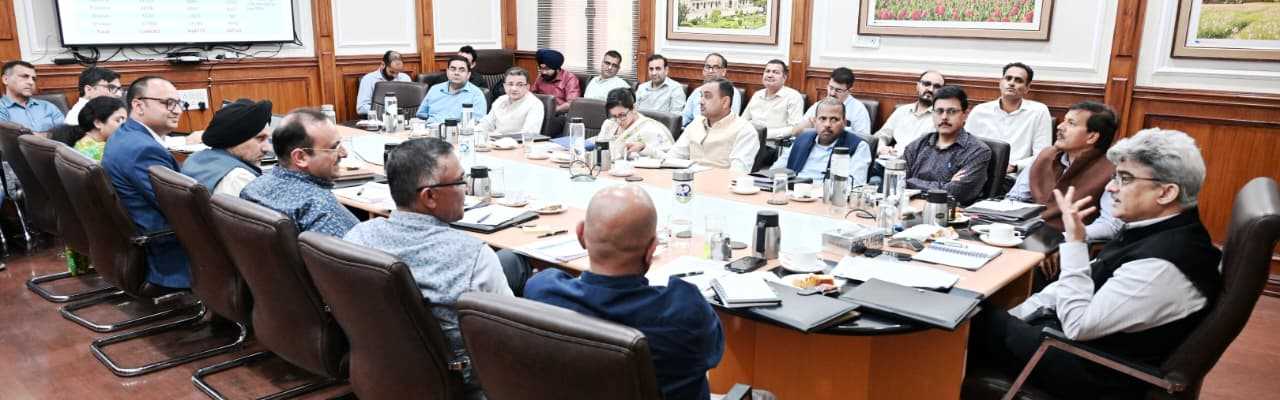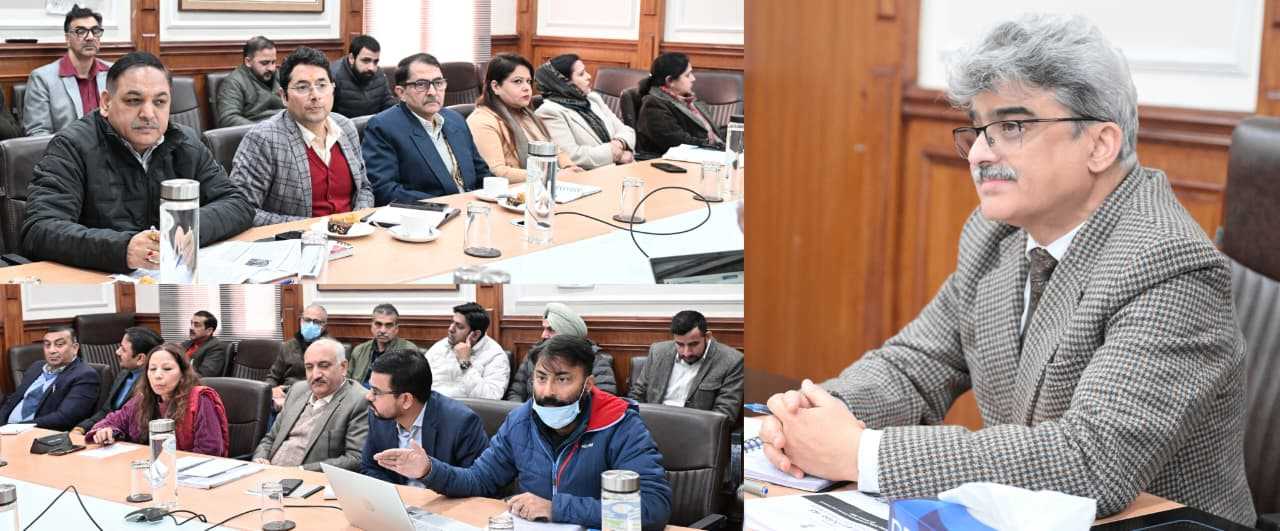
In a major initiative aimed at making the population of J&K future-ready for emerging employment opportunities, the Skill Development Department today presented a comprehensive and forward-looking roadmap to Chief Secretary, Atal Dulloo to transform the skilling ecosystem of the UT.
The meeting was attended by Vice-Chancellors of local Universities, Director IIM Jammu, Managing Director, J&K Bank, Secretary, Education; MD, Skill Mission and representatives from premier institutions including IIT, NIFT and other reputed academic and professional institutions.
While reviewing the roadmap, the Chief Secretary emphasized the need to explore the concept of Global Capability Centres (GCCs) in Jammu & Kashmir for the creation of better and high-quality employment opportunities. He also suggested developing fellowship programmes to create a strong pool of skilled human resources within the UT.
The Chief Secretary appreciated the overall framework of the plan, stating that it incorporates all essential constituents required for skilling different sections of the population, making it inclusive and forward-looking in character.
He, however, stressed that the roadmap should be made more practical, outcome-driven and implementable, with clearly defined roles and responsibilities of all participating institutions, including national-level institutions such as IITs, IIMs, AIIMS, NITs, Universities, SKIMS and other professional institutions.
Emphasising employability, the Chief Secretary called for strengthening industry–academia linkages to ensure greater applicability and job orientation of skilling programmes, making them market-aligned and future-ready.
He further directed that the roadmap be circulated among various stakeholders including Universities, academic institutions and relevant government departments for comments and suggestions so that the final document becomes more effective and impactful in terms of outcomes.
Presenting the roadmap, Secretary, Skill Development Department, Kumar Rajeev Ranjan, informed that the plan will be implemented over the next five years, with the objective of empowering nearly 14 lakh individuals across Jammu & Kashmir through industry-aligned skilling, ensuring inclusive growth, enhanced employability and long-term economic resilience.
Elaborating on the vision, the Secretary stated that the overarching goal of the roadmap is to empower every individual in Jammu & Kashmir to secure a gainful livelihood through market-aligned skilling, thereby unlocking opportunities in both the present and future economy.
The Secretary further divulged that the proposed outcomes include exposure to skilling for 6–7 lakh school students, structured skill courses for 2–2.5 lakh college students, and technical or short-term skilling for 5–6 lakh youth and working-age individuals, promoting lifelong learning across relevant trades. He added that the roadmap is structured around four integrated tracks, each addressing a specific stage of the skilling and employment lifecycle.
Detailing the implementation strategy, Director, Skill Development Department, Shahzad Alam, stated that the first track, ‘Foundational Skilling in Schools’, focuses on compulsory exposure to vocational and 21st-century skills for students from Classes 6 to 12th. He elaborated that the students will be introduced to trades, services, digital economy, local entrepreneurship and workplace readiness through structured modules, exposure visits, school-level skill hackathons and psychometric career assessments to help them identify their interests and capabilities in addition to academic performance. Dedicated coordinators, mobile skilling vans, teacher training led by SCERT, and school-level skilling committees will support effective implementation.
The second track, ‘Career Launchpad in Colleges’, targets college students, senior secondary pass-outs and fresh graduates. It proposes the introduction of minor skilling courses, summer internships, finishing school modules and accessible coaching for competitive examinations such as JEE and NEET.
Under this track, stackable and high-demand courses will be delivered in blended mode. Academic credits for skilling, stipends for internships and structured placement support will help bridge the gap between education and employment. Governance will be ensured through college skilling committees and apex-level administrative monitoring.
The third track, ‘Industry-Ready Technical Skilling’, focuses on strengthening ITIs, polytechnics and technical institutions through a hub-and-spoke model, diversified course offerings, introduction of dual systems of training and flexible entry-exit pathways aligned with NSQF levels.
Under this track Polytechnics are proposed to evolve into a J&K Skills University framework, supported by centres of excellence, faculty development programmes, infrastructure upgrades and strengthened apprenticeship linkages with MSMEs.
The fourth track, ‘Upskilling and Lifelong Learning’, addresses the needs of the existing workforce and the informal sector. It promotes short-term skilling convergence, mid-career skill upgradation and competitive examination preparation under the Lakshya Scheme, with special focus on the 30–45 age group.
The track also emphasises recognition of prior learning (RPL) for artisans and traditional workers, entrepreneurial skill development and institutionalising lifelong learning as a social and economic norm. Model short-term skill centres are proposed in every district, along with upskilling vouchers, loan support and scholarships to ensure effective implementation.
The Chief Secretary was also briefed on the proposal for a unified, end-to-end job listing platform for the youth of Jammu & Kashmir, integrating international, national and UT-level employment opportunities. The platform aims to address fragmented job ecosystems, improve job discovery and tracking by creating a verified talent pool and unlock overseas employment potential too.
For international recruitment, a structured strategy has been outlined, including youth preference mapping, establishment of migrant resource and foreign language centres, partnerships with global recruitment agencies, and end-to-end visa and contract facilitation. Successful models from states such as Telangana, Kerala, Karnataka and Meghalaya were cited, with scope for collaboration through the proposed J&K Overseas Employment Corporation.
A two-tier recruitment model has also been proposed, covering both international and national/UT-level placements, supported by API integration with job portals, corporate tie-ups, district employment offices and mandatory publication of government job notifications on the Mission YUVA platform.
The participating stakeholders took this occasion to share their valuable inputs on strengthening institutional frameworks, leveraging available infrastructure and manpower, and ensuring coordinated implementation to make the skilling ecosystem a major success across the length and bread of J&K in the months to come.
In a major initiative aimed at making the population of J&K future-ready for emerging employment opportunities, the Skill Development Department today presented a comprehensive and forward-looking roadmap to Chief Secretary, Atal Dulloo to transform the skilling ecosystem of the UT.
The meeting was attended by Vice-Chancellors of local Universities, Director IIM Jammu, Managing Director, J&K Bank, Secretary, Education; MD, Skill Mission and representatives from premier institutions including IIT, NIFT and other reputed academic and professional institutions.
While reviewing the roadmap, the Chief Secretary emphasized the need to explore the concept of Global Capability Centres (GCCs) in Jammu & Kashmir for the creation of better and high-quality employment opportunities. He also suggested developing fellowship programmes to create a strong pool of skilled human resources within the UT.
The Chief Secretary appreciated the overall framework of the plan, stating that it incorporates all essential constituents required for skilling different sections of the population, making it inclusive and forward-looking in character.
He, however, stressed that the roadmap should be made more practical, outcome-driven and implementable, with clearly defined roles and responsibilities of all participating institutions, including national-level institutions such as IITs, IIMs, AIIMS, NITs, Universities, SKIMS and other professional institutions.
Emphasising employability, the Chief Secretary called for strengthening industry–academia linkages to ensure greater applicability and job orientation of skilling programmes, making them market-aligned and future-ready.
He further directed that the roadmap be circulated among various stakeholders including Universities, academic institutions and relevant government departments for comments and suggestions so that the final document becomes more effective and impactful in terms of outcomes.
Presenting the roadmap, Secretary, Skill Development Department, Kumar Rajeev Ranjan, informed that the plan will be implemented over the next five years, with the objective of empowering nearly 14 lakh individuals across Jammu & Kashmir through industry-aligned skilling, ensuring inclusive growth, enhanced employability and long-term economic resilience.
Elaborating on the vision, the Secretary stated that the overarching goal of the roadmap is to empower every individual in Jammu & Kashmir to secure a gainful livelihood through market-aligned skilling, thereby unlocking opportunities in both the present and future economy.
The Secretary further divulged that the proposed outcomes include exposure to skilling for 6–7 lakh school students, structured skill courses for 2–2.5 lakh college students, and technical or short-term skilling for 5–6 lakh youth and working-age individuals, promoting lifelong learning across relevant trades. He added that the roadmap is structured around four integrated tracks, each addressing a specific stage of the skilling and employment lifecycle.
Detailing the implementation strategy, Director, Skill Development Department, Shahzad Alam, stated that the first track, ‘Foundational Skilling in Schools’, focuses on compulsory exposure to vocational and 21st-century skills for students from Classes 6 to 12th. He elaborated that the students will be introduced to trades, services, digital economy, local entrepreneurship and workplace readiness through structured modules, exposure visits, school-level skill hackathons and psychometric career assessments to help them identify their interests and capabilities in addition to academic performance. Dedicated coordinators, mobile skilling vans, teacher training led by SCERT, and school-level skilling committees will support effective implementation.
The second track, ‘Career Launchpad in Colleges’, targets college students, senior secondary pass-outs and fresh graduates. It proposes the introduction of minor skilling courses, summer internships, finishing school modules and accessible coaching for competitive examinations such as JEE and NEET.
Under this track, stackable and high-demand courses will be delivered in blended mode. Academic credits for skilling, stipends for internships and structured placement support will help bridge the gap between education and employment. Governance will be ensured through college skilling committees and apex-level administrative monitoring.
The third track, ‘Industry-Ready Technical Skilling’, focuses on strengthening ITIs, polytechnics and technical institutions through a hub-and-spoke model, diversified course offerings, introduction of dual systems of training and flexible entry-exit pathways aligned with NSQF levels.
Under this track Polytechnics are proposed to evolve into a J&K Skills University framework, supported by centres of excellence, faculty development programmes, infrastructure upgrades and strengthened apprenticeship linkages with MSMEs.
The fourth track, ‘Upskilling and Lifelong Learning’, addresses the needs of the existing workforce and the informal sector. It promotes short-term skilling convergence, mid-career skill upgradation and competitive examination preparation under the Lakshya Scheme, with special focus on the 30–45 age group.
The track also emphasises recognition of prior learning (RPL) for artisans and traditional workers, entrepreneurial skill development and institutionalising lifelong learning as a social and economic norm. Model short-term skill centres are proposed in every district, along with upskilling vouchers, loan support and scholarships to ensure effective implementation.
The Chief Secretary was also briefed on the proposal for a unified, end-to-end job listing platform for the youth of Jammu & Kashmir, integrating international, national and UT-level employment opportunities. The platform aims to address fragmented job ecosystems, improve job discovery and tracking by creating a verified talent pool and unlock overseas employment potential too.
For international recruitment, a structured strategy has been outlined, including youth preference mapping, establishment of migrant resource and foreign language centres, partnerships with global recruitment agencies, and end-to-end visa and contract facilitation. Successful models from states such as Telangana, Kerala, Karnataka and Meghalaya were cited, with scope for collaboration through the proposed J&K Overseas Employment Corporation.
A two-tier recruitment model has also been proposed, covering both international and national/UT-level placements, supported by API integration with job portals, corporate tie-ups, district employment offices and mandatory publication of government job notifications on the Mission YUVA platform.
The participating stakeholders took this occasion to share their valuable inputs on strengthening institutional frameworks, leveraging available infrastructure and manpower, and ensuring coordinated implementation to make the skilling ecosystem a major success across the length and bread of J&K in the months to come.

© Copyright 2023 brighterkashmir.com All Rights Reserved. Quantum Technologies