
BREAKING NEWS
Srinagar, Mar 6: The Environmental Policy Group (EPG) has expressed deep concern over the rapidly deteriorating water condition of Dal Lake following the widespread cyanobacterial bloom that has engulfed a significant portion of the lake’s expanse.
Based on field observations, scientific understanding, and independent inputs, EPG strongly contests attempts to attribute the bloom to seasonal temperature variation or reduced water inflow.
The bloom began approximately two weeks ago when ambient temperatures were relatively cool, not high. This fact alone rules out temperature as the triggering factor in the present case.
While there has been some scarcity of surface water inflow due to a dry spell, nearly 30 percent of the lake’s inflow is sustained by subsurface lake-bed springs. Such hydrological conditions, in isolation, are not scientifically sufficient to trigger a bloom of this magnitude. In fact, the reduced inflow currently being cited appears to be constraining control and dilution measures rather than explaining the bloom’s origin.
EPG has been informed that shortly before the bloom appeared, mechanical deweeding operations were undertaken under an annual contract awarded by the Lake Conservation and Management Authority (LCMA).
The contractor was reportedly directed to carry out large-scale deweeding without prior scientific evaluation of the timing of intervention, the percentage of vegetation to be removed, or the ecological consequences of disturbing rooted lake-bed weeds. In earlier years, deweeding was undertaken with established scientific protocols, including assessment of ecological thresholds. The absence of such an evaluation in the present instance represents a serious procedural lapse.
Mechanical removal of rooted vegetation without ecological safeguards disturbs lake-bed sediments that are enriched with nutrients such as phosphorus (P) and nitrogen (N). Excessive sediment disturbance leads to the resuspension and dispersion of these nutrients into the water column. Cyanobacteria naturally present in freshwater systems rapidly utilise these nutrients, triggering explosive growth. The scale and uniformity of the present bloom strongly indicate that nutrient enrichment caused by sediment disturbance was the likely catalyst.
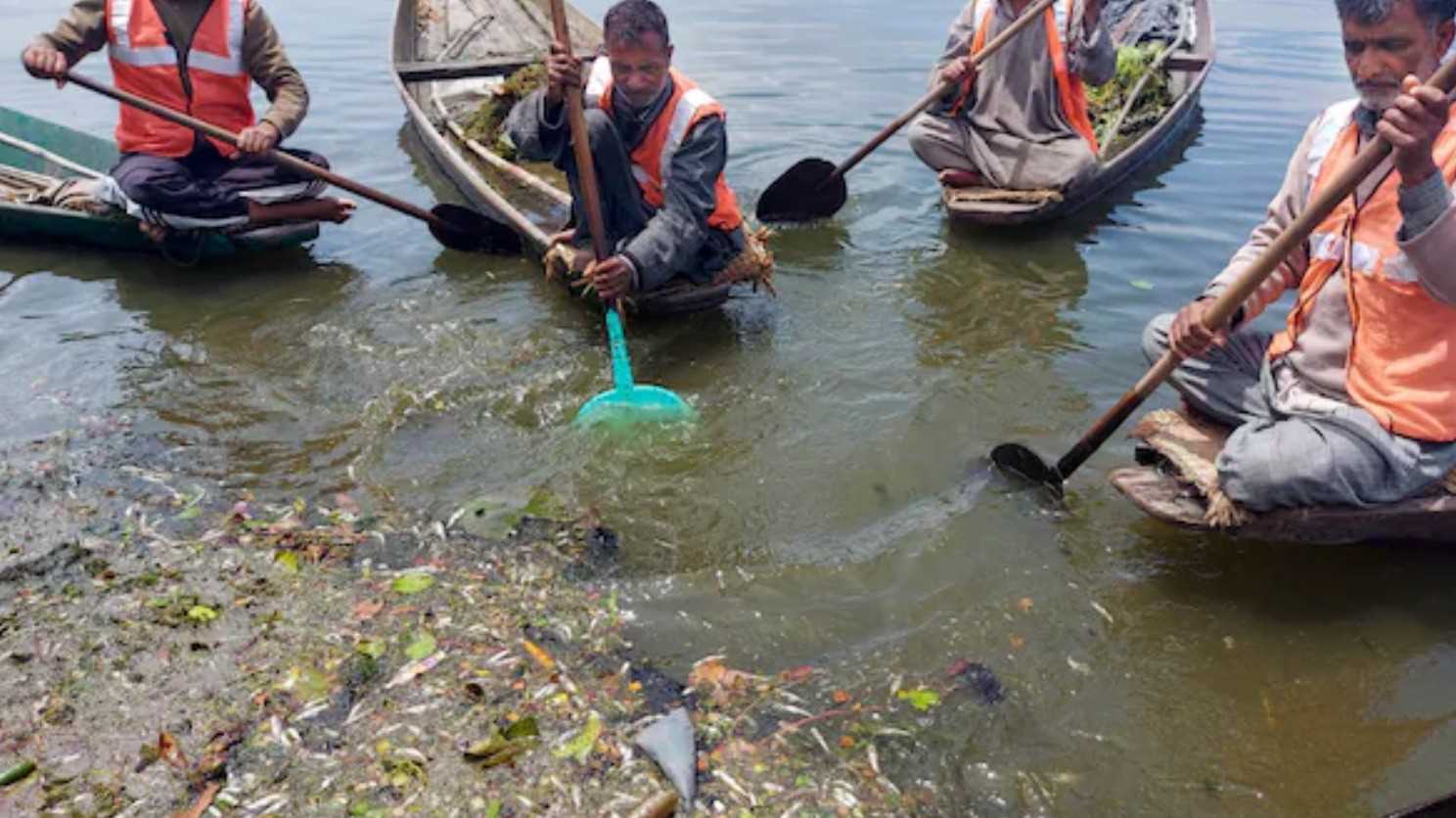
The bloom has manifested in the form of thick green scum resembling spilled paint across the lake surface, accompanied by foul odor and extensive green discoloration of the water body. These characteristics are typical indicators of a Microcystis bloom, caused by cyanobacteria proliferating in nutrient-rich, eutrophic freshwater systems. Independent microscopic examination of affected water samples has reportedly confirmed the bloom as Microcystis. Sources have further indicated that objections were raised against conducting deweeding without scientific monitoring and impact testing, but these concerns were not heeded.
EPG finds it deeply troubling that instead of acknowledging potential procedural lapses, LCMA appears to be attempting to downplay the seriousness of the situation through selective video messaging to media outlets. Transparent accountability and scientific clarity are essential in managing ecologically sensitive water bodies, particularly one as critical as Dal Lake.
Scientific literature clearly establishes that Microcystis blooms produce toxins, including microcystins, which are hepatotoxic and may also have neurotoxic effects. Human exposure can result in skin rashes, throat irritation, respiratory complications, pneumonia, and severe gastrointestinal distress. Ecologically, such blooms degrade water quality, reduce biodiversity, block sunlight penetration, and deplete dissolved oxygen levels, thereby disrupting aquatic ecosystems and accelerating eutrophication.
Of additional concern is the fact that water from Dal Lake and the interconnected Nigeen Lake is lifted for municipal supply through the Nishat Water Treatment Plant via the Dal Bund lift station and through the Pokhribal Lift Scheme. A video circulated by the Superintending Engineer (Hydraulic), Circle Srinagar, states that water treatment plants are closely monitoring water quality parameters and ensuring that bloom-affected water is adequately treated before being supplied to Srinagar city consumers. While these assurances are noted, EPG emphasises that reactive treatment at the plant level cannot substitute for preventive ecological management at source.
Based on the sequence of events and the scientific reasoning outlined above, the Environmental Policy Group concludes that the present Microcystis bloom appears to have been triggered due to negligence at the highest levels of LCMA in permitting large-scale deweeding operations without scientific safeguards and ecological monitoring.
EPG calls for an independent and transparent scientific inquiry into the recent deweeding operations, immediate public disclosure of water quality data, including toxin monitoring results, and the establishment of a permanent multidisciplinary oversight mechanism for lake management. Dal Lake is not only an ecological treasure but also a public health and economic lifeline. Its management must be guided by scientific integrity, accountability, and long-term sustainability rather than administrative expediency.
Srinagar, Mar 6: The Environmental Policy Group (EPG) has expressed deep concern over the rapidly deteriorating water condition of Dal Lake following the widespread cyanobacterial bloom that has engulfed a significant portion of the lake’s expanse.
Based on field observations, scientific understanding, and independent inputs, EPG strongly contests attempts to attribute the bloom to seasonal temperature variation or reduced water inflow.
The bloom began approximately two weeks ago when ambient temperatures were relatively cool, not high. This fact alone rules out temperature as the triggering factor in the present case.
While there has been some scarcity of surface water inflow due to a dry spell, nearly 30 percent of the lake’s inflow is sustained by subsurface lake-bed springs. Such hydrological conditions, in isolation, are not scientifically sufficient to trigger a bloom of this magnitude. In fact, the reduced inflow currently being cited appears to be constraining control and dilution measures rather than explaining the bloom’s origin.
EPG has been informed that shortly before the bloom appeared, mechanical deweeding operations were undertaken under an annual contract awarded by the Lake Conservation and Management Authority (LCMA).
The contractor was reportedly directed to carry out large-scale deweeding without prior scientific evaluation of the timing of intervention, the percentage of vegetation to be removed, or the ecological consequences of disturbing rooted lake-bed weeds. In earlier years, deweeding was undertaken with established scientific protocols, including assessment of ecological thresholds. The absence of such an evaluation in the present instance represents a serious procedural lapse.
Mechanical removal of rooted vegetation without ecological safeguards disturbs lake-bed sediments that are enriched with nutrients such as phosphorus (P) and nitrogen (N). Excessive sediment disturbance leads to the resuspension and dispersion of these nutrients into the water column. Cyanobacteria naturally present in freshwater systems rapidly utilise these nutrients, triggering explosive growth. The scale and uniformity of the present bloom strongly indicate that nutrient enrichment caused by sediment disturbance was the likely catalyst.
The bloom has manifested in the form of thick green scum resembling spilled paint across the lake surface, accompanied by foul odor and extensive green discoloration of the water body. These characteristics are typical indicators of a Microcystis bloom, caused by cyanobacteria proliferating in nutrient-rich, eutrophic freshwater systems. Independent microscopic examination of affected water samples has reportedly confirmed the bloom as Microcystis. Sources have further indicated that objections were raised against conducting deweeding without scientific monitoring and impact testing, but these concerns were not heeded.
EPG finds it deeply troubling that instead of acknowledging potential procedural lapses, LCMA appears to be attempting to downplay the seriousness of the situation through selective video messaging to media outlets. Transparent accountability and scientific clarity are essential in managing ecologically sensitive water bodies, particularly one as critical as Dal Lake.
Scientific literature clearly establishes that Microcystis blooms produce toxins, including microcystins, which are hepatotoxic and may also have neurotoxic effects. Human exposure can result in skin rashes, throat irritation, respiratory complications, pneumonia, and severe gastrointestinal distress. Ecologically, such blooms degrade water quality, reduce biodiversity, block sunlight penetration, and deplete dissolved oxygen levels, thereby disrupting aquatic ecosystems and accelerating eutrophication.
Of additional concern is the fact that water from Dal Lake and the interconnected Nigeen Lake is lifted for municipal supply through the Nishat Water Treatment Plant via the Dal Bund lift station and through the Pokhribal Lift Scheme. A video circulated by the Superintending Engineer (Hydraulic), Circle Srinagar, states that water treatment plants are closely monitoring water quality parameters and ensuring that bloom-affected water is adequately treated before being supplied to Srinagar city consumers. While these assurances are noted, EPG emphasises that reactive treatment at the plant level cannot substitute for preventive ecological management at source.
Based on the sequence of events and the scientific reasoning outlined above, the Environmental Policy Group concludes that the present Microcystis bloom appears to have been triggered due to negligence at the highest levels of LCMA in permitting large-scale deweeding operations without scientific safeguards and ecological monitoring.
EPG calls for an independent and transparent scientific inquiry into the recent deweeding operations, immediate public disclosure of water quality data, including toxin monitoring results, and the establishment of a permanent multidisciplinary oversight mechanism for lake management. Dal Lake is not only an ecological treasure but also a public health and economic lifeline. Its management must be guided by scientific integrity, accountability, and long-term sustainability rather than administrative expediency.

© Copyright 2023 brighterkashmir.com All Rights Reserved. Quantum Technologies