
BREAKING NEWS
Srinagar, Nov 6: The rabab, often regarded as the soul of Kashmiri music, is witnessing renewed demand, with traditional craftsmen receiving orders from across the country and abroad, keeping alive an age-old artistic tradition.
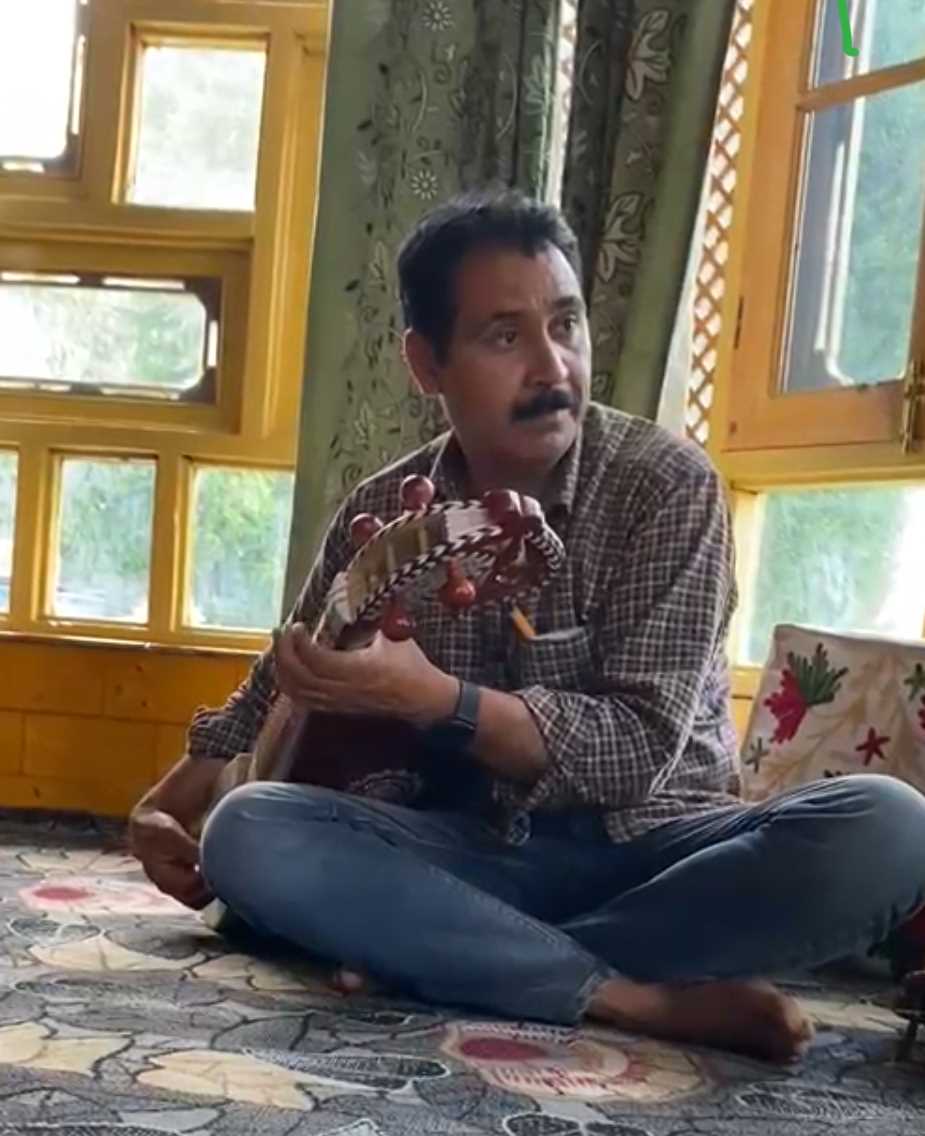
Carved primarily from mulberry wood and known for its distinctive shape and rich resonance, the rabab has 16 to 17 strings and occupies a special place in Kashmir’s Sufi and folk music. Though believed to have originated in Afghanistan, the instrument is thought to have reached Kashmir centuries ago, possibly during the reign of Sultan Zain-ul-Abidin in the 15th century.
For Mushtaq Ahmad Dar, a third-generation rabab maker from Narbal in central Kashmir’s Budgam district, the craft has evolved from a family hobby into a full-time profession.
Dar told Hindusthan Samachar that he receives regular orders not only from Kashmir but also from different parts of India and overseas. Increasingly, customers are purchasing rababs not just as musical instruments but also as decorative pieces and gifts.
Recalling one such experience, Dar said a local lawyer had ordered a rabab worth Rs 35,000 as a gift for a relative in the United States. However, after seeing the finished instrument at his workshop, the customer decided to keep it for himself. He subsequently purchased three rababs and a sarangi.
Dar operates a two-room workshop at his home, where he works from 9 am to 10 pm, sometimes putting in 14 hours a day. Besides rababs, he also makes santoor and sarangi, although the rabab accounts for the bulk of his orders.
“I took it up as a hobby at first, and then it became my full-time profession. It is a very good source of livelihood,” he said, adding that demand is so strong that some customers return without getting their orders fulfilled.
An ordinary rabab takes at least one-and-a-half months to complete and costs between Rs 35,000 and Rs 36,000. Instruments featuring intricate craftsmanship take longer and command higher prices. Dar said he had also sold a specially crafted rabab for Rs 1.20 lakh.
The craft runs deep in his family. He learnt it from his father, a government employee who practised rabab-making as a hobby. Today, his father and brothers assist him, while the younger generation is also showing interest in carrying forward the tradition.
However, the craft faces challenges, particularly the growing scarcity of mulberry wood, its principal raw material. Dar fears that difficulty in procuring quality wood could affect production and the future of the traditional occupation.
Structurally, the Kashmiri rabab is carved from a single block of wood, with a hollow body covered by a stretched skin membrane, usually goat skin. Its strings pass over a bridge resting on the membrane, producing its characteristic deep and mellow sound. Played with a plectrum, the instrument also features sympathetic strings that vibrate when the main strings are plucked.
Experts regard the rabab as an ancestor of the sarod. The instrument, commonly known as the Kabuli rabab in Kashmir and Afghanistan, has evolved across regions while retaining its cultural significance.
Despite challenges such as changing musical preferences and a shortage of formal training opportunities, the rabab continues to enjoy recognition beyond the Valley. In 2024, UNESCO inscribed the art of crafting and playing the rubab on its Representative List of the Intangible Cultural Heritage of Humanity through a joint nomination by Afghanistan, Iran, Tajikistan and Uzbekistan.
For craftsmen like Dar, every rabab is more than a wooden instrument. It represents generations of skill, cultural memory and the enduring musical identity of Kashmir.

© Copyright 2023 brighterkashmir.com All Rights Reserved. Quantum Technologies