
BREAKING NEWS
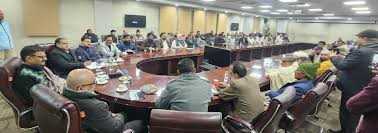
JAMMU, JAN 11: In a initiative aimed at deepening the democratic engagement and advancing the constitutional mandate of social justice, Minister for Jal Shakti, Forest, Ecology & Environment and Tribal Affairs, Javed Ahmed Rana, today held a day long mega public outreach programme with members of Other Backward Classes (OBCs), Scheduled Tribes (STs) and Scheduled Castes (SCs) at Panchayat Bhawan, Jammu.
The outreach programme was conceived as a rights-based participatory platform, enabling historically marginalised and socially disadvantaged communities to directly articulate their grievances, lived realities and developmental aspirations before the government.
Apart from several members of SC/ST and OBC communities, the interaction was attended by Mohammad Mumtaz Ali, Director Tribal Affairs, J&K; Dr. Abdul Khabir, Director, Tribal Research Institute, J&K, Pradeepchandra P. Wahule, Conservator of Forests; Mohammad Hanief, Chief Engineer, Jal Shakti (PHE); Manoj Gupta, Chief Engineer, Irrigation & Flood Control along with officers from various concerned departments.
The interaction sought to move beyond file centric governance towards people-centric administration, ensuring that public policy is informed by ground-level experiences and guided by the principles of equity, dignity and distributive justice as envisioned in the Constitution.
Addressing the gathering, the Minister underscored that meaningful public outreach is not an act of benevolence but a constitutional obligation of the State, particularly towards marginalized communities.
He stressed that transparent, accessible and responsive governance is essential to dismantle historical exclusions and ensure substantive equality, especially for SC, ST and OBC populations.
“Dr B.R. Ambedkar reminded us that political democracy cannot survive without social and economic democracy. These interactions are an effort to translate that vision into administrative action,” the Minister observed.
During the interaction, delegations highlighted the concerns relating to safe and adequate drinking water, erratic supply, leaking pipelines, defunct filtration plants and inadequate tube wells, particularly in rural, tribal and Kandi belts. Besides, housing insecurity, especially among the migratory tribal families, was raised at length.
The participants highlighted the absence of stable shelters, vulnerability to climatic adversities and delays in forest and revenue clearances, which prevent timely repairs and reconstruction of damaged dwellings.
The lack of all-weather road connectivity in remote and hilly areas emerged as a recurring concern. Education-related issues, particularly concerning the tribal children and youth, were discussed in detail.
The participants stressed that inadequate hostel infrastructure for Gujjar-Bakarwal students, especially girls, directly contributes to high dropout rates and poor learning outcomes.
Responding to the issues raised, the Minister stated that such direct engagements reveal ground realities often obscured in routine reporting mechanisms.
The Minister emphasized the need for inter-departmental convergence among Jal Shakti, Rural Development, Education, Health, Forest and Tribal Affairs departments, stressing that water, roads, education, healthcare and housing are interlinked determinants of social well-being.
He assured that all grievances would be systematically documented, followed by time-bound action plans, regular field reviews and strengthened accountability mechanisms.
He reiterated that access to drinking water, housing, roads, education and healthcare must be treated as core governance responsibilities flowing from constitutional morality, not as fragmented departmental schemes
JAMMU, JAN 11: In a initiative aimed at deepening the democratic engagement and advancing the constitutional mandate of social justice, Minister for Jal Shakti, Forest, Ecology & Environment and Tribal Affairs, Javed Ahmed Rana, today held a day long mega public outreach programme with members of Other Backward Classes (OBCs), Scheduled Tribes (STs) and Scheduled Castes (SCs) at Panchayat Bhawan, Jammu.
The outreach programme was conceived as a rights-based participatory platform, enabling historically marginalised and socially disadvantaged communities to directly articulate their grievances, lived realities and developmental aspirations before the government.
Apart from several members of SC/ST and OBC communities, the interaction was attended by Mohammad Mumtaz Ali, Director Tribal Affairs, J&K; Dr. Abdul Khabir, Director, Tribal Research Institute, J&K, Pradeepchandra P. Wahule, Conservator of Forests; Mohammad Hanief, Chief Engineer, Jal Shakti (PHE); Manoj Gupta, Chief Engineer, Irrigation & Flood Control along with officers from various concerned departments.
The interaction sought to move beyond file centric governance towards people-centric administration, ensuring that public policy is informed by ground-level experiences and guided by the principles of equity, dignity and distributive justice as envisioned in the Constitution.
Addressing the gathering, the Minister underscored that meaningful public outreach is not an act of benevolence but a constitutional obligation of the State, particularly towards marginalized communities.
He stressed that transparent, accessible and responsive governance is essential to dismantle historical exclusions and ensure substantive equality, especially for SC, ST and OBC populations.
“Dr B.R. Ambedkar reminded us that political democracy cannot survive without social and economic democracy. These interactions are an effort to translate that vision into administrative action,” the Minister observed.
During the interaction, delegations highlighted the concerns relating to safe and adequate drinking water, erratic supply, leaking pipelines, defunct filtration plants and inadequate tube wells, particularly in rural, tribal and Kandi belts. Besides, housing insecurity, especially among the migratory tribal families, was raised at length.
The participants highlighted the absence of stable shelters, vulnerability to climatic adversities and delays in forest and revenue clearances, which prevent timely repairs and reconstruction of damaged dwellings.
The lack of all-weather road connectivity in remote and hilly areas emerged as a recurring concern. Education-related issues, particularly concerning the tribal children and youth, were discussed in detail.
The participants stressed that inadequate hostel infrastructure for Gujjar-Bakarwal students, especially girls, directly contributes to high dropout rates and poor learning outcomes.
Responding to the issues raised, the Minister stated that such direct engagements reveal ground realities often obscured in routine reporting mechanisms.
The Minister emphasized the need for inter-departmental convergence among Jal Shakti, Rural Development, Education, Health, Forest and Tribal Affairs departments, stressing that water, roads, education, healthcare and housing are interlinked determinants of social well-being.
He assured that all grievances would be systematically documented, followed by time-bound action plans, regular field reviews and strengthened accountability mechanisms.
He reiterated that access to drinking water, housing, roads, education and healthcare must be treated as core governance responsibilities flowing from constitutional morality, not as fragmented departmental schemes

© Copyright 2023 brighterkashmir.com All Rights Reserved. Quantum Technologies