
BREAKING NEWS
The book also traces the spread of Bhakti beyond the Tamil land. Bhakti, like a river in the north, took on a force and gave rise to personalities like Kabir, Mirabai, Tulsidas, and Guru Nanak. According to Srinivasan, Bhakti was modified by these later saints to fit local circumstances, yet retained its Tamil roots. As such, the Tamil Bhakti movement can be regarded as the birthplace of a pan-Indian revolution of devotionalism, a revolution that transformed the face of religion over the centuries
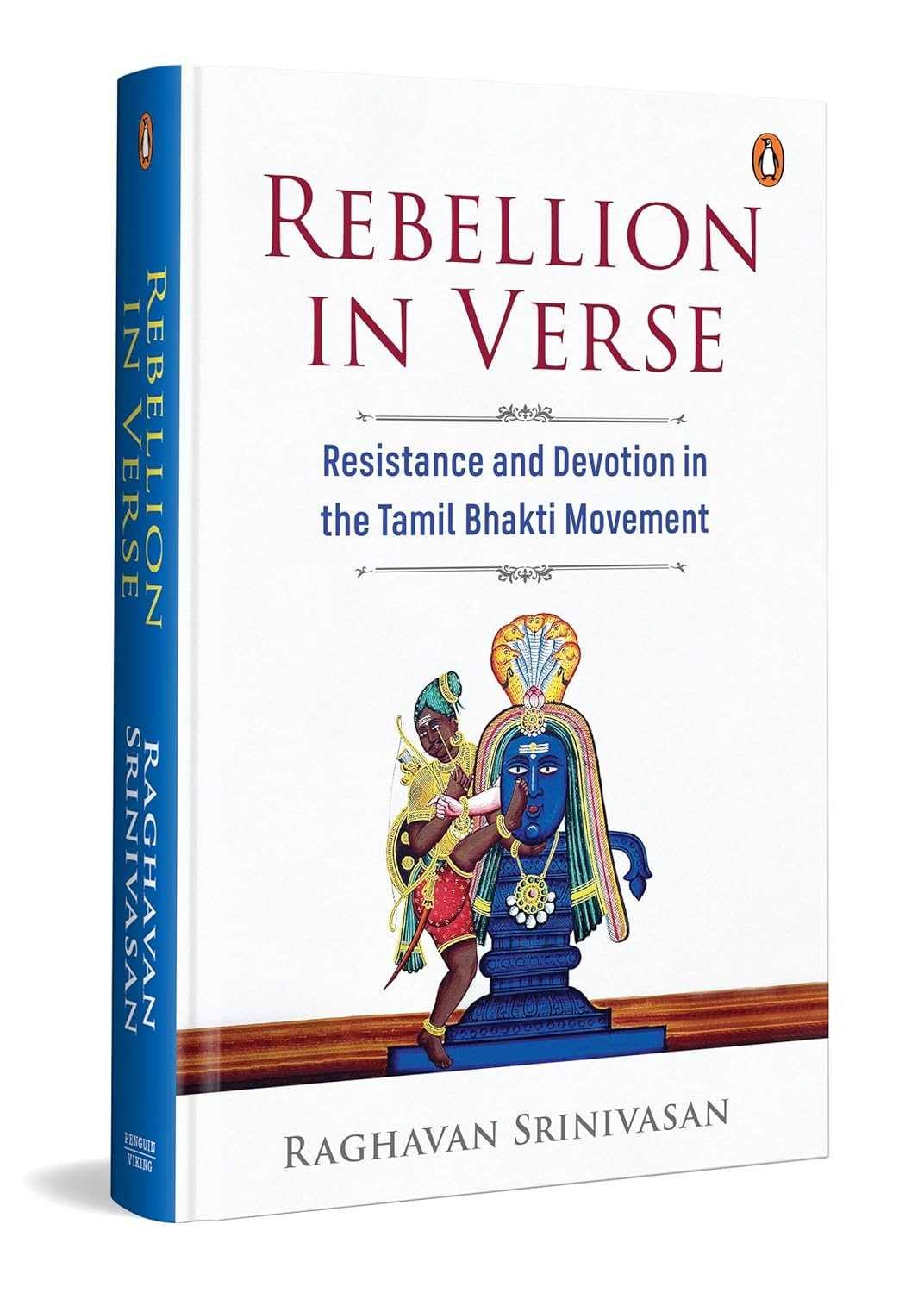
‘Raghavan Srinivasan in Rebellion in Verse: Resistance and Devotion in the Tamil Bhakti Movement’ provides an expansive and nuanced description of one of the most dramatic cultural events in South Asia. The book, published by Penguin Random House India, situates the Tamil Bhakti movement in the context not only of a devotional efflorescence but also of a social and political revolution.
Srinivasan has produced a work that is historical and interpretive, a blend of the lives of saints, the socio-economic status of medieval Tamilakam, and the legacy of Bhakti in the subcontinent.
Bhakti as Rebellion
The book preface provides us with the flavour of the book, indicating that Bhakti is a rebellion, hymn-wrapped. It is vital to state the following: Srinivasan argues that Bhakti was not a form of religious enlightenment but a radical redesign of the social structure.
Saints such as Nandanar, Kannappar and Adipaththar are the names of those who will challenge the caste system and the orthodoxy of rituals, thereby becoming incarnations of devotion as resistance. When the author foreshadows these voices, he emphasises the two-natured Bhakti: a theological movement and a grassroots social uprising.
History and Learning Conditions
Srinivasan dates the Bhakti upsurge to the sixth century, a period when both Buddhism and Jainism had already penetrated Tamil society. However, as he notes, the new productive forces, that is, merchants, craftsmen, and peasants, wanted to be freed from Vedic orthodoxy. Bhakti was then a clarion call, a democratic spirituality that directly appealed to the masses.
The poetic political aspect of the saints' choice to write in Tamil rather than in Sanskrit is raised. As Tamil is promoted as the language of devotion, Bhakti introduced divine wisdom into the possession of the elite and handed it over to the masses. It was an especially radical linguistic alternative, Srinivasan asserts: the spiritual realm was transformed into an active sphere, and the deity was no longer mediated by the priest but presented to potters, farmers, and fishermen.
Saints as Revolutionaries
The book has strength in its colourful description of the individual saints. Examples include Appar, who was an inactive critic of Vedic ritualism and whose poetry criticised the usefulness of Vedic learning through rote and ritual karma. Andal, a Vaishnavite saint-poet, is proclaimed to have denied mortal marriage and claimed an extreme claim of female agency in a patriarchal society. Nandanar, the outcast devotee, and Karaikal Ammaiyar, the anaesthetised lady saint, are presented as those who overturned the categorisations in society, and it was even possible to engage in cross-caste and cross-gender devotion.
By introducing these lives into the limelight, Srinivasan demonstrates that the Bhakti saints were not useless mystics; rather, they were change agents. Their songs were action, and their living was rebellious. The book requires that Bhakti be both a social commentary and a spiritual exercise.
Temples as Community Spaces
The other important thing about the book is that it explores the nature of temples as community centres in people's lives. Temples were also centres of art, music and literature, as well as places of worship. The decision to promote the Tamil hymns as Tamil Vedas, which were traditionally processed before the Sanskrit books, was a procession to inclusiveness. This dislocation of the ritual hierarchy was not just a symbolic issue; it entailed a powerful shift in the culture's forces.
Gender and Caste Egalitarian Impulse
Srinivasan is particularly keen on how Bhakti passed the test of challenging hierarchies. There are women saints, such as Andal and Karaikal Ammaiyar, who are portrayed as asserting spiritual and social authority. Outcaste characters like Nandanar challenged exclusion, and it was radical inclusivity that was the Bhakti feature. In this respect, Bhakti was not devotional per se, but egalitarian, creating the image of a society in which devotion was higher than birth and rank.
Bhakti Beyond Tamilakam
The book also traces the spread of Bhakti beyond the Tamil land. Bhakti, like a river in the north, took on a force and gave rise to personalities like Kabir, Mirabai, Tulsidas, and Guru Nanak. According to Srinivasan, Bhakti was modified by these later saints to fit local circumstances, yet retained its Tamil roots. As such, the Tamil Bhakti movement can be regarded as the birthplace of a pan-Indian revolution of devotionalism, a revolution that transformed the face of religion over the centuries.
Academic Contribution
Rebellion in Verse is an academic contribution to several ongoing debates. First, it questions the disposition to consider Bhakti as something spiritual only, demanding on its socio-political aspects. Second, it foreshadows the role of language, revealing the use of Tamil as a tool of empowerment. Third, it emphasises the meeting point of gender, caste, and devotion, with a detailed account of how Bhakti brought down the hierarchies.
Historiography is also addressed in the book. Srinivasan frames his work as a representative, though sample, exploration, acknowledging the challenge of documenting the lives of more than sixty Nayanars and twelve Alwars. His focus on the rebellious spirit of the saints opposes subsequent attempts to name them as the statue of a saint, deprived of their radical flair.
Style and Accessibility
Srinivasan's prose is academic and easy to understand. The story is filled with translated verses, background illustrations, and a detailed explanation of Tamil society. Even the preface, which is a paradigm of writing evocatively, describes the Bhakti movement as a cultural earthquake that transformed faith and society. This academic rigour, coupled with literary brilliance, renders the book an appropriate resource for both academic experts and average readers.
Contemporary Relevance
The book's insistence that Bhakti is still relevant today is one of its strongest aspects. The radical inclusivity and fearless voices of the movement, as Srinivasan observes, provide lessons for the world still struggling with divisions and inequalities. The saints are a reminder that faith can be a force of change that overcomes oppression and builds communities. But it is ironic that most of these characters have ended up as statues, their rebellious hymns lost behind the orthodoxy they sought to overthrow.
Rebellion in Verse asks readers to rediscover the revolutionary nature of Bhakti by bringing their voices back. It is not only a historical work but also an appeal to remember that devotion can be democratic, and that spirituality can serve as a seat of justice.
Critical Reflections
Although the book is quite detailed, one may still wish for more interaction with the structures of the economy that supported the rise of Bhakti. The reference to traders, artisans, and farmers as productive forces that emerged is suggestive enough, yet the argument would be enhanced by additional discussion of the influence of material conditions on the functioning of devotional practices.
On the same note, the transmission of Bhakti into the north is well explained, though the means of the transmission, i.e., trade routes, pilgrimages, and textual circulation, could use some emphasis.
However, such are small points is still relevant today is one of its strongest aspects. The radical inclusivity and fearless voices of the movement, as Srinivasan observes, provide lessons for the world still struggling with divisions and inequalities. The saints are a reminder that faith can be a force of change that overcomes oppression and builds communities In a work that does great things: introducing Bhakti as rebellion.
Tailpiece
‘Rebellion in Verse: Resistance and Devotion in the Tamil Bhakti Movement’ by Raghavan Srinivasan, published by Penguin Random House India, is an important book in the history of the South Asian religion and culture. Representing Bhakti as both devotional and revolutionary, the book undermines traditional accounts and nudges the saints back to their proper role as social change agents.
The book is a treasure trove for religious, historical, and literary scholars. To a general reader, it is an easy way to get an entry into one of the deepest movements in India. Most importantly, it teaches us that devotion, when expressed in the language of the people, may turn into something subversive - the hymn that shakes the empire and remakes the society.
Email:------------------------------daanishinterview@gmail.com
The book also traces the spread of Bhakti beyond the Tamil land. Bhakti, like a river in the north, took on a force and gave rise to personalities like Kabir, Mirabai, Tulsidas, and Guru Nanak. According to Srinivasan, Bhakti was modified by these later saints to fit local circumstances, yet retained its Tamil roots. As such, the Tamil Bhakti movement can be regarded as the birthplace of a pan-Indian revolution of devotionalism, a revolution that transformed the face of religion over the centuries
‘Raghavan Srinivasan in Rebellion in Verse: Resistance and Devotion in the Tamil Bhakti Movement’ provides an expansive and nuanced description of one of the most dramatic cultural events in South Asia. The book, published by Penguin Random House India, situates the Tamil Bhakti movement in the context not only of a devotional efflorescence but also of a social and political revolution.
Srinivasan has produced a work that is historical and interpretive, a blend of the lives of saints, the socio-economic status of medieval Tamilakam, and the legacy of Bhakti in the subcontinent.
Bhakti as Rebellion
The book preface provides us with the flavour of the book, indicating that Bhakti is a rebellion, hymn-wrapped. It is vital to state the following: Srinivasan argues that Bhakti was not a form of religious enlightenment but a radical redesign of the social structure.
Saints such as Nandanar, Kannappar and Adipaththar are the names of those who will challenge the caste system and the orthodoxy of rituals, thereby becoming incarnations of devotion as resistance. When the author foreshadows these voices, he emphasises the two-natured Bhakti: a theological movement and a grassroots social uprising.
History and Learning Conditions
Srinivasan dates the Bhakti upsurge to the sixth century, a period when both Buddhism and Jainism had already penetrated Tamil society. However, as he notes, the new productive forces, that is, merchants, craftsmen, and peasants, wanted to be freed from Vedic orthodoxy. Bhakti was then a clarion call, a democratic spirituality that directly appealed to the masses.
The poetic political aspect of the saints' choice to write in Tamil rather than in Sanskrit is raised. As Tamil is promoted as the language of devotion, Bhakti introduced divine wisdom into the possession of the elite and handed it over to the masses. It was an especially radical linguistic alternative, Srinivasan asserts: the spiritual realm was transformed into an active sphere, and the deity was no longer mediated by the priest but presented to potters, farmers, and fishermen.
Saints as Revolutionaries
The book has strength in its colourful description of the individual saints. Examples include Appar, who was an inactive critic of Vedic ritualism and whose poetry criticised the usefulness of Vedic learning through rote and ritual karma. Andal, a Vaishnavite saint-poet, is proclaimed to have denied mortal marriage and claimed an extreme claim of female agency in a patriarchal society. Nandanar, the outcast devotee, and Karaikal Ammaiyar, the anaesthetised lady saint, are presented as those who overturned the categorisations in society, and it was even possible to engage in cross-caste and cross-gender devotion.
By introducing these lives into the limelight, Srinivasan demonstrates that the Bhakti saints were not useless mystics; rather, they were change agents. Their songs were action, and their living was rebellious. The book requires that Bhakti be both a social commentary and a spiritual exercise.
Temples as Community Spaces
The other important thing about the book is that it explores the nature of temples as community centres in people's lives. Temples were also centres of art, music and literature, as well as places of worship. The decision to promote the Tamil hymns as Tamil Vedas, which were traditionally processed before the Sanskrit books, was a procession to inclusiveness. This dislocation of the ritual hierarchy was not just a symbolic issue; it entailed a powerful shift in the culture's forces.
Gender and Caste Egalitarian Impulse
Srinivasan is particularly keen on how Bhakti passed the test of challenging hierarchies. There are women saints, such as Andal and Karaikal Ammaiyar, who are portrayed as asserting spiritual and social authority. Outcaste characters like Nandanar challenged exclusion, and it was radical inclusivity that was the Bhakti feature. In this respect, Bhakti was not devotional per se, but egalitarian, creating the image of a society in which devotion was higher than birth and rank.
Bhakti Beyond Tamilakam
The book also traces the spread of Bhakti beyond the Tamil land. Bhakti, like a river in the north, took on a force and gave rise to personalities like Kabir, Mirabai, Tulsidas, and Guru Nanak. According to Srinivasan, Bhakti was modified by these later saints to fit local circumstances, yet retained its Tamil roots. As such, the Tamil Bhakti movement can be regarded as the birthplace of a pan-Indian revolution of devotionalism, a revolution that transformed the face of religion over the centuries.
Academic Contribution
Rebellion in Verse is an academic contribution to several ongoing debates. First, it questions the disposition to consider Bhakti as something spiritual only, demanding on its socio-political aspects. Second, it foreshadows the role of language, revealing the use of Tamil as a tool of empowerment. Third, it emphasises the meeting point of gender, caste, and devotion, with a detailed account of how Bhakti brought down the hierarchies.
Historiography is also addressed in the book. Srinivasan frames his work as a representative, though sample, exploration, acknowledging the challenge of documenting the lives of more than sixty Nayanars and twelve Alwars. His focus on the rebellious spirit of the saints opposes subsequent attempts to name them as the statue of a saint, deprived of their radical flair.
Style and Accessibility
Srinivasan's prose is academic and easy to understand. The story is filled with translated verses, background illustrations, and a detailed explanation of Tamil society. Even the preface, which is a paradigm of writing evocatively, describes the Bhakti movement as a cultural earthquake that transformed faith and society. This academic rigour, coupled with literary brilliance, renders the book an appropriate resource for both academic experts and average readers.
Contemporary Relevance
The book's insistence that Bhakti is still relevant today is one of its strongest aspects. The radical inclusivity and fearless voices of the movement, as Srinivasan observes, provide lessons for the world still struggling with divisions and inequalities. The saints are a reminder that faith can be a force of change that overcomes oppression and builds communities. But it is ironic that most of these characters have ended up as statues, their rebellious hymns lost behind the orthodoxy they sought to overthrow.
Rebellion in Verse asks readers to rediscover the revolutionary nature of Bhakti by bringing their voices back. It is not only a historical work but also an appeal to remember that devotion can be democratic, and that spirituality can serve as a seat of justice.
Critical Reflections
Although the book is quite detailed, one may still wish for more interaction with the structures of the economy that supported the rise of Bhakti. The reference to traders, artisans, and farmers as productive forces that emerged is suggestive enough, yet the argument would be enhanced by additional discussion of the influence of material conditions on the functioning of devotional practices.
On the same note, the transmission of Bhakti into the north is well explained, though the means of the transmission, i.e., trade routes, pilgrimages, and textual circulation, could use some emphasis.
However, such are small points is still relevant today is one of its strongest aspects. The radical inclusivity and fearless voices of the movement, as Srinivasan observes, provide lessons for the world still struggling with divisions and inequalities. The saints are a reminder that faith can be a force of change that overcomes oppression and builds communities In a work that does great things: introducing Bhakti as rebellion.
Tailpiece
‘Rebellion in Verse: Resistance and Devotion in the Tamil Bhakti Movement’ by Raghavan Srinivasan, published by Penguin Random House India, is an important book in the history of the South Asian religion and culture. Representing Bhakti as both devotional and revolutionary, the book undermines traditional accounts and nudges the saints back to their proper role as social change agents.
The book is a treasure trove for religious, historical, and literary scholars. To a general reader, it is an easy way to get an entry into one of the deepest movements in India. Most importantly, it teaches us that devotion, when expressed in the language of the people, may turn into something subversive - the hymn that shakes the empire and remakes the society.
Email:------------------------------daanishinterview@gmail.com

© Copyright 2023 brighterkashmir.com All Rights Reserved. Quantum Technologies