05-21-2026     3 رجب 1440

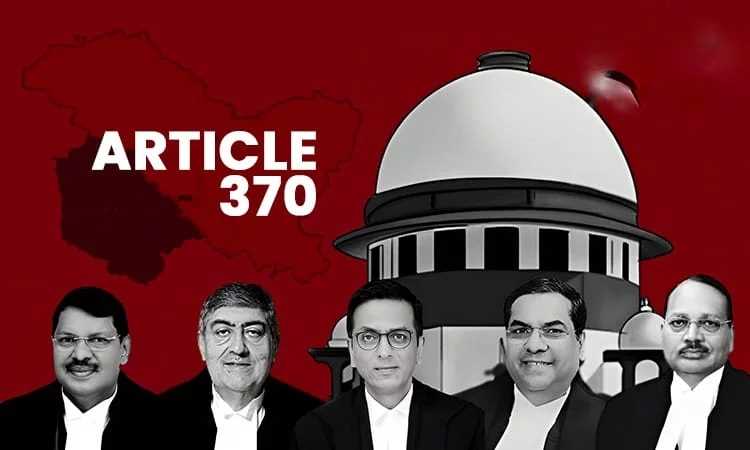
SC upholds abrogation of Art 370

• Article 370 was a temporary provision
• J&K did not retain any element of sovereignty after execution of Instrument of Accession
• J&K’s constitution was subordinate to constitution of India
• Prez empowered to revoke Art 370 in absence of Constituent Assembly of the erstwhile state
• President’s exercise to abrogate Article 370 was not mala fide

December 12, 2023 | Farooq Wani

The five-judge constitution bench of Supreme Court on Monday upheld the Centre’s August , 2019 decision to abrogate Article 370, that granted special status to the erstwhile state of Jammu and Kashmir, and declared the presidential proclamation of 2019 abrogating Article 370 as valid.
Ending a decades long debate on J&K’s special status, the five-judge Constitution bench, headed by Chief Justice D Y Chandrachud, delivered three concurring judgements upholding abrogation of the constitutional schemes that provided special status to Jammu and Kashmir when it was annexed to the Union of India in 1947.
On August 5, 2019, centre scrapped J&K’s special status and bifurcated erstwhile J&K state into two Union Territories --- Jammu and Kashmir (with legislature) and Ladakh (without legislature).
Writing the judgement for himself and Justices B R Gavai and Surya Kant, the CJI said Article 370 was a temporary provision and the president was empowered to revoke it in the absence of the Constituent Assembly of the erstwhile state.
In the verdict, the CJI stated that the Constitution of India was a complete code for constitutional governance.
“The President had the power to issue a notification declaring that Article 370(3) ceases to operate without the recommendation of the Constituent Assembly. The continuous exercise of power under Article 370(1) by the President indicates that the gradual process of constitutional integration was ongoing,” the CJI said while pronouncing the verdict.
He said the erstwhile state of J&K does not retain any “element of sovereignty” after the execution of the Instrument of Accession and the issuance of the proclamation dated November 25, 1949 by which the Constitution of India was adopted.
“Article 370 was a feature of asymmetric federalism and not sovereignty,” Justice Chandrachud said.
He said the exercise of power by the president under Article 370(1)(d) to issue CO 272 (by which Indian Constitution was put into effect in J&K) was not mala fide.
“The President in exercise of power under Article 370(3) can unilaterally issue a notification that Article 370 ceases to exist,” he said.
“The President did not have to secure the concurrence of the Government of the State or Union Government acting on behalf of the State Government under the second proviso to Article 370(1)(d) while applying all the provisions of the Constitution to Jammu and Kashmir because such an exercise of power has the same effect as an exercise of power under Article 370(3) for which the concurrence or collaboration with the State Government was not required,” Justice Chandrachud said.
He said the petitioners did not challenge the issuance of the proclamations under Section 92 of the Jammu and Kashmir Constitution and Article 356 of the Indian Constitution until the special status of Jammu and Kashmir was abrogated.
“The challenge to the Proclamations does not merit adjudication because the principal challenge is to the actions which were taken after the Proclamation was issued,” he said.
“The exercise of power by the President after the Proclamation under Article 356 is issued is subject to judicial review. The exercise of power by the President must have a reasonable nexus with the object of the Proclamation,”the CJI asserted.
He said those challenging the exercise of power must prima facie establish that it was a mala fide or extraneous exercise of power.
“Once a prima facie case is made, the onus shifts to the Union to justify the exercise of such power,” the CJI said.

SC upholds abrogation of Art 370

• Article 370 was a temporary provision
• J&K did not retain any element of sovereignty after execution of Instrument of Accession
• J&K’s constitution was subordinate to constitution of India
• Prez empowered to revoke Art 370 in absence of Constituent Assembly of the erstwhile state
• President’s exercise to abrogate Article 370 was not mala fide

December 12, 2023 | Farooq Wani

The five-judge constitution bench of Supreme Court on Monday upheld the Centre’s August , 2019 decision to abrogate Article 370, that granted special status to the erstwhile state of Jammu and Kashmir, and declared the presidential proclamation of 2019 abrogating Article 370 as valid.
Ending a decades long debate on J&K’s special status, the five-judge Constitution bench, headed by Chief Justice D Y Chandrachud, delivered three concurring judgements upholding abrogation of the constitutional schemes that provided special status to Jammu and Kashmir when it was annexed to the Union of India in 1947.
On August 5, 2019, centre scrapped J&K’s special status and bifurcated erstwhile J&K state into two Union Territories --- Jammu and Kashmir (with legislature) and Ladakh (without legislature).
Writing the judgement for himself and Justices B R Gavai and Surya Kant, the CJI said Article 370 was a temporary provision and the president was empowered to revoke it in the absence of the Constituent Assembly of the erstwhile state.
In the verdict, the CJI stated that the Constitution of India was a complete code for constitutional governance.
“The President had the power to issue a notification declaring that Article 370(3) ceases to operate without the recommendation of the Constituent Assembly. The continuous exercise of power under Article 370(1) by the President indicates that the gradual process of constitutional integration was ongoing,” the CJI said while pronouncing the verdict.
He said the erstwhile state of J&K does not retain any “element of sovereignty” after the execution of the Instrument of Accession and the issuance of the proclamation dated November 25, 1949 by which the Constitution of India was adopted.
“Article 370 was a feature of asymmetric federalism and not sovereignty,” Justice Chandrachud said.
He said the exercise of power by the president under Article 370(1)(d) to issue CO 272 (by which Indian Constitution was put into effect in J&K) was not mala fide.
“The President in exercise of power under Article 370(3) can unilaterally issue a notification that Article 370 ceases to exist,” he said.
“The President did not have to secure the concurrence of the Government of the State or Union Government acting on behalf of the State Government under the second proviso to Article 370(1)(d) while applying all the provisions of the Constitution to Jammu and Kashmir because such an exercise of power has the same effect as an exercise of power under Article 370(3) for which the concurrence or collaboration with the State Government was not required,” Justice Chandrachud said.
He said the petitioners did not challenge the issuance of the proclamations under Section 92 of the Jammu and Kashmir Constitution and Article 356 of the Indian Constitution until the special status of Jammu and Kashmir was abrogated.
“The challenge to the Proclamations does not merit adjudication because the principal challenge is to the actions which were taken after the Proclamation was issued,” he said.
“The exercise of power by the President after the Proclamation under Article 356 is issued is subject to judicial review. The exercise of power by the President must have a reasonable nexus with the object of the Proclamation,”the CJI asserted.
He said those challenging the exercise of power must prima facie establish that it was a mala fide or extraneous exercise of power.
“Once a prima facie case is made, the onus shifts to the Union to justify the exercise of such power,” the CJI said.


  • Address: R.C 2 Quarters Press Enclave Near Pratap Park, Srinagar 190001.
  • Phone: 0194-2451076 , +91-941-940-0056 , +91-962-292-4716
  • Email: brighterkmr@gmail.com
Owner, Printer, Publisher, Editor: Farooq Ahmad Wani
Legal Advisor: M.J. Hubi
Printed at: Sangermal offset Printing Press Rangreth ( Budgam)
Published from: Gulshanabad Chraresharief Budgam
RNI No.: JKENG/2010/33802
Office No’s: 0194-2451076
Mobile No’s 9419400056, 9622924716 ,7006086442
Postal Regd No: SK/135/2010-2019
POST BOX NO: 1001
Administrative Office: R.C 2 Quarters Press Enclave Near Pratap Park ( Srinagar -190001)

© Copyright 2023 brighterkashmir.com All Rights Reserved. Quantum Technologies

Owner, Printer, Publisher, Editor: Farooq Ahmad Wani
Legal Advisor: M.J. Hubi
Printed at: Abid Enterprizes, Zainkote Srinagar
Published from: Gulshanabad Chraresharief Budgam
RNI No.: JKENG/2010/33802
Office No’s: 0194-2451076, 9622924716 , 9419400056
Postal Regd No: SK/135/2010-2019
Administrative Office: Abi Guzer Srinagar

© Copyright 2018 brighterkashmir.com All Rights Reserved.