
BREAKING NEWS
Lost Spring- the stories of stolen childhood by Anees Jung- has the main theme of child labour and the way forward. At the same time the short story highlights the ignorance of children folk on part of govt. in terms of infrastructural lacking in educational sphere
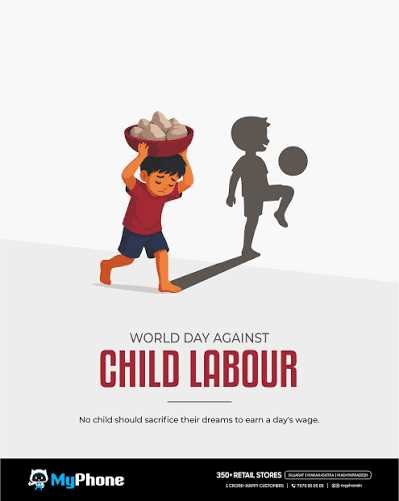
The World Day Against Child Labour is an International Labour Organization (ILO)-sanctioned holiday first launched in 2002aiming to raise awareness and activism to prevent child labour. It was spurred by ratifications of ILO Convention No. 138 on the minimum age for employment and ILO Convention No. 182 on the worst forms of child labour. The World Day Against Child Labour, which is held every year on June 12, is intended to foster the worldwide movement against child labour. The Slogan: The campaign champions the slogan "Red card to child labour: Fair play for children, decent work for adults," which advocates for adult livelihood support, universal social protection, and stronger legal enforcement.
In 2026, there are approximately 46 million out-of-school children (aged 6 to 17) in India. This represents about 17% of the school-age population. The dropout rates are highest among secondary and higher secondary levels, prompting the government to launch initiatives like NIOS to bring youth back into education. Breakdown by Age & Education Level. The burden of out-of-school children (OOSC) is distributed across different age cohorts:
Primary (6–10 years): ~19.3 million OOSC.
Upper Primary (11–13 years): ~5.2 million OOSCS
Secondary (14–15 years): ~10.7 million OOSC
Higher Secondary (16–17 years): ~10.8 million OOSC
Regional Concentration: The problem is highly localized; nearly 58% of the national elementary-level out-of-school children are concentrated in just two states: Uttar Pradesh and Bihar.
Key Causes: Gender Disparities: Adolescent girls account for nearly 3 million of recent dropouts.
Retention Rates: Structural gaps in the system mean that only about 47.2% of children entering Class I reach Class X.
Marginalized Communities: Social discrimination, geographical isolation, and poverty continue to be the main structural barriers keeping children from completing their full cycle of elementary education.
Extreme poverty & parental ignorance: extremely poor people are just in wait for when their children become able to move their hands and feet so send them for work in order to lessen their financial burden. Consequently the children are deprived of the fun and play plus early education. In some cases the parents are illiterate and ignorant and don’t realize the importance of child’s growth and development
Action Taken: Recognizing the massive gap, especially in the 14-18 age group, the Ministry of Education rolled out a high-level National Institute of Open Schooling (NIOS) distance-learning initiative to provide alternate education and skill development.
In this context I would like to refer to a short story written by Anees Jung. Anees Jung (born 15 December 1944) is an Indian author, journalist and columnist for newspapers in India and abroad, whose most known work, Unveiling India (1987) was a chronicle of the lives of women in India, noted especially for the depiction of Muslim women behind the purdah.
Lost Spring- the stories of stolen childhood by Anees Jung- has the main theme of child labour and the way forward. At the same time the short story highlights the ignorance of children folk on part of govt. in terms of infrastructural lacking in educational sphere. The political hypocrisy is one of the themes that the said story has. The story revolves round the two boys named Saheb-e-Aalam and Mukesh who represent the two different sections of the society – one that is rag picker community who have migrated from Bangladesh in 1971 and the other who belongs to bangle making community of Ferozabad-Dehli. The author, very early in the morning, meets a boy – Saheb-e-Aalam and asks him why he has been doing rag picking and not going to school. The boy replies that there is no school in their locality and if the author builds a school, he will go there to study. After some days ,the author happens to meet the same boy and feels embarrassed when asked whether she has build a school. Saheb’s parents have migrated from Bangladesh in 1971 after their fields were washed away by floods. 1971 is the year when Bangladesh got separated from Pakistan. The irony of the situation rises its peak when we read the statement; Although Seemapuri is at periphery of Dehli, yet miles away from it. The statement is itself indicative of how Seemapuri is ignored on part of govt authorities. They have no civic amenities, no sanitation, and drainage and sewage system. They have no national identity. Only ration cards have been allotted to them for the sake of enrolling their names in voter list. End of the day, Saheb-e-Aalam takes a job at a tea stall where he is paid 800 rupees per month and two times meals. Hence lost his own world in which he would roam freely and the light bag he carried with him has been replaced with a heavy canister.
In the second part of story, the author meets Mukesh –a young boy like Sahib-e-Aalam who wants to become a motor mechanic. Mukesh takes the author his locality where the poverty is reflected by every household where the families have been working in bangle manufacturing industry for centuries and which took their eyesight and health to the extreme level. An old lady in his home has bangles on her wrists, but the irony is that she can’t not see the colour of her bangles. There are dreams in the eyes of bachelor girls that they can’t realize. Every household has the same story to tell. When the author asks Mukesh’s Grandma about her husband’s health she replies very remorsefully- it is his karma, it is his destiny. The author asks them why they can’t make a cooperative society they said that they are afraid of police and besides there are Sahukars, Middlemen etc who don’t allow them to make one. So, this story manifests how societies are formed and how poverty deprives the children of their basic right to education. At the same time it reflects how the govt behaves and how she ought to behave with the poor people.
The Way forward: eliminating and eradicating child labour can’t be done within the wink of eye. It requires efforts at larger scale. Framing the laws only would not help to achieve the required target and desired results. Although, Indian constitution has made it the fundamental right of children of the age group of 6-14 years (Ref. article 21-A), its implementation is still a big puzzle for all of us. It is still a riddle to be solved for govt as well as public. Certain imperative steps are required to bridge the gap. Some of these steps would be like:
Parental awareness programs: parents are the sole responsible stake holders in this matter. So they must be made aware of the importance and criticality of children education at an early age. Early education should be made totally free. There should no fee to enroll a child in 1st grade. Providing midday meals only has no impact factor at all. It has made a scope for corruption inside school system. In today’s world food is issue at all. But the problem aggravates when it comes to fee deposition, uniform and the books. This collective burden becomes a hurdle for most of the poor parents. So fee must be waved off and uniform must be provided by the school.
Govt must improve the infrastructural facilities so that the public becomes attracted towards govt schools as 70% of the public can’t afford private education. Besides, imposition of rule on private school is the need of the hour. A certain percentage seats in private schools must be reserved for the poor section students like falling under the category of AAY, BPL and PHH. Orphan and the children whose parents are handicapped must be given complete fee relaxation in both govt and private sector. Above all,job market provision is the paramount need of the hour. For most of the people are in despair after their children can’t earn even after having certain degrees and qualifications which has a direct impact on children enrolment in schools. Hence, all the stake holders are work in collective manner so that this problem can be solved once and for all.
Email:------------------------ishaq7007@gmail.com
Lost Spring- the stories of stolen childhood by Anees Jung- has the main theme of child labour and the way forward. At the same time the short story highlights the ignorance of children folk on part of govt. in terms of infrastructural lacking in educational sphere
The World Day Against Child Labour is an International Labour Organization (ILO)-sanctioned holiday first launched in 2002aiming to raise awareness and activism to prevent child labour. It was spurred by ratifications of ILO Convention No. 138 on the minimum age for employment and ILO Convention No. 182 on the worst forms of child labour. The World Day Against Child Labour, which is held every year on June 12, is intended to foster the worldwide movement against child labour. The Slogan: The campaign champions the slogan "Red card to child labour: Fair play for children, decent work for adults," which advocates for adult livelihood support, universal social protection, and stronger legal enforcement.
In 2026, there are approximately 46 million out-of-school children (aged 6 to 17) in India. This represents about 17% of the school-age population. The dropout rates are highest among secondary and higher secondary levels, prompting the government to launch initiatives like NIOS to bring youth back into education. Breakdown by Age & Education Level. The burden of out-of-school children (OOSC) is distributed across different age cohorts:
Primary (6–10 years): ~19.3 million OOSC.
Upper Primary (11–13 years): ~5.2 million OOSCS
Secondary (14–15 years): ~10.7 million OOSC
Higher Secondary (16–17 years): ~10.8 million OOSC
Regional Concentration: The problem is highly localized; nearly 58% of the national elementary-level out-of-school children are concentrated in just two states: Uttar Pradesh and Bihar.
Key Causes: Gender Disparities: Adolescent girls account for nearly 3 million of recent dropouts.
Retention Rates: Structural gaps in the system mean that only about 47.2% of children entering Class I reach Class X.
Marginalized Communities: Social discrimination, geographical isolation, and poverty continue to be the main structural barriers keeping children from completing their full cycle of elementary education.
Extreme poverty & parental ignorance: extremely poor people are just in wait for when their children become able to move their hands and feet so send them for work in order to lessen their financial burden. Consequently the children are deprived of the fun and play plus early education. In some cases the parents are illiterate and ignorant and don’t realize the importance of child’s growth and development
Action Taken: Recognizing the massive gap, especially in the 14-18 age group, the Ministry of Education rolled out a high-level National Institute of Open Schooling (NIOS) distance-learning initiative to provide alternate education and skill development.
In this context I would like to refer to a short story written by Anees Jung. Anees Jung (born 15 December 1944) is an Indian author, journalist and columnist for newspapers in India and abroad, whose most known work, Unveiling India (1987) was a chronicle of the lives of women in India, noted especially for the depiction of Muslim women behind the purdah.
Lost Spring- the stories of stolen childhood by Anees Jung- has the main theme of child labour and the way forward. At the same time the short story highlights the ignorance of children folk on part of govt. in terms of infrastructural lacking in educational sphere. The political hypocrisy is one of the themes that the said story has. The story revolves round the two boys named Saheb-e-Aalam and Mukesh who represent the two different sections of the society – one that is rag picker community who have migrated from Bangladesh in 1971 and the other who belongs to bangle making community of Ferozabad-Dehli. The author, very early in the morning, meets a boy – Saheb-e-Aalam and asks him why he has been doing rag picking and not going to school. The boy replies that there is no school in their locality and if the author builds a school, he will go there to study. After some days ,the author happens to meet the same boy and feels embarrassed when asked whether she has build a school. Saheb’s parents have migrated from Bangladesh in 1971 after their fields were washed away by floods. 1971 is the year when Bangladesh got separated from Pakistan. The irony of the situation rises its peak when we read the statement; Although Seemapuri is at periphery of Dehli, yet miles away from it. The statement is itself indicative of how Seemapuri is ignored on part of govt authorities. They have no civic amenities, no sanitation, and drainage and sewage system. They have no national identity. Only ration cards have been allotted to them for the sake of enrolling their names in voter list. End of the day, Saheb-e-Aalam takes a job at a tea stall where he is paid 800 rupees per month and two times meals. Hence lost his own world in which he would roam freely and the light bag he carried with him has been replaced with a heavy canister.
In the second part of story, the author meets Mukesh –a young boy like Sahib-e-Aalam who wants to become a motor mechanic. Mukesh takes the author his locality where the poverty is reflected by every household where the families have been working in bangle manufacturing industry for centuries and which took their eyesight and health to the extreme level. An old lady in his home has bangles on her wrists, but the irony is that she can’t not see the colour of her bangles. There are dreams in the eyes of bachelor girls that they can’t realize. Every household has the same story to tell. When the author asks Mukesh’s Grandma about her husband’s health she replies very remorsefully- it is his karma, it is his destiny. The author asks them why they can’t make a cooperative society they said that they are afraid of police and besides there are Sahukars, Middlemen etc who don’t allow them to make one. So, this story manifests how societies are formed and how poverty deprives the children of their basic right to education. At the same time it reflects how the govt behaves and how she ought to behave with the poor people.
The Way forward: eliminating and eradicating child labour can’t be done within the wink of eye. It requires efforts at larger scale. Framing the laws only would not help to achieve the required target and desired results. Although, Indian constitution has made it the fundamental right of children of the age group of 6-14 years (Ref. article 21-A), its implementation is still a big puzzle for all of us. It is still a riddle to be solved for govt as well as public. Certain imperative steps are required to bridge the gap. Some of these steps would be like:
Parental awareness programs: parents are the sole responsible stake holders in this matter. So they must be made aware of the importance and criticality of children education at an early age. Early education should be made totally free. There should no fee to enroll a child in 1st grade. Providing midday meals only has no impact factor at all. It has made a scope for corruption inside school system. In today’s world food is issue at all. But the problem aggravates when it comes to fee deposition, uniform and the books. This collective burden becomes a hurdle for most of the poor parents. So fee must be waved off and uniform must be provided by the school.
Govt must improve the infrastructural facilities so that the public becomes attracted towards govt schools as 70% of the public can’t afford private education. Besides, imposition of rule on private school is the need of the hour. A certain percentage seats in private schools must be reserved for the poor section students like falling under the category of AAY, BPL and PHH. Orphan and the children whose parents are handicapped must be given complete fee relaxation in both govt and private sector. Above all,job market provision is the paramount need of the hour. For most of the people are in despair after their children can’t earn even after having certain degrees and qualifications which has a direct impact on children enrolment in schools. Hence, all the stake holders are work in collective manner so that this problem can be solved once and for all.
Email:------------------------ishaq7007@gmail.com

© Copyright 2023 brighterkashmir.com All Rights Reserved. Quantum Technologies