
BREAKING NEWS
Sociology is a scientific field of study as it applies systematic and empirical methods, such as structured observation, surveys, interviews, and statistical analysis to understand social life rather than relying on pure speculation
Sociology - coined by Auguste Comte in the 19th century, combining the Latin word Socius (companion) and Greek word logos (study of) - is the systematic study of human society, social relationships, and group behaviour. It examines how organizations, groups, and societies are organized and how people within them interact with one another. The study ranges from micro-level interactions (individual conversations) to macro-level structures (global institutions, class, and culture).
Sociology is a scientific field of study as it applies systematic and empirical methods, such as structured observation, surveys, interviews, and statistical analysis to understand social life rather than relying on pure speculation. Unlike natural sciences, sociology studies complex, variable human behaviour where controlled laboratory experiments are rare, but it remains scientific through its rigorous methodological approach towards collecting and analysing data required to study societies, changing societal structures and the human behaviour.
As established by the Theory of Structural Functionalism (Key Contributors: Émile Durkheim, Herbert Spencer, Talcott Parsons), society is a complex system whose parts work together to promote solidarity and stability, as each social institution (family, education, government) has a specific function and all these components together result in Manifested Functions (desired outcomes) and Latent Functions (undesired outcomes). All these parts of a society effect the society as a whole and even if one of them changes, it results in the change of the societal structure.
Now, with respect to the current world, the contemporary societies, the meaning of societies and the structure, organization, and hierarchy of societies is changing rapidly due to the exponential technological advancements day by day. The technological penetration is resulting in changed societal structures. Such as, the rise of the Internet has erased geographical borders and has made the world a global village. Moreover, the rise of algorithm-driven social spheres has erupted across social media platforms, as Tech Algorithms continue to affect the choices, conversations and information consumption of billions of individuals across the globe. With all these technological advancements in effect, Artificial Intelligence has further changed the society in previous few years, as day by day it is becoming a more essential asset for the economic and social development of an individual, a race or a country. On the basis of access to these upcoming technologies, new classes are being formed in the society (people who have access to technology and people who don’t), resulting in new marginalised communities and further marginalisation of already marginalised communities. And all technological developments, from the Industrial revolution to today’s Artificial Intelligence revolution, run on energy, and fossil fuels have been an irreplaceable part for the energy demand of development from ages, which in turn has resulted in global climate crisis and has given birth to further inequalities. All these changes summed up are continuously changing societies and, surely, the upcoming technologies will further change the structural and organizational landscape of societies all around the world.
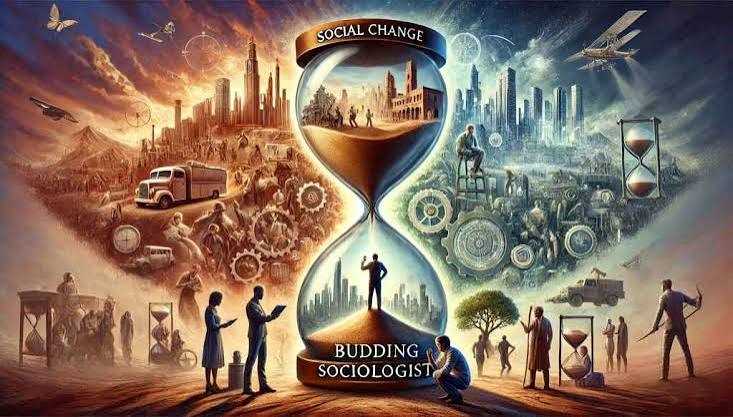
As, we have seen that societies are changing and so is the need for the study of societies to change, and Sociology has been evolving since its birth in 19th century till today and continues to evolve through every change that the world has witnessed. In 19th century, the Industrial Revolution, mass urbanization, and the decline of traditional monarchies led early sociologists (Auguste Comte, Émile Durkheim, etc) to attempt to establish sociology as a "natural science of society" (Positivism). They sought fixed, universal social laws to explain societies and human behaviour. Then, in early-to-mid 20th century, the rise of massive corporate bureaucracies, world wars, and sprawling modern cities resulted in the focus shifting from grand macro-laws to institutional mechanics. As, during that era “The Chicago School of Sociology” pioneered urban ecology, studying “how physical city environments shaped crime and immigrant integration”. Moreover, Max Weber introduced Verstehen (interpretive understanding), arguing that sociology must measure subjective human meaning and it should not confine itself to mere rigid statistics.
The late 20th century followed with the shift from manufacturing economies towards service/information economies, global trade, civil rights movements, and post-colonialism, which led to the collapse of rigid theories like Structural Functionalism because they couldn't explain the rapid social conflicts of the 1960s and 70s. Hence, Sociology evolved to encompass fragmented, intersectional perspectives (Feminist theory, Critical Race theory, post-structuralism), acknowledging that “society” is not a single unit, but an overlapping mosaic of differing power dynamics.
Now, in the 21st century, the rise of the internet, algorithm-driven social spheres, automation, and global climate crises have led to societies being no longer bound by geographic borders. Therefore, Modern sociologists are studying “network societies” and “surveillance capitalism” analysing how non-human elements—like algorithms, artificial intelligence, and global networks— are shaping the human behaviour. As, sociology has done over nearly two and a half centuries, that whenever society invents a new structure or faces an unprecedented crisis, sociology spins off a specialized scientific subfield to study it, it has done the same this time following the rise of Internet, Artificial Intelligence and Algorithms. Various new fields of study have emerged in sociology like environmental sociology, digital sociology, and medical sociology.
Moreover, in addition to new sub-fields, there is a need of new scientific methods to study data and it has been filled by new methods, as Local Sampling (Relying on paper surveys, localized census reports, and physical mail-in questionnaires) has been replaced by Computational Social Science (Utilizing Big Data, scraping millions of social media data points, and using machine learning to map out massive, global network nodes), Physical Ethnography (A researcher physically living in a village or neighborhood to observe a culture firsthand) has been replaced by Digital-Ethnography (Immersing into virtual worlds, online forums, and decentralized digital spaces where geographic boundaries do not exist, in order to observe the world as a global village) and Static Variables (Treating social categories (like gender, race, or class) as fixed and isolated variables in data modelling) has been replaced by Intersectional Modelling (Utilizing complex statistical modelling to evaluate how multiple social identities can interact simultaneously to produce systemic outcomes).
Hence, sociology has also developed with the evolution of societies and has also consistently changed, including its scientific and numerical methods, with the structural evolution of the contemporary society. In summary, sociology has acted as a mirror to humanity and as the shape of human interaction changes, this mirror keeps reshaping its lenses and scientific tools to keep the reflection in focus, while maintaining its position and status as an important science required in order to study humanity, social interactions, social hierarchy and social order.
Email:----------------------------hussainakhter078@gmail.com
Sociology is a scientific field of study as it applies systematic and empirical methods, such as structured observation, surveys, interviews, and statistical analysis to understand social life rather than relying on pure speculation
Sociology - coined by Auguste Comte in the 19th century, combining the Latin word Socius (companion) and Greek word logos (study of) - is the systematic study of human society, social relationships, and group behaviour. It examines how organizations, groups, and societies are organized and how people within them interact with one another. The study ranges from micro-level interactions (individual conversations) to macro-level structures (global institutions, class, and culture).
Sociology is a scientific field of study as it applies systematic and empirical methods, such as structured observation, surveys, interviews, and statistical analysis to understand social life rather than relying on pure speculation. Unlike natural sciences, sociology studies complex, variable human behaviour where controlled laboratory experiments are rare, but it remains scientific through its rigorous methodological approach towards collecting and analysing data required to study societies, changing societal structures and the human behaviour.
As established by the Theory of Structural Functionalism (Key Contributors: Émile Durkheim, Herbert Spencer, Talcott Parsons), society is a complex system whose parts work together to promote solidarity and stability, as each social institution (family, education, government) has a specific function and all these components together result in Manifested Functions (desired outcomes) and Latent Functions (undesired outcomes). All these parts of a society effect the society as a whole and even if one of them changes, it results in the change of the societal structure.
Now, with respect to the current world, the contemporary societies, the meaning of societies and the structure, organization, and hierarchy of societies is changing rapidly due to the exponential technological advancements day by day. The technological penetration is resulting in changed societal structures. Such as, the rise of the Internet has erased geographical borders and has made the world a global village. Moreover, the rise of algorithm-driven social spheres has erupted across social media platforms, as Tech Algorithms continue to affect the choices, conversations and information consumption of billions of individuals across the globe. With all these technological advancements in effect, Artificial Intelligence has further changed the society in previous few years, as day by day it is becoming a more essential asset for the economic and social development of an individual, a race or a country. On the basis of access to these upcoming technologies, new classes are being formed in the society (people who have access to technology and people who don’t), resulting in new marginalised communities and further marginalisation of already marginalised communities. And all technological developments, from the Industrial revolution to today’s Artificial Intelligence revolution, run on energy, and fossil fuels have been an irreplaceable part for the energy demand of development from ages, which in turn has resulted in global climate crisis and has given birth to further inequalities. All these changes summed up are continuously changing societies and, surely, the upcoming technologies will further change the structural and organizational landscape of societies all around the world.
As, we have seen that societies are changing and so is the need for the study of societies to change, and Sociology has been evolving since its birth in 19th century till today and continues to evolve through every change that the world has witnessed. In 19th century, the Industrial Revolution, mass urbanization, and the decline of traditional monarchies led early sociologists (Auguste Comte, Émile Durkheim, etc) to attempt to establish sociology as a "natural science of society" (Positivism). They sought fixed, universal social laws to explain societies and human behaviour. Then, in early-to-mid 20th century, the rise of massive corporate bureaucracies, world wars, and sprawling modern cities resulted in the focus shifting from grand macro-laws to institutional mechanics. As, during that era “The Chicago School of Sociology” pioneered urban ecology, studying “how physical city environments shaped crime and immigrant integration”. Moreover, Max Weber introduced Verstehen (interpretive understanding), arguing that sociology must measure subjective human meaning and it should not confine itself to mere rigid statistics.
The late 20th century followed with the shift from manufacturing economies towards service/information economies, global trade, civil rights movements, and post-colonialism, which led to the collapse of rigid theories like Structural Functionalism because they couldn't explain the rapid social conflicts of the 1960s and 70s. Hence, Sociology evolved to encompass fragmented, intersectional perspectives (Feminist theory, Critical Race theory, post-structuralism), acknowledging that “society” is not a single unit, but an overlapping mosaic of differing power dynamics.
Now, in the 21st century, the rise of the internet, algorithm-driven social spheres, automation, and global climate crises have led to societies being no longer bound by geographic borders. Therefore, Modern sociologists are studying “network societies” and “surveillance capitalism” analysing how non-human elements—like algorithms, artificial intelligence, and global networks— are shaping the human behaviour. As, sociology has done over nearly two and a half centuries, that whenever society invents a new structure or faces an unprecedented crisis, sociology spins off a specialized scientific subfield to study it, it has done the same this time following the rise of Internet, Artificial Intelligence and Algorithms. Various new fields of study have emerged in sociology like environmental sociology, digital sociology, and medical sociology.
Moreover, in addition to new sub-fields, there is a need of new scientific methods to study data and it has been filled by new methods, as Local Sampling (Relying on paper surveys, localized census reports, and physical mail-in questionnaires) has been replaced by Computational Social Science (Utilizing Big Data, scraping millions of social media data points, and using machine learning to map out massive, global network nodes), Physical Ethnography (A researcher physically living in a village or neighborhood to observe a culture firsthand) has been replaced by Digital-Ethnography (Immersing into virtual worlds, online forums, and decentralized digital spaces where geographic boundaries do not exist, in order to observe the world as a global village) and Static Variables (Treating social categories (like gender, race, or class) as fixed and isolated variables in data modelling) has been replaced by Intersectional Modelling (Utilizing complex statistical modelling to evaluate how multiple social identities can interact simultaneously to produce systemic outcomes).
Hence, sociology has also developed with the evolution of societies and has also consistently changed, including its scientific and numerical methods, with the structural evolution of the contemporary society. In summary, sociology has acted as a mirror to humanity and as the shape of human interaction changes, this mirror keeps reshaping its lenses and scientific tools to keep the reflection in focus, while maintaining its position and status as an important science required in order to study humanity, social interactions, social hierarchy and social order.
Email:----------------------------hussainakhter078@gmail.com

© Copyright 2023 brighterkashmir.com All Rights Reserved. Quantum Technologies